






Derek Jarman: The Right Colour for the Video Age

Derek Jarman working on his 'Queer' series at his studio in London, 1992. Photo: Howard Sooley.


The emergence of Derek Jarman‘s most visible, and arguably most successful, period as a filmmaker, painter, and gardener—among other things—occurred almost in parallel with the rise to power of British prime minister Margaret Thatcher. Jarman’s first feature film, Sebastiane, was released in 1976, a year after Thatcher was elected leader of the Conservative Party. Both, in their own ways, would spend the subsequent decade and a half reshaping British culture.
While Thatcher was busy eviscerating the rights of workers, privatising state assets, waging war in the Falklands, and clutching her pearls over campaigns to educate the public on safer sex during the AIDS epidemic, Jarman was developing a body of work that remains at once joyous, sensuous, anarchic, and seething in its rage against the profoundly homophobic, class-obsessed social context of a nation whose embarrassment at having lost its empire, and refusal to reckon with the human cost of such an endeavour, manifested—and maybe still manifests—as mournful self-destruction.
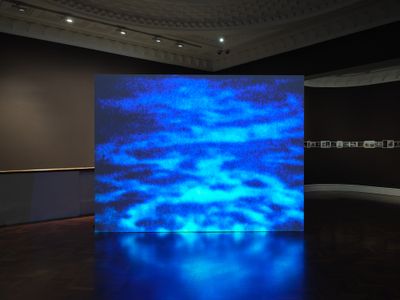
Though perhaps best remembered for his feature films, Jarman trained as a painter at the Slade School of Fine Art in London between 1963 and 1967, and continued painting throughout his career. Delphinium Days, which recently opened at Gus Fisher Gallery in Tāmaki Makaurau Auckland, presents Jarman’s paintings to audiences in Aotearoa New Zealand for the first time.
Curated by Lisa Beauchamp, Michael Lett, and Aaron Lister, the exhibition includes a selection of paintings produced by Jarman between 1986 and 1993—the year before his death from AIDS-related illness—alongside early Super 8 films from the 1970s and intimate photographs by writer Howard Sooley taken in and around Jarman’s now-legendary home of Prospect Cottage on the shingled coast of Dungeness, in the Southeast of the UK.
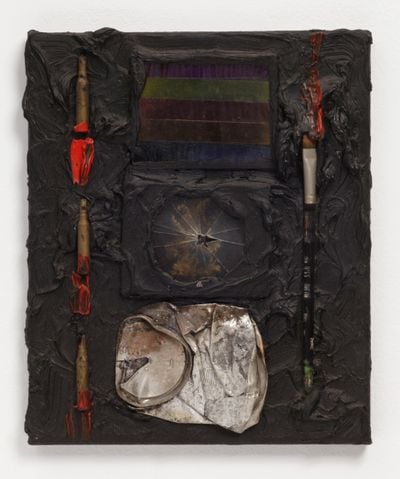
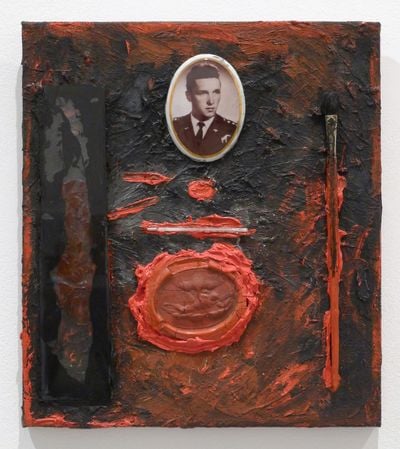
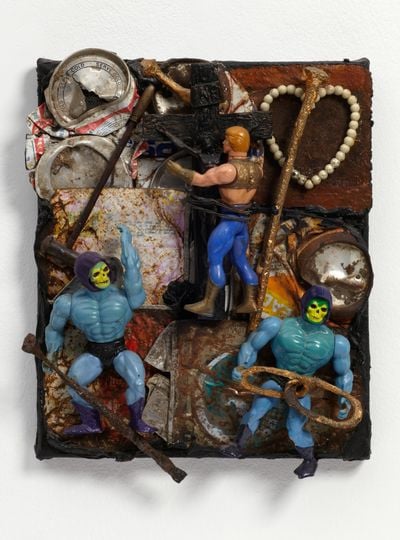
The exhibition establishes the artist’s connection to Aotearoa through his father, Lancelot Elworthy Jarman, who was born in Waitaha Canterbury in 1907, and fought in World War II as a pilot in the Royal Air Force. Among the works on show, Lancelot’s presence is made most explicit in a series of Jarman’s ‘black paintings’, which he produced from 1986 onwards, in the wake of the twin events of his diagnosis as HIV positive and his father’s death. Shattered glass fragments, crushed beer cans, religious icons, and the trappings of warfare hang suspended upon and within thick, globular surfaces of black paint and tar. In Untitled (Ganymede) (1990), an ovular portrait of the artist’s stern-faced father as a young man in military garb sits upon a canvas laden with gestural strokes of reds and blacks. To his left, a pane of glass; to his right, a paintbrush and, beneath him, a thermometer and a medallion with a relief of the Ancient Greek God Zeus, in the form of an eagle, swooping up the mortal Ganymede to become his plaything.
Within many of these paintings, what emerges is a profoundly ambivalent relationship between father and son—made more complex through grief’s reckoning—a relation of pathos for a man caught among the tides of war trauma, middle-class aspiration, and the disciplining of British social convention, entangled with an aversion for the stoic, almost paranoid, masculinity through which these things manifested. This relation is made evident in Jarman’s writing, particularly Kicking the Pricks (1987), in which he writes of the ‘terrible sadness’ 1 that invaded his father’s life following WWII, later describing him as ‘obsessed by a need to belong ... He fought their war mercilessly and felt cheated.’2
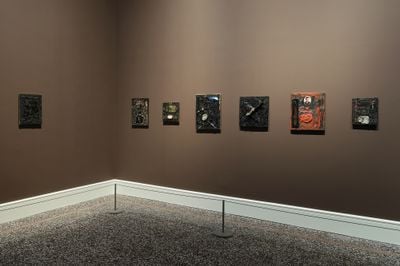
On the one hand, Jarman’s use of black seems a matter of preservation, recalling the tar applied to fishermen’s cottages, such as the artist’s own, as protection against the harsh coastal environment. On the other, tar evokes the mediaeval method of punishment and collective shame-making of laying tar and feathers upon the skin. In Battle of Britain (1989), a model warplane hangs in paint and tar among raining bullets, with scruffy feathers clinging to its front half. It’s a painterly treatment of social ritual, which also finds itself performed by hysterical cops in an excruciating scene in Jarman’s film The Garden (1990).
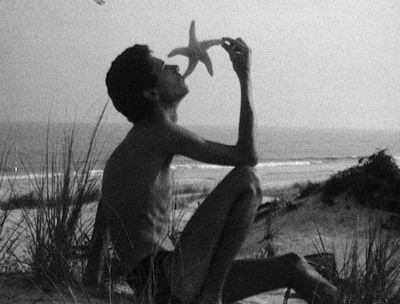
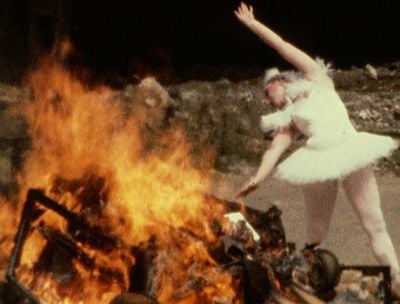
Elsewhere, two of Jarman’s Super 8 films from the 1970s, My Very Beautiful Movie (1974) and Jordan’s Dance (1977), offer a grainy, dream-like impression of a visual language in development. The former presents a steamy, coquette-ish romp Fire Island, the queer beach paradise close to New York City. The latter features punk legend Jordan, who would later play Amyl Nitrate in Jarman’s Jubilee (1978), spinning and pirouetting around a pile of burning furniture, as another figure stokes the flames with books.
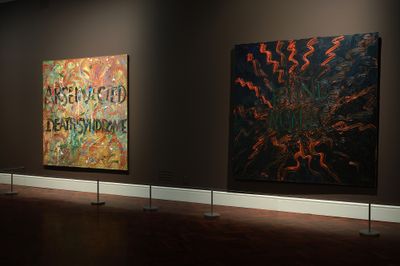
These glimpses of Jarman’s nascent experimentalism are bookended by a selection of monumental paintings made in the final year of his life. Produced with studio assistance from Piers Clemmet and Karl Lydon, these works, from the series ‘Evil Queen’ (1993), again feature paint applied thickly, frantically, into which phrasing such as ‘Arse Injected Death Syndrome’ or ‘Blind Maniac’ has been etched. These acid-tongued epithets are, at times, playfully self-deprecating, at others evocative of a vibrant rage not only towards his illness—his loss of sight, energy, coordination—but also towards a criminally negligent government more interested in discouraging schools and local councils from promoting homosexuality as a ‘pretended family relationship’ than saving lives, and a vicious tabloid press gleefully fanning the flames of moral panic around HIV/AIDS.
Jarman writes of having set himself a challenge upon receiving his diagnosis as HIV positive: to ‘disclose [his] secret and survive Margaret Thatcher.’ An ambition he achieved politically if not mortally. He goes on, ‘Now I have set my sights on the millennium and a world where we are all equal.’3 Jarman was open about his status at a time when being so carried significant personal cost. In doing so, he made a significant contribution to reshaping public discourse around HIV/AIDS, particularly by insisting that the voices of positive people be heard within the public realm.
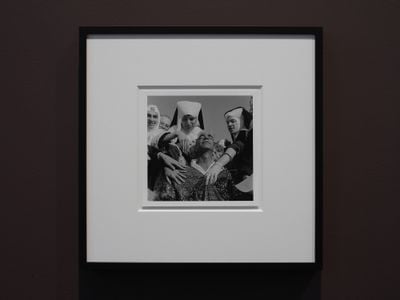
In the 30 years since his death, the artist has attained legendary status. It can be hard to cut through that—to witness or speak of Jarman’s work without falling into saint- or martyr-making, to avoid over-narrating illness into his practice. Cumulatively, Delphinium Days offers an encounter with a body of work that is at once an extended consideration of mortality, but—much like his films—remains fugitive, refusing to be bound to narrative logic, redemption, or sloganeering, nor to be instrumentalised into a language of victimhood. Instead, the work casts open the texture, complexity, erotics, perverted religiosity, joyfulness, and rage of Jarman’s vision, and its continuing resonance for us here and now. —[O]
Delphinium Days closes at Gus Fisher Gallery on 14 September 2024. Due to the temporary closure of the exhibition’s co-developer, City Gallery Te Whare Toi Wellington, The Dowse Art Museum will be exhibiting Delphinium Days from 28 September 2024 to 26 January 2025.
1 Derek Jarman, Kicking the Pricks (1987) (University of Minnesota Press: Minneapolis, 2010), p.107.
2 Ibid, p.118.
3 Quoted in Oliver Penny, ‘Pray to be released from image’: Mourning, Desire, and Self-Erasure in Derek Jarman’s Blue’, Drain Magazine, https://drainmag.com/pray-to-be-released-from-image1-mourning-desire-and-self-erasure-in-derek-jarmans-blue/#ftn28.
Main image: Derek Jarman working on his 'Queer' series at his studio in London, 1992. Photo: Howard Sooley.


A respected voice in contemporary art discourse.
Focusing on ambitious storytelling and insightful art-world commentary. Ocula Magazine publishes in-depth interviews, critical essays and timely analysis on the artists, exhibitions and ideas driving the global art world.
Learn more about Ocula Magazine
Showcasing the best of the art world.
Ocula partners with galleries from around the world to highlight their artists, artworks and exhibitions. Gallery membership is by application and invitation, with each member vetted by an independent panel.
Learn more about Ocula Membership
Specialises in the sale of major artworks.
Led by a team with deep ties to the world’s leading auction houses, galleries and collectors. Ocula’s advisory team offers bespoke services to high-net-worth clients from around the world who are looking to acquire the best of contemporary and modern art.
Learn more about our team and services