The art world in focus
Subscribe to our newsletter for news and insights on artists, galleries and exhibitions.
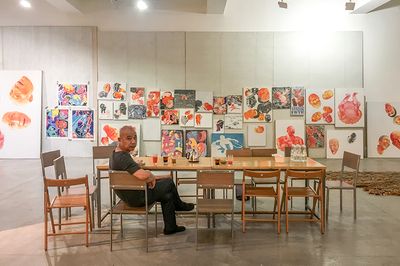
Fang Lijun. Courtesy the artist.
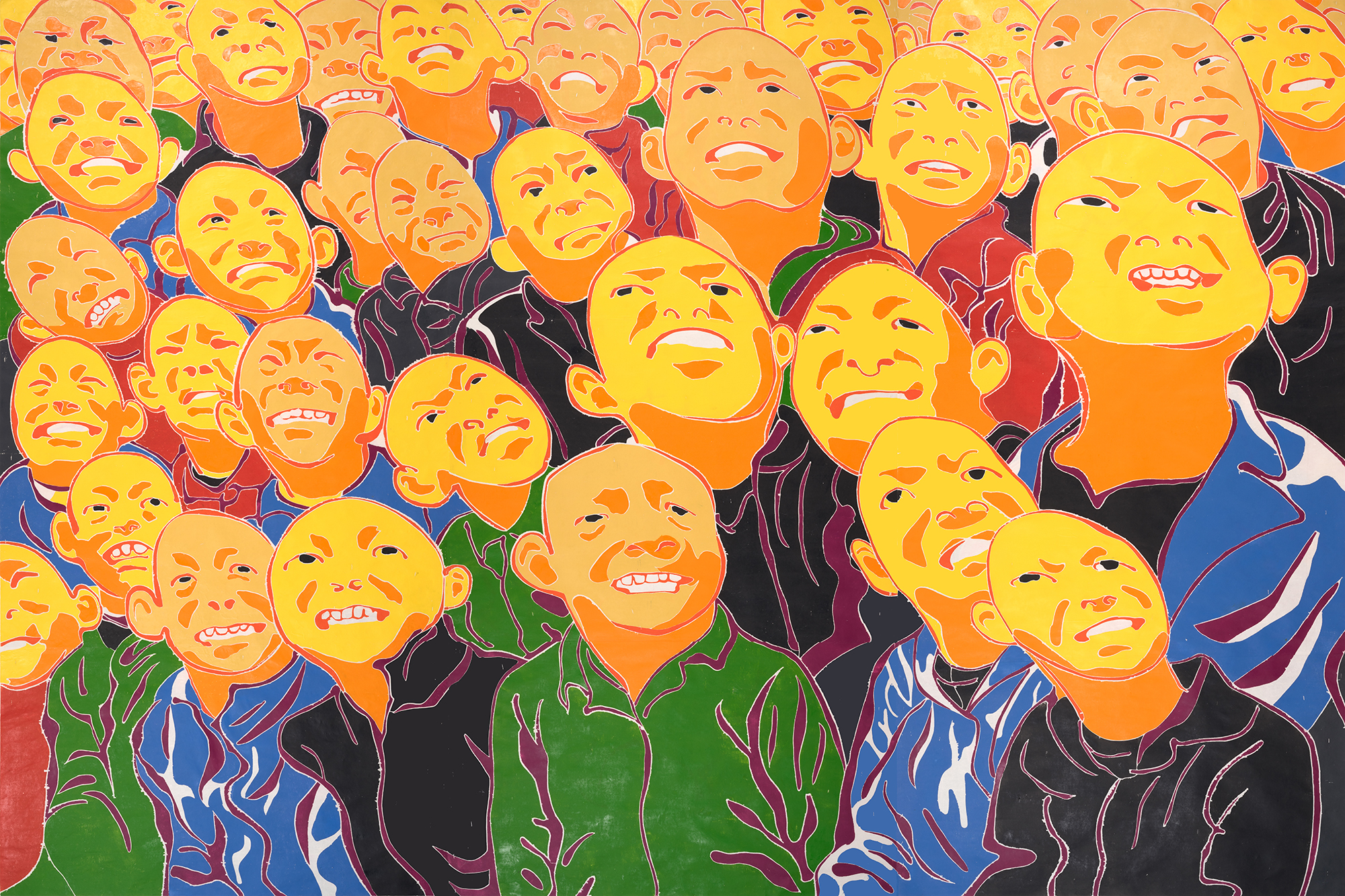
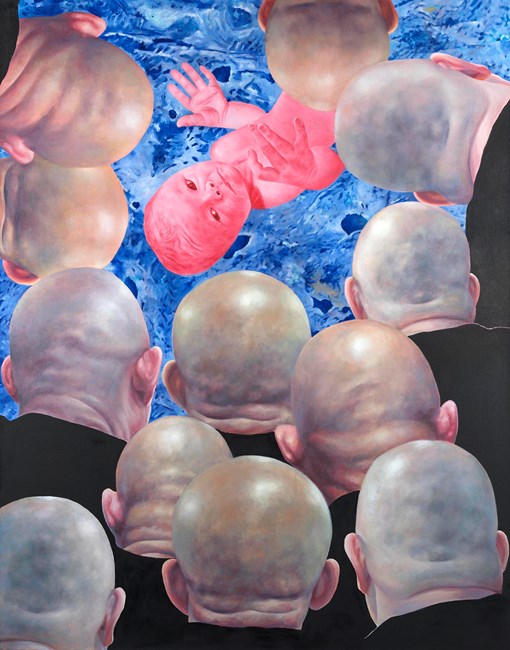
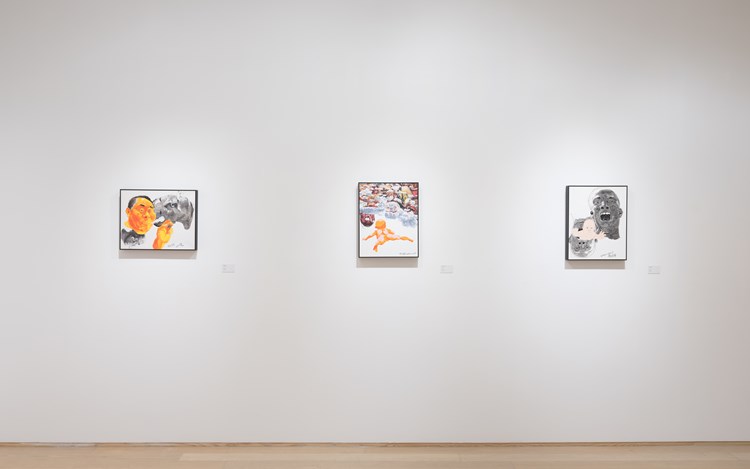
Fang Lijun‘s immense woodblock print 2016 (2016) encompasses one wall of the artist’s solo exhibition at Hanart TZ Gallery in Hong Kong, This All Too HumanWorld (3 November–2 December 2017). The work features, in Fang’s bright and graphic signature style, a throng of anonymous, bald-headed figures cluttered across the picture plane. They look towards the sky, their grins evoking a sense of collective anxiety. In his trade mark use of garish colours, the artist successfully creates a tension between idealism and helplessness, a sentiment that held particular relevance when his work was first gaining international recognition in the 1990s, and finds renewed potency today. The anonymity of Fang’s bald figures is, as the artist explains, a means of enabling viewers to project themselves onto the work and enter a process of self-reflection. In his most recent work, Fang has also started to frequently incorporate an infant figure, which he explains as being for the purpose of enhancing the anonymity of his subjects, further pushing viewers to project themselves onto his works.
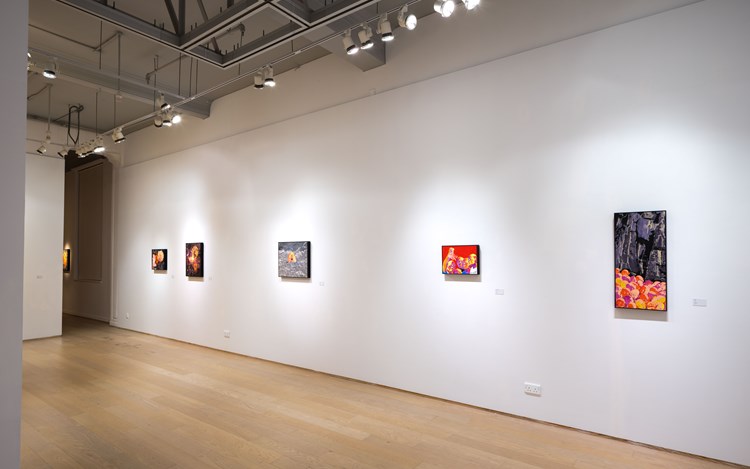
This All Too Human World includes a selection of 19 paintings and woodblock prints that often contrast his usual bright popping colours of yellows, greens, blues and pinks with dark browns, blacks and blues. In 2016 Autumn (2016), for example, the bruised tones of bald heads belonging to figures which crowd around a whaling infant are contrasted with the bright pink of the baby and the glaring blue of the background. In the woodblock print series ‘2017’, colourful, grimacing faces are assembled against tones of black, blue and purple.
In this interview, Fang discusses his latest work and his desire to push his creative processes to the absolute limit.
The term Cynical Realism was first mentioned by the art critic Li Xianting back in 1991. After he mentioned this term, people started looking at my work in this way. I’ve always liked mischievousness, mockery, making fun of people ... It’s part of my personality, and I think that it’s something that’s universal and something that people can relate to when looking at my work. But I’ve never really attached myself to the term Cynical Realism.
Whether it’s inside, or outside, it has to start from somewhere. It’s very personal, to create, and the subject matter that I use might bring suffering, or create certain feelings. These feelings are connected among people. No matter where you’re from, whether you’re from England, the States, Africa, China, we’re all connected by empathy.
When I first started doing these works, I was depicting a symbolic human being. I was trying to mock people—mediocre people, with no faces, no particular features. After all these years, I found that infants are more suited to what I’m trying to convey. We were all babies, and babies all look quite alike. So instead of trying to depict a generic human as an adult, the infant is a purer symbol. It’s easier to project yourself onto an image of an infant rather than adult.

The fact that you found that painting intriguing means that you already had that intuitive reaction. As an artist it’s my job to visualise my instinctive reactions to the world. These things might come from my surroundings, or the news, but I’m trying to translate these feelings as subject matter in my paintings. The work that you mentioned expresses what I feel towards the world; not necessarily in China but the whole world.

For the ceramics, it’s a process of entering extremism and pushing limits. The ceramics are extremely fragile, and often break. Creating artworks is never difficult for me, it’s just a process. Rather it’s the dedication that I find difficult. Creating ceramics is just a more extreme exploration of process. Jingdezhen is the centre of ceramics in China, and I think perhaps the only place in China where people are proud of being craftsmen.
A lot of people are very angry. Ceramics have a very long history in China. The art of porcelain is an art of perfectionism—only one ceramic work out of 999 might be considered a successful piece; the rest is thrown away. In the modern eye that looks like a waste. But I think, what if you look at it differently—why not throw away that one perfect piece and keep the 999 imperfect ones?
I have a lot of other friends working in Jingdezhen. Creating ceramics requires a lot of attention to detail; issues come about easily, there might be cracks, or the colour isn’t right ... My friends—because of the market, or simply out of habit—like to polish and hide these defects. But that’s boring to me—I don’t understand the point of hiding faults in ceramics. I’ve tried to convince my friends but none of them listen to me, they want to make them perfect. I don’t think it should be about perfectionism, but rather the meaning behind the work.

For me artwork is always valuable when it’s honest. I don’t pay too much attention to how the local audience might react to the work, it’s my honest reaction to human nature in general. The feelings that I’m trying to express in my works are universal.
My general direction is to push all of my work to the extreme. I’m working on 100 or more works at the same time currently, and in all kinds of media. I work on many works at the same time, whether that be in Chengdu, Beijing or Jingdezhen ... I spend a lot of time on the road so I don’t really have enough time to think about a different way of working, just about how I can push what I am currently doing to the absolute limit.—[O]
A respected voice in contemporary art discourse.
Focusing on ambitious storytelling and insightful art-world commentary. Ocula Magazine publishes in-depth interviews, critical essays and timely analysis on the artists, exhibitions and ideas driving the global art world.
Learn more about Ocula Magazine
Showcasing the best of the art world.
Ocula partners with galleries from around the world to highlight their artists, artworks and exhibitions. Gallery membership is by application and invitation, with each member vetted by an independent panel.
Learn more about Ocula Membership
Specialises in the sale of major artworks.
Led by a team with deep ties to the world’s leading auction houses, galleries and collectors. Ocula’s advisory team offers bespoke services to high-net-worth clients from around the world who are looking to acquire the best of contemporary and modern art.
Learn more about our team and services