






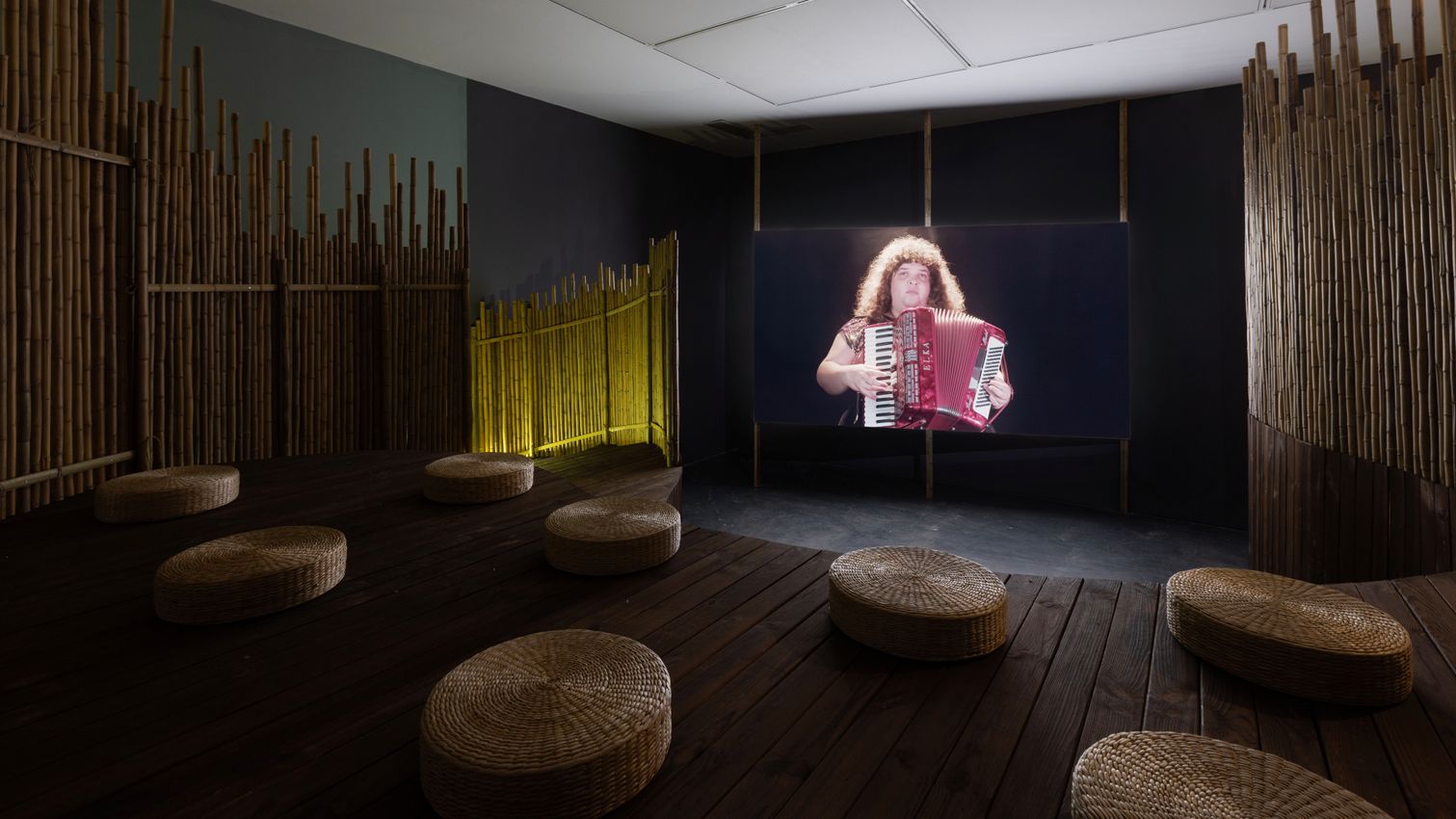
Fang Lu and Arie Kishon Blur Cultural Cosmologies
At Beijing’s SPURS Gallery, a new film by Fang Lu and Arie Kishon explores the crossovers between Chinese and Jewish cultures. Save to My Ocula
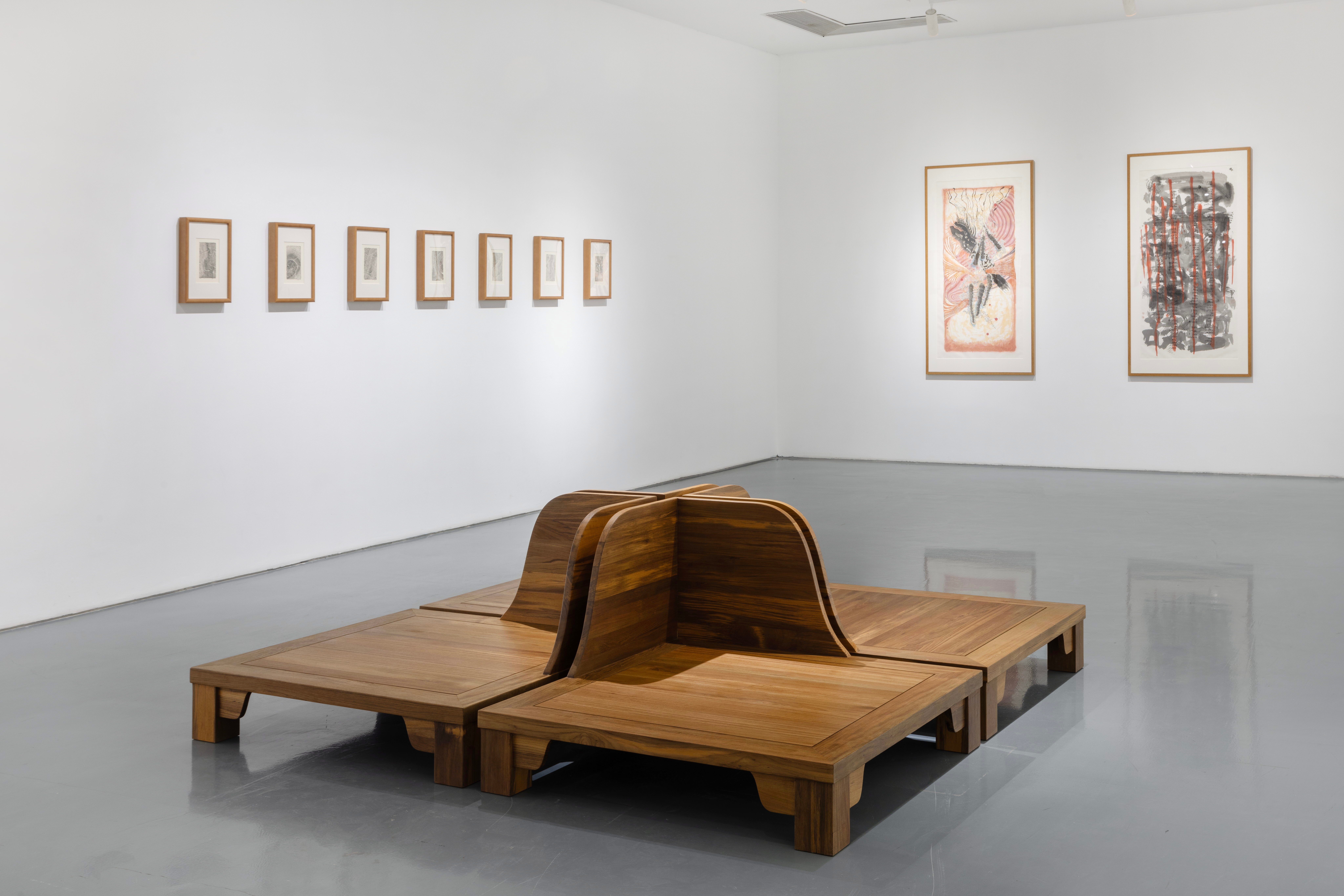
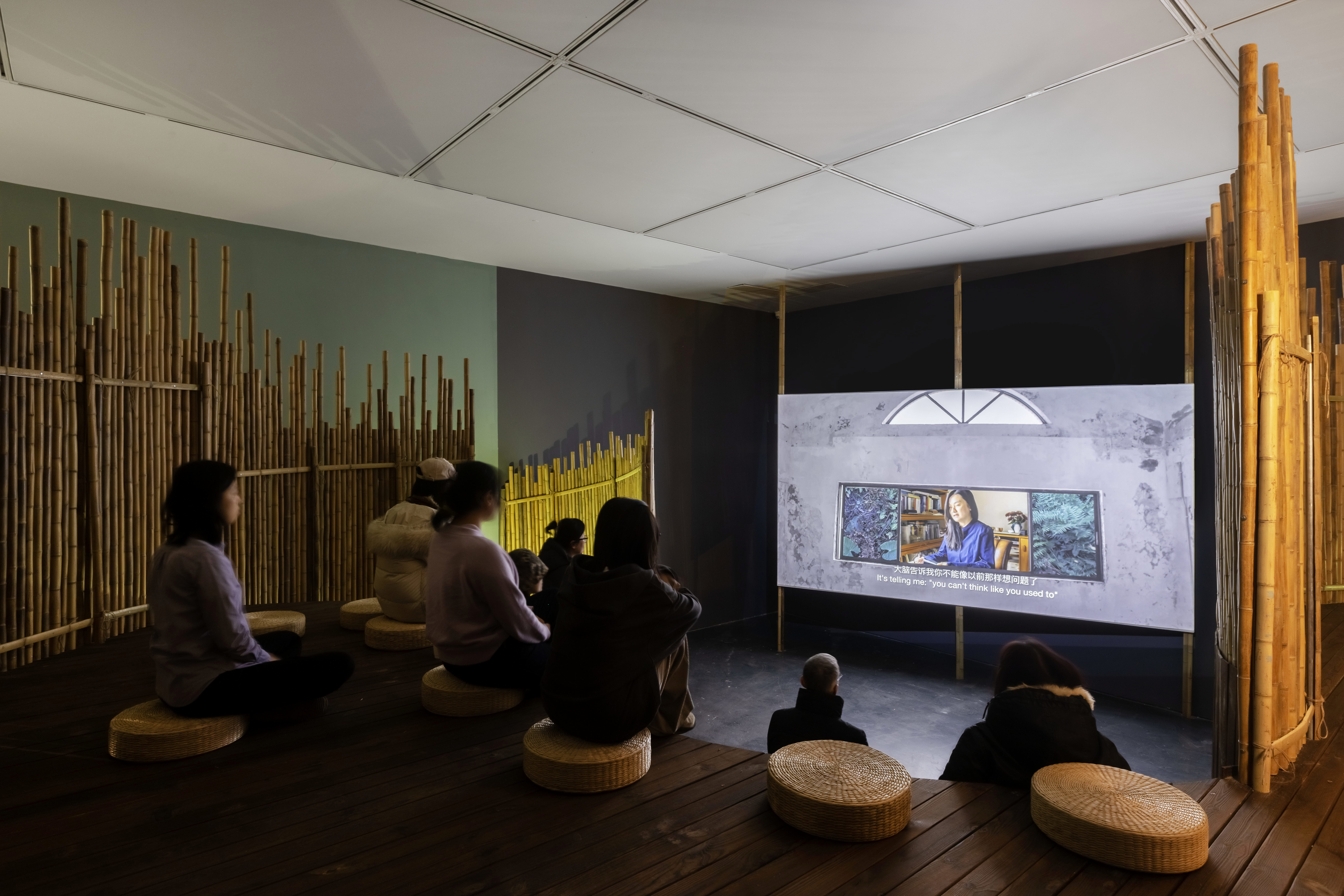
Upon entering Fang Lu and Arie Kishon’s exhibition, the viewer finds themselves in a cinema room, styled like a Chinese garden, in which the artists’ new film Shechina (2025) screens. Encircling the tiered wooden seating is a curved bamboo fence, contrasting against the traditional, uniform setting for modern cinema. The rest of the show builds on this meditative atmosphere in works that span a range of media, including abstract ink paintings reminiscent of the patterned drawing method Zentangle paired with Diamond Wave Chair (2025), a wooden sculpture that can be arranged in various configurations.
Within the sanctuary-like viewing space, Shechina opens with a sequence of black-and-white stills that follow the artist Xu Tan—a pioneering figure in research-based art in China since the 1990s—as he arrives at an empty dwelling. Xu appears to be watching himself being interviewed in a film shot in colour, which is overlaid onto various parts of the building as he walks through it. This inserted footage explores Xu’s artistic research on depression and, as we watch, we come to the realisation that the empty dwelling symbolises the artist’s inner emotional landscape: a space of isolation.
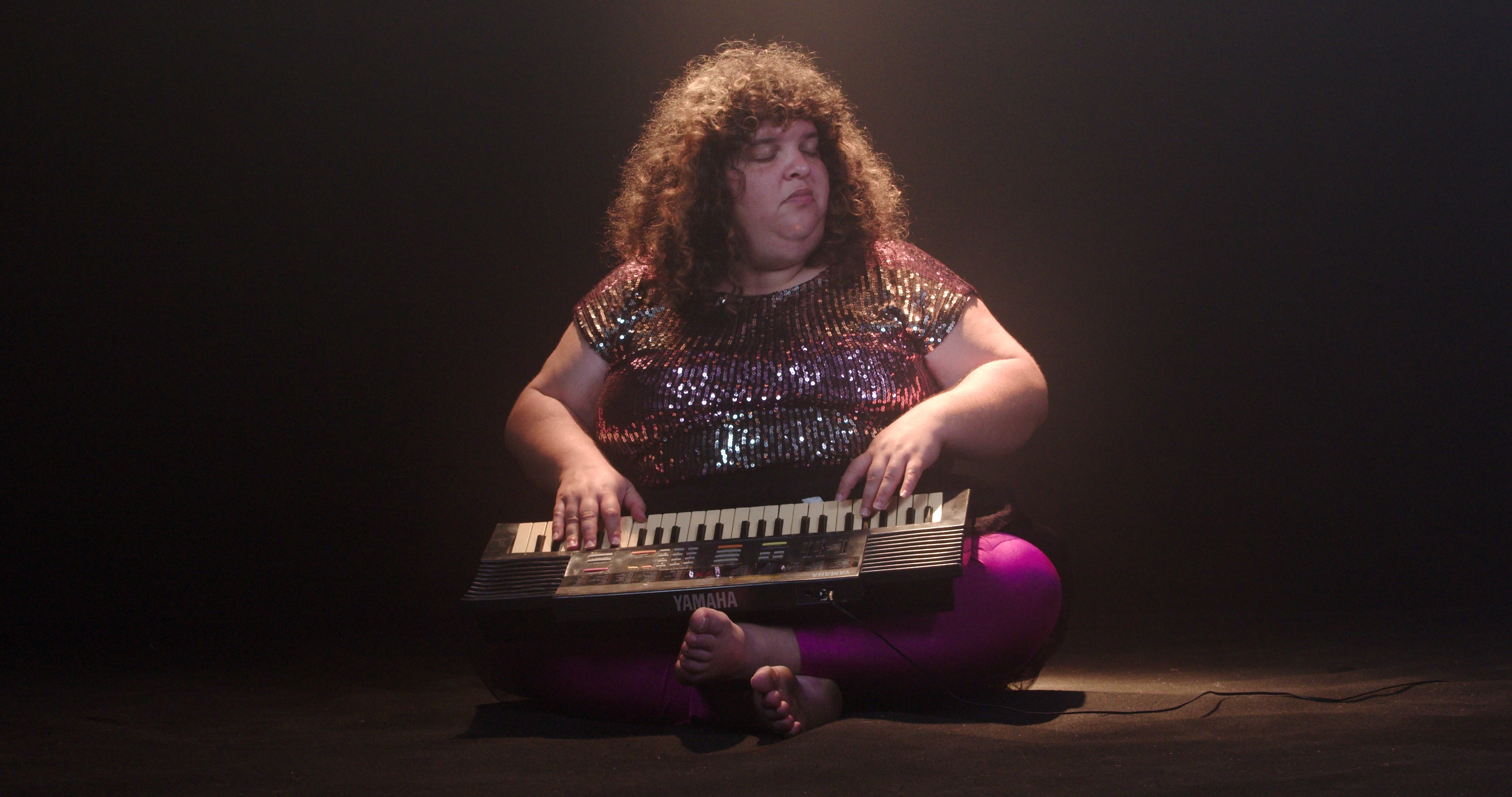
Xu’s interview goes on to introduce some of Fang’s and Kishon’s fellow art workers and healers—a Puerto Rican-born acupuncturist, a Chinese curator, and an American painter—all of whom share their embodied experiences of suffering. Occasionally, close-up shots show Tel Aviv folk musician Mihal Goldshtein performing with body percussion and accordion while singing the resonant refrain, ‘I wanna change, I wanna grow, forget all the things I thought I knew. So, I look deep inside.’ Incarnating the Hebrew term Shechina—which denotes the feminine aspect of God and the concept of a divine yet tangible dwelling—Goldstein contrasts with Xu, who, in the parallel black-and-white footage, embodies the male deity Hechina, a neologism that amalgamates Fang’s and Kishon’s respective Chinese and Israeli heritages.
The duo’s signature approach of inviting fellow artists to perform intimate personal scenarios within their work encourages us to see Xu and Goldstein as their artistic selves rather than as fictional characters. The film treads a fine line between fact and fiction and, although some of the documentary footage can feel lengthy, the artists’ foregrounding of personal and cultural identity keeps the work intellectually invigorating, while providing a welcome addition to explorations of the crossovers between Chinese and Jewish cultures and identities. —[O]
Fang Lu and Arie Kishon: Somewhere in the center, I created you was on view at SPURS Gallery, Beijing, from 4 January through 19 February 2025.
Main image: Exhibition view: Fang Lu and Arie Kishon, Somewhere in the center, I created you, SPURS Gallery, Beijing (4 January–19 February 2025). Photo: © Yang Hao.

A respected voice in contemporary art discourse.
Focusing on ambitious storytelling and insightful art-world commentary. Ocula Magazine publishes in-depth interviews, critical essays and timely analysis on the artists, exhibitions and ideas driving the global art world.
Learn more about Ocula Magazine
Showcasing the best of the art world.
Ocula partners with galleries from around the world to highlight their artists, artworks and exhibitions. Gallery membership is by application and invitation, with each member vetted by an independent panel.
Learn more about Ocula Membership
Specialises in the sale of major artworks.
Led by a team with deep ties to the world’s leading auction houses, galleries and collectors. Ocula’s advisory team offers bespoke services to high-net-worth clients from around the world who are looking to acquire the best of contemporary and modern art.
Learn more about our team and services