





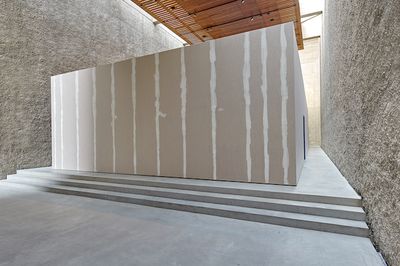
Berlin Art Week 2015 runs until the 20th of September. This offers a great reason for international art lovers to travel to Berlin and see some of the best commercial gallery exhibitions of the year. The art fairs, abc art berlin contemporary and POSITIONS BERLIN (both open to the public from the 17th of September to the 20th of September) are also worth visiting. Ocula’s Berlin correspondent, Rachael Vance offers her selection of must see gallery exhibitions to visit around town.
König Galerie
Camille Henrot, The Pale Fox
Until 1 November 2015
The last iteration of New York based French art-star Camille Henrot’s solo exhibition The Pale Fox is presented at König Galerie during Berlin Art Week 2015. Exhibited for the first time in a commercial gallery setting, Henrot’s exhibition has previously been shown in varying constellations at the Chisenhale Gallery in London, the Kunsthall Charlottenborg in Copenhagen, the Bétonsalon-Center for Art and Research in Paris and the Westfälischer Kunstverein in Münster. At König Galerie the show is installed in the gallery’s upstairs exhibition space within a reconstructed concrete Brutalist church. Despite the custom-built temporary exhibition space complete with four erected walls, the imposing surroundings dominate what is intended to be an intimate viewing room.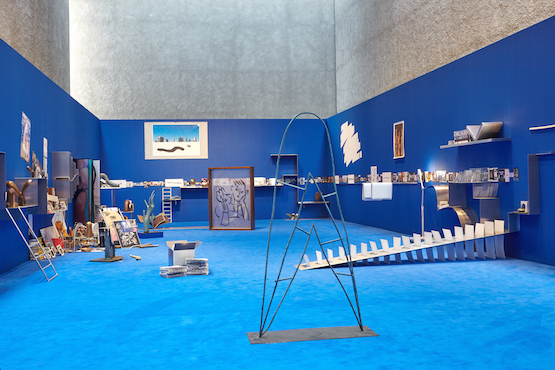
Perhaps best known for her film Grosse Fatigue which was awarded the Silver Lion at the 55th Venice Biennale, Henrot has continued to captivate international audiences with her analysis of the human condition. Primarily concerned with the meaning of culture, Henrot’s work aims to continuously critique, transform and overturn its own findings. The Pale Fox is no exception. A deep ultramarine carpeted room draws audiences into Henrot’s universe intended to act as a representative visual timeline of the universe. Suggestive of a stage set for a film, the pastiched micro environ draws viewers into a puzzling morass intended for individual analysis spawned by the artist’s creative process based upon free association.
In an anti-clockwise direction viewers take in themes of birth and childhood, growth and teenagerhood, adulthood and old age. A remote controlled plastic snake—a recurring motif in Henrot’s practice—mechanically slinks across the floor. A linear central aluminium structure wraps around the room, acting as both timeline and shelf. The metal curves direct the visitor through the space in a chronological fashion—acting somewhat as an unofficial navigation tool. Further adding to the exhibition structure, the four walls of the room are conceived around the classical four elements: Earth, water, air and fire; underpinned by the four cardinal points of the compass; and four philosophical principles of Leibniz: “The principle of being”, “the law of continuity”, “the principle of sufficient reason” and “the principle of the identity of indiscernibles.”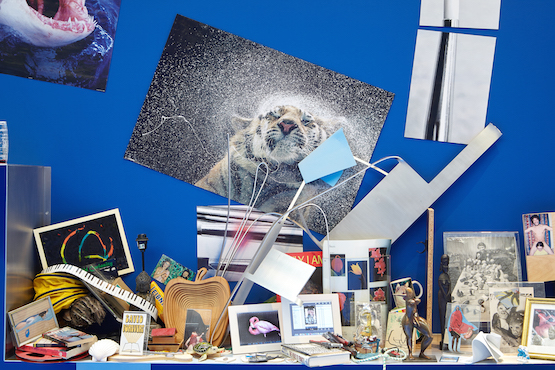
This wunderkammer of fragments diversely includes bronze Brancusi-esque sculptures, Matisse-like pieces, calligraphic ink drawings, images of sharks and primates, National Geographic magazines, newspapers, Aboriginal artworks, apocalyptic imagery and digital tablets displaying moving images from the Internet. The natural world collides with human creations from the modern age. Conflating scientific, mythological, spiritual and historical themes through a concoction of hybridised imagery The Pale Fox encourages ambiguity and intrigue.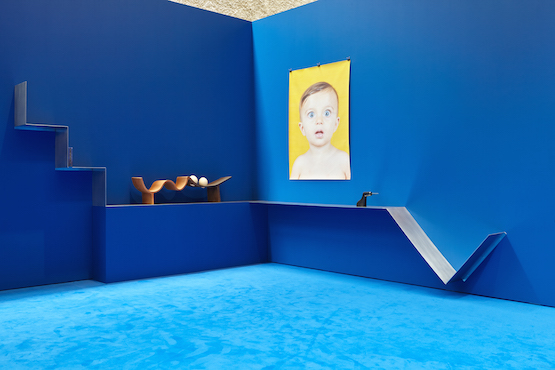
carlier | gebauer
Laure Prouvost, Dear dirty dark drink drift down deep droll (in der dole)
Until 28 October 2015
Another acclaimed French female artist with work on display during Berlin Art Week is 2013 Turner Prize winner Laure Prouvost. Prouvost’s solo exhibition at carlier | gebauer presents new works which focus on ideas surrounding the escape into unexpected environments. The captivating exhibition confronts visitors from the beginning, forcing them to physically push through a seemingly impenetrable bookcase wall that acts as the gateway to the show. The intrigue continues. Immersed in darkness, fumbling down a corridor, audiences encounter Prouvost’s film Into all that is here (2015). The nine-minute film mimics the exhibition space’s darkness enticing the viewer to follow a journey deeper into the subconscious of the film’s unseen subject prompted by voices and subtitles. Using footage of foraging through trees and the sound the rustling of leaves underfoot, the video’s narrative is laden with an atmosphere of disorientation. Ultimately the journey leads to a place of pleasure, where relief, heightened sensation and fantasy are indulged, and represented by vibrant flowers, slimy nectar and butterflies that proceed to follow a process of disintegration.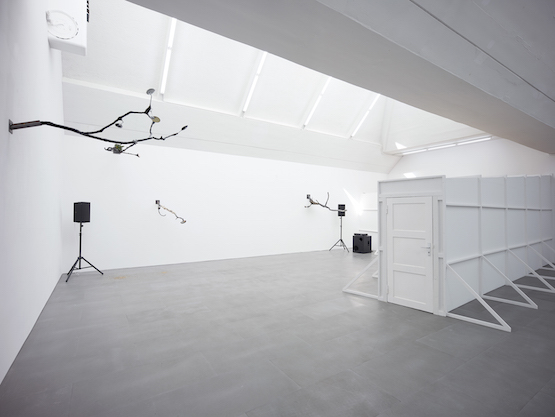
Moving further throughout the space, visitors are met with eccentric, unfamiliar terrain in the best possible way. The excavation of ideas finds form in a selection of ‘shovel’ and ‘branch’ sculptures adorned with mirrors, staircases, a frying pan, bird’s nest, cell phone, trumpet and exhaust pipe. These bewitching details are offset by a commanding three-panel tapestry entitled Diner Party (2015) that demonstrates Provoust’s artistic diversity and idiosyncratic language.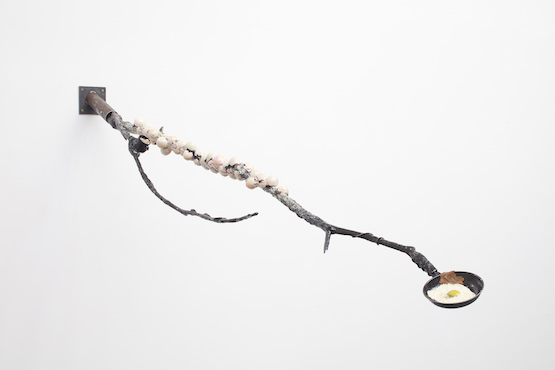
Kraupa-Tuskany Zeidler
Slavs and Tatars, Dschinn and Dschuice
Until 14 November 2015
Housed within an office building in close proximity to Alexanderplatz, Kraupa-Tuskany Zeidler have mounted a solo presentation entitled Dschinn and Dschuice by hyped art collective Slavs and Tatars. Unsuspectingly, beyond an institutional corridor, visitors step into another world.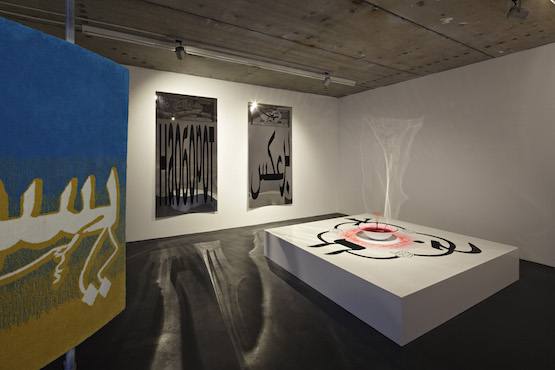
Aiming to investigate the tensions between Eastern and Western identities through associative objects that engage with linguistics, politics, faith and tradition, the collective’s output finds a variety of forms. Dschinn and Dschuice consists of an assorted offering of works spanning various media that include a fetishistic sculpture comprising a wig of human hair sitting atop a wooden rahlé (a stand for holy books) and combs of dichroic glass in the shape of mosque silhouettes embedded vertically into a tree branch installed in a corner of the gallery. Language is literally employed in the woollen yarn tapestry Alphabet Abdal (2015) drawing upon a conglomeration of Arabic-script, while the works Reverse Dshihad (Russian) (2015) and Reverse Dshihad (Urdu) (2015) present esoteric text on polished steel panels via a silkscreen process. The hybridised practice of Slavs and Tatars enlivens ideas concerning the transcultural and consequences of globalisation.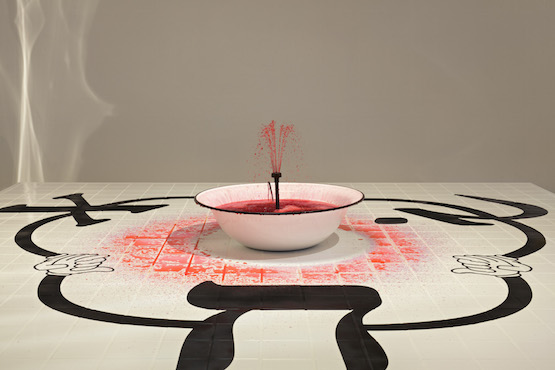
Chert
Carla Scott Fullerton, If these walls had ears
Tyra Tingleff, I gave the postman your name
Until 31 October 2015
The intimate exhibition space of Chert off Skalitzer Straße is holding a solo presentation of works by Scottish sculptor Carla Scott Fullerton. Interested in materiality and process, Fullerton’s installation of old screen-print frames that act as part of her Screen Sculpture series poetically reveal their construction and overlapping layers of transparent coloured abstract compositions. Fullerton cites architectural references through the use of construction bricks that act as supports to her pieces. A suite of irregular, contorted metal rods hung across the gallery walls are juxtaposed with etched copper plates and etched plastic sheets. Moving through the gallery and descending into the second space Fullerton’s Framed Seeds, made up of potted plants in cement pots, are arranged on the floor adding a natural counterpoint to the overriding industrial aesthetic.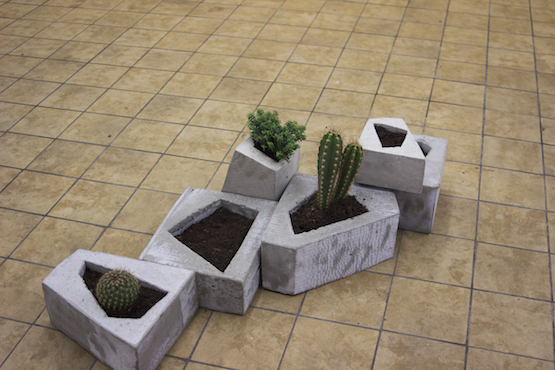
Outside the gallery displayed within vitrines dispersed throughout the courtyard are Norwegian artist Tyra Tingleff’s equally process-driven oil paintings on linen. Chert continues to present impressive talent.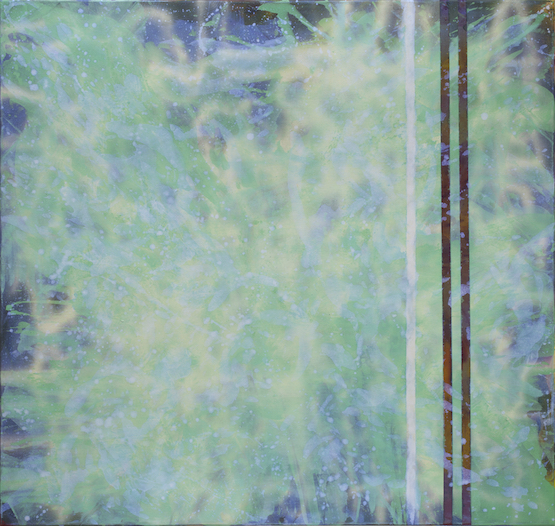
KOW
Hito Steyerl, Left To Our Own Devices
Until 5 December 2015
Known for its socio-politically driven exhibition program, KOW presents a solo presentation of works by acclaimed German artist Hito Steyerl. Best known for co-representing Germany at this year’s Venice Biennale, Steyerl’s practice was chosen as part of the gallery’s ONE YEAR OF FILMMAKERS program and is the artist’s first gallery show in her home country. Preoccupied with media, political violence, technology, and contemporary culture, the filmmaker and author of essayist documentary videos presents five video works.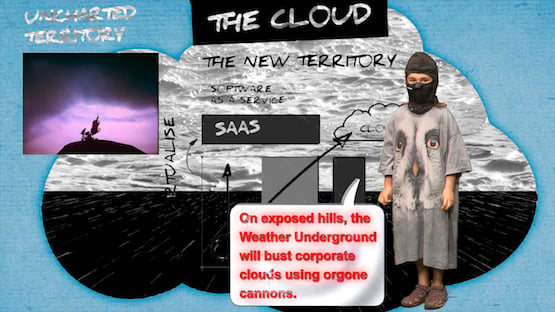
The exhibition is found across three exhibition spaces in the sleek multi-level gallery designed by leading architect Arno Brandlhuber. The first film audiences encounter (and crowning achievement of the exhibition) is Liquidity Inc PR (2014), which is given pride of place within the main viewing area. With a running time of thirty-minutes the film takes on an unpredictable narrative positioned somewhere between reality and speculation. The piece narrates the journey of protagonist Jacob Wood, a financial advisor who turns his hand to a career in mixed martial arts. With recurring themes revolving around water, fluidity, survival and the notion of limits, images of human cage fights, text and digital animation figures seemingly drowning in the ocean are blurred and interrupted by obscure financial weather reports. Arthur Russell’s song Let’s Go Swimming is aptly included as part of the soundtrack.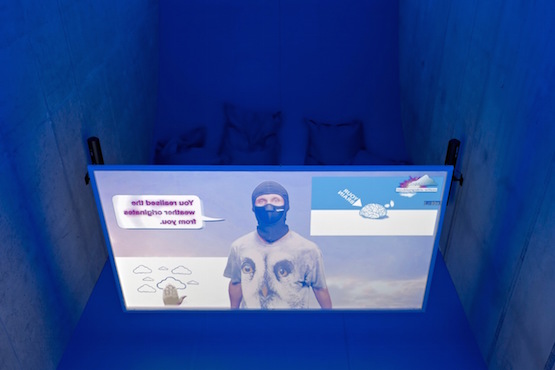
Three pieces installed together in the downstairs area (I Dreamed a Dream: Politics in the Age of Mass Art Production (2013); Duty Free Art (2015); and Is the Museum a Battlefield? (2013)) exemplify the lecture performance aspect of Steyerl’s practice and interest in the ethics of production and reception of images. Duty Free Art (2015) includes an accompanying overhead projection that falls over a horizontal sand box with transfixing corresponding imagery in synch with Steyerl’s commentary. These dense, philosophical monologues find humour in I Dreamed a Dream: Politics in the Age of Mass Art Production (2013) with footage from Susan Boyle’s singing performance on Britain’s Got Talent, charting ideas of exploitation. In the final room Steyerl’s video Guards (2012) takes museum attendants with a background as law enforcement officers as its central focus, thus transforming a museum environment into a quasi battle zone. A standout, must-see exhibition during Berlin Art Week.—[O]
Main image: Installation view, Camille Henrot, The Pale Fox, 2014-2015 at KÖNIG GALERIE. Courtesy the artist and KÖNIG GALERIE. Photo: Ulf Saupe

A respected voice in contemporary art discourse.
Focusing on ambitious storytelling and insightful art-world commentary. Ocula Magazine publishes in-depth interviews, critical essays and timely analysis on the artists, exhibitions and ideas driving the global art world.
Learn more about Ocula Magazine
Showcasing the best of the art world.
Ocula partners with galleries from around the world to highlight their artists, artworks and exhibitions. Gallery membership is by application and invitation, with each member vetted by an independent panel.
Learn more about Ocula Membership
Specialises in the sale of major artworks.
Led by a team with deep ties to the world’s leading auction houses, galleries and collectors. Ocula’s advisory team offers bespoke services to high-net-worth clients from around the world who are looking to acquire the best of contemporary and modern art.
Learn more about our team and services