





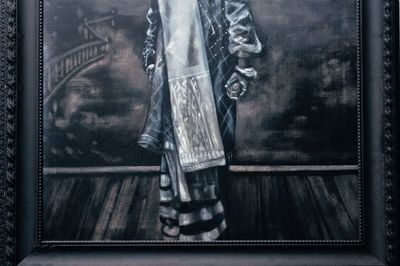
Fyerool Darma, Portrait No. 11 (Puan Saleha, Zaliha or Salihat), from the series 'Moyang' (2017). Acrylic on linen and burnt wood. 101 × 77 × 7 cm. Courtesy the artist and Yeo Workshop.
Born, raised and based in Singapore, Fyerool Darma has recently become one of the most sought-after artists working in Southeast Asia. Beginning with his breakout solo exhibition Moyang at Singapore’s Flaneur Gallery (19–29 March 2015), he went on to become one of the youngest artists in the 2016 Singapore Biennale (27 October 2016–26 February 2017). His multidisciplinary works speak of forgotten histories and often utilise archives as research material or as sites of contestation.
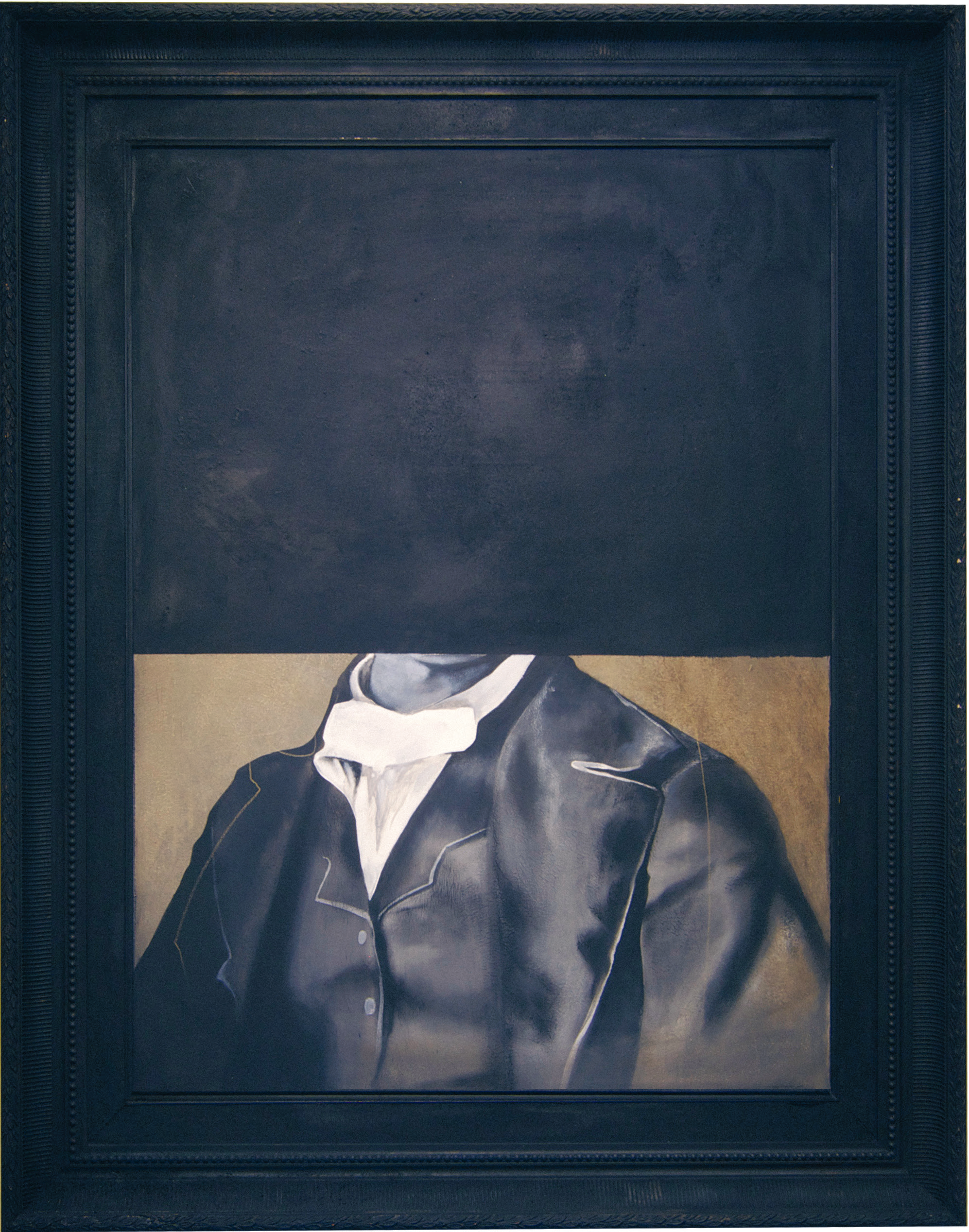
Fyerool’s dissected canvases included in Moyang attempt to ‘resurrect’ historical figures such as the Javanese 19th-century painter Raden Saleh, and Sir Thomas Stamford Raffles, the British statesman often credited with the founding of modern Singapore, striking a chord with regional art audiences. Since then, Fyerool has continued surfacing overlooked aspects of Singapore’s history in various exhibitions, touching on subjects relating to anthropology, colonialism and mythology. At the same time, his ‘excavations’ have also seen him going beyond painting by incorporating sculpture, performance and soon, installation works. He is currently preparing for his next solo show which will be held at Yeo Workshop in Singapore in the second half of 2017.
I’d like to start with your first major solo exhibition Moyang, which was titled after the Malay word for ‘ancestor’. To me, that exhibition announced your arrival on the local art scene, though you had been participating in various group shows prior to that. If I could summarise that show in one word, it would be ‘rediscovery’. What was the impulse that led you to that show?
To provide some background, prior to that show, most of my works were based on a protagonist, which resulted in the ‘Blue Boy’ series of paintings [2011–2014]. I went on to destroy those works and was left with some excess materials in my studio as a result. It was natural for me to then utilise those materials and start with a clean slate. During that period, I also came across a postcard that was given to me by a former colleague when she left the video production house where I was working. On the front was an image of Raden Saleh, and on the back a message that said, ‘Find your voice. This is you.’ I didn’t think much of it back then, but at the same time, I also proceeded to do what I knew best—painting—by copying a historical portrait of Raden Saleh. Through that process and reflecting on my fine art training in painting, I came to understand myself more. I began to understand the role of the individual before taking on these historical themes and figures in my subsequent works.
It’s interesting that you mentioned your stint at the production house, because coincidentally that was when I was your ‘client’; you were the research assistant working with the curators (including myself) of National Gallery Singapore to produce videos on Southeast Asian art for the gallery. Would you say that was the moment when research and archives became key strategies for your artistic practice?
Definitely. Not only was I exposed to art historical data and other research material provided by the curators, the work also gave me an understanding of what the role of the artist is and who defines it. The artist is more than the solitary figure in his or her studio. He or she can interact with and utilise all available research material to realise a work, hopefully, in its most honest form. If you recall the series of portraits produced during Moyang, I was trying to understand the idea of time—how these 19th-century images might seem very distant, but with a click of a button on the online archives, can be so accessible, so very close to us, so to speak. By adding colours and treating these images with the various methods I work with, they become relevant to the contemporary audience.
Working at the video production house also made me realise the power of storytelling. I had to interpret historical facts for the scriptwriters to produce a narrative, so words—or more specifically, text—took on a new importance for me. That stint made me realise how interpreting history is such a complex thing because words became sacred to me. That one year leading up to my solo show remains the most important phase in my practice so far.
One of the highlights following Moyang and the showcasing of your work The Most Mild Mannered Men (2016) at the 2016 Singapore Biennale was Bank Negara Malaysia Museum and Art Gallery, Kuala Lumpur, acquiring your works from an exhibition they organised, Art of ASEAN: Our Exhibition (26 November 2015–14 February 2016). This surprised me, because it’s not something that happens all the time. I realised it might have been because your works speak of a common, shared history within Nusantara, generally understood as the Malay Archipelago. Self-identifying as part of this larger community and being very familiar with the languages and cultural practices, do you feel burdened or anxious taking on this subject in your artwork?
The ideas for those works were already there, prior to the interest from our next-door neighbours, so I didn’t feel a burden or anxiety. However, it was very reassuring for me to be acknowledged via the acquisition because it sparked a conversation about the narratives that I was excavating through my works. Everything was deliberate in terms of why certain paintings were painted the way they were and why certain narratives were brought up. To me, that is the real power of art—when people discuss your works, no matter their politics. Actually, the motivation for me is for my works to spark a conversation with my own parents. Institutional interest has always been a bonus for me, but if my parents have some comments about the works I produce, or if I feel that I can discuss them with my parents, I feel that I’m heading in the right direction.
So your parents are your first critics! Do you consult them before embarking on something new?
I wouldn’t go to that extent, but I often discuss with them certain topics and ideas that I’m working on. It’s really interesting for me to hear their thoughts and opinions because they are obviously not trained historians, though they are interested in history. So the motivation for me is to make them understand that art is one of the ways we can better understand our own histories.
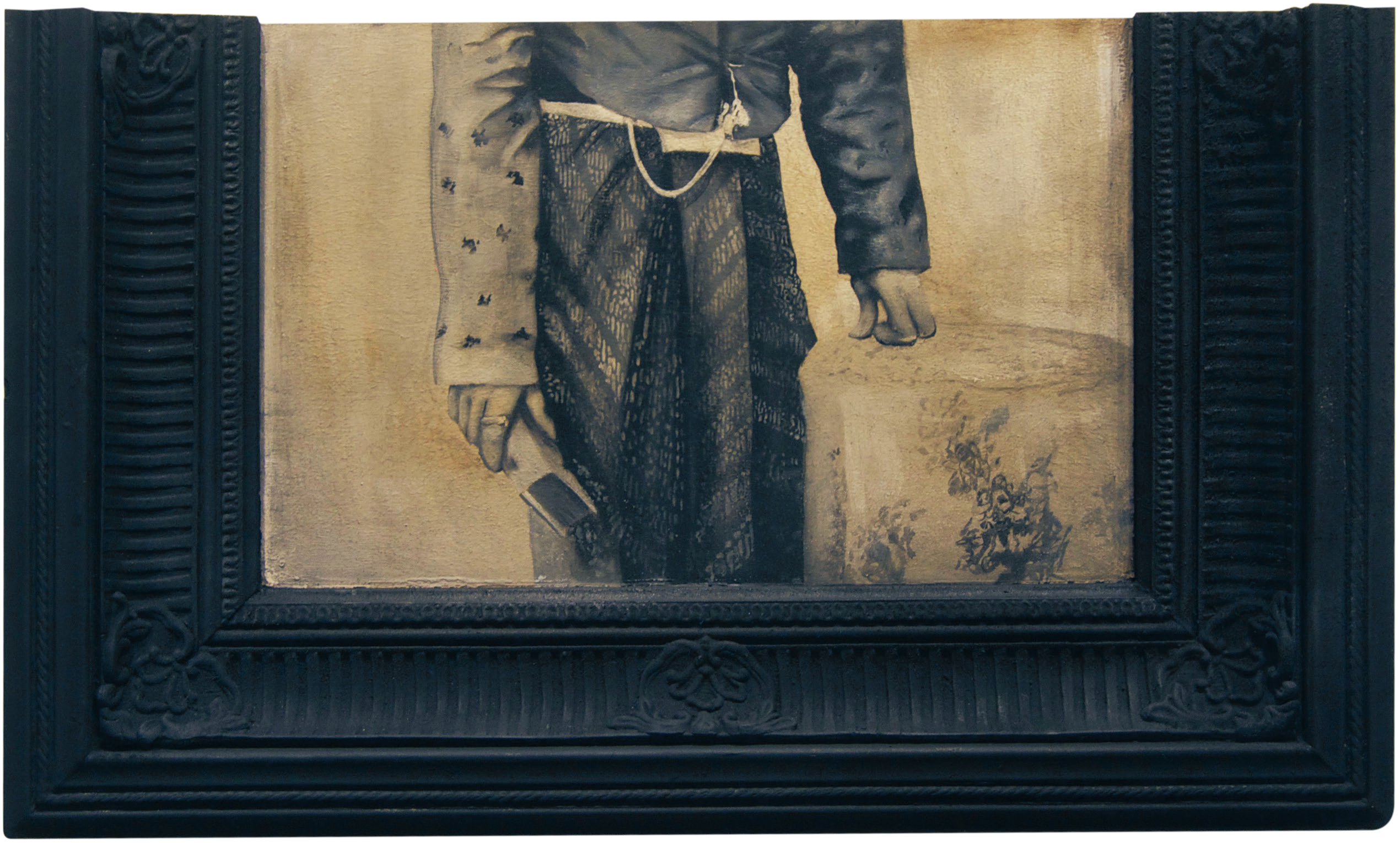
The titles of your works, for example, Portrait No. 4 (The progenitor, pendatang or probably Seri Tri Buana) (2015) and Pulo Blakang Mati (2014), allude to certain historical figures and forgotten places on maps. I see them as almost equal to the images that you create. Could you share more about the thought process behind this aspect of your practice?
It’s interesting you mention this, because it goes back to the primacy of the text for me. Usually I begin with an idea, followed by the title, before I begin to visualise the work. I cannot ignore the textual aspect, even though I’m sometimes informed by audio and visual elements. I’m constantly translating the various texts that I’ve come across. Through this process too, I increasingly realise that texts are sacred across various languages. They mean different things to different people across time and history.
For many local artists, nostalgia is a motivation for producing art. However, for you, I sense that there is instead an urgency to address or to make visible a forgotten aspect of history.
Of course, different artists deal with history differently, and I respect that. When I look at history, I feel a sense of nostalgia too, but I see the latter as more of a disease than an emotion. It is something that you might have experienced. I don’t think I have that baggage because the narratives that I deal with are all quite distant from me. They occurred long before my own existence and I only encounter them through oral history or books. Having said that, I do acknowledge that nostalgia is one way for me to access an understanding of that particular time in history.
Finally, I want to comment on the somewhat-recent rise of Nusantara as a term in our regional art discourse. Just five years ago, the term wasn’t so common, but recently, more artists are using it either as a geographical framework or a way to talk about overlooked histories. How do you understand this concept?
Yes, I agree with you on this observation, and I must admit that your MA thesis opened my mind and provided me a certain method to think about aspects of our history and about my own location within this region. Then I realised that there are a lot of gaps within our understanding of history here. You know the term buka lahan? It’s quite a ritualistic term and is usually used in agriculture to mean ‘clearing land’ before the planting of new crops. I felt that your thesis was trying to do that: plug in the gaps and provide others the opportunity to have a fresh take on the Malay position as part of a minority group in Singapore. And that’s how I’ve been working; telling those minor stories again and again. It’s the only way to ensure the stories don’t get submerged by the dominant discourse. —[O]
This interview was first published in Art-In-Sight by Gillman Barracks, and it is now reproduced here in full with the permission of National Arts Council of Singapore (NAC). In 2017 Ocula was pleased to partner with NAC to produce the print publication Art-In-Sight to mark the fifth anniversary of Gillman Barracks. Gillman Barracks is a visual arts cluster that was set up to present and generate discourse on international and especially Southeast Asia art. Art-In-Sight features interviews with key figures involved with Gillman Barracks, including artists, collectors and gallerists, alongside wide-ranging essays that survey Gillman Barracks through various lenses. You can view the full book online by visiting Gillman Barracks website here.
Main image: Fyerool Darma, Portrait No. 11 (Puan Saleha, Zaliha or Salihat), from the series 'Moyang' (2017). Acrylic on linen and burnt wood. 101 × 77 × 7 cm. Courtesy the artist and Yeo Workshop.

A respected voice in contemporary art discourse.
Focusing on ambitious storytelling and insightful art-world commentary. Ocula Magazine publishes in-depth interviews, critical essays and timely analysis on the artists, exhibitions and ideas driving the global art world.
Learn more about Ocula Magazine
Showcasing the best of the art world.
Ocula partners with galleries from around the world to highlight their artists, artworks and exhibitions. Gallery membership is by application and invitation, with each member vetted by an independent panel.
Learn more about Ocula Membership
Specialises in the sale of major artworks.
Led by a team with deep ties to the world’s leading auction houses, galleries and collectors. Ocula’s advisory team offers bespoke services to high-net-worth clients from around the world who are looking to acquire the best of contemporary and modern art.
Learn more about our team and services