





Gary Simmons ‘Dancing in Darkness’
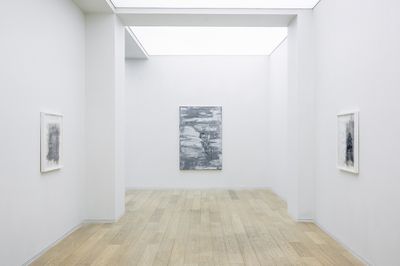
Exhibition view: Gary Simmons, Dancing in Darkness, Simon Lee Gallery, Hong Kong (4 July–29 August 2020). Courtesy the artist and Simon Lee Gallery. Photo: Daniel Murray.


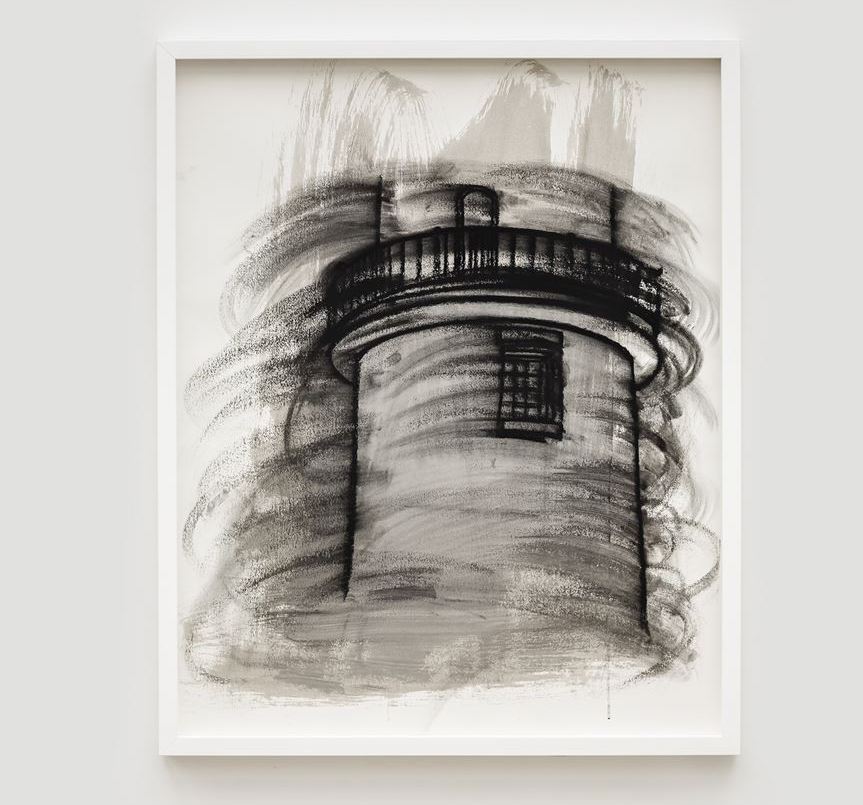
But while Simmons’ drawings and paintings are characterised by marks of erasure, ghostly trails and stubborn stains linger, like the histories—and in turn, prejudices—that never seem to go away. The gesture of erasure continues in the artist’s recent exhibition at Simon Lee Gallery Hong Kong, Dancing in Darkness, but this time with a focus on architecture rather than vintage animations. Images of lighthouses and watchtowers are repeated across five charcoal and gouache on paper drawings and one oil paint and cold wax on canvas, their forms depicted in fragments, smudged, and partially erased. Painted in a grisaille palette, the visual effect is that of a dystopian wasteland—razor wire, surveillance cameras, and towers seemingly emerging out of tempestuous wind and fog.
The centrepiece of the exhibition, Misty Tower Top (2019), outlines a prison watchtower in white against a background of slate grey. The tower is partially obscured by thick frenzied strokes of white and grey paint—only a small section of the tower is left untouched and discernible, as though the tower is emerging from a thick fog or mist. Paint is applied in thick horizontal layers across the canvas with a palette knife: more an act of furious defacement.
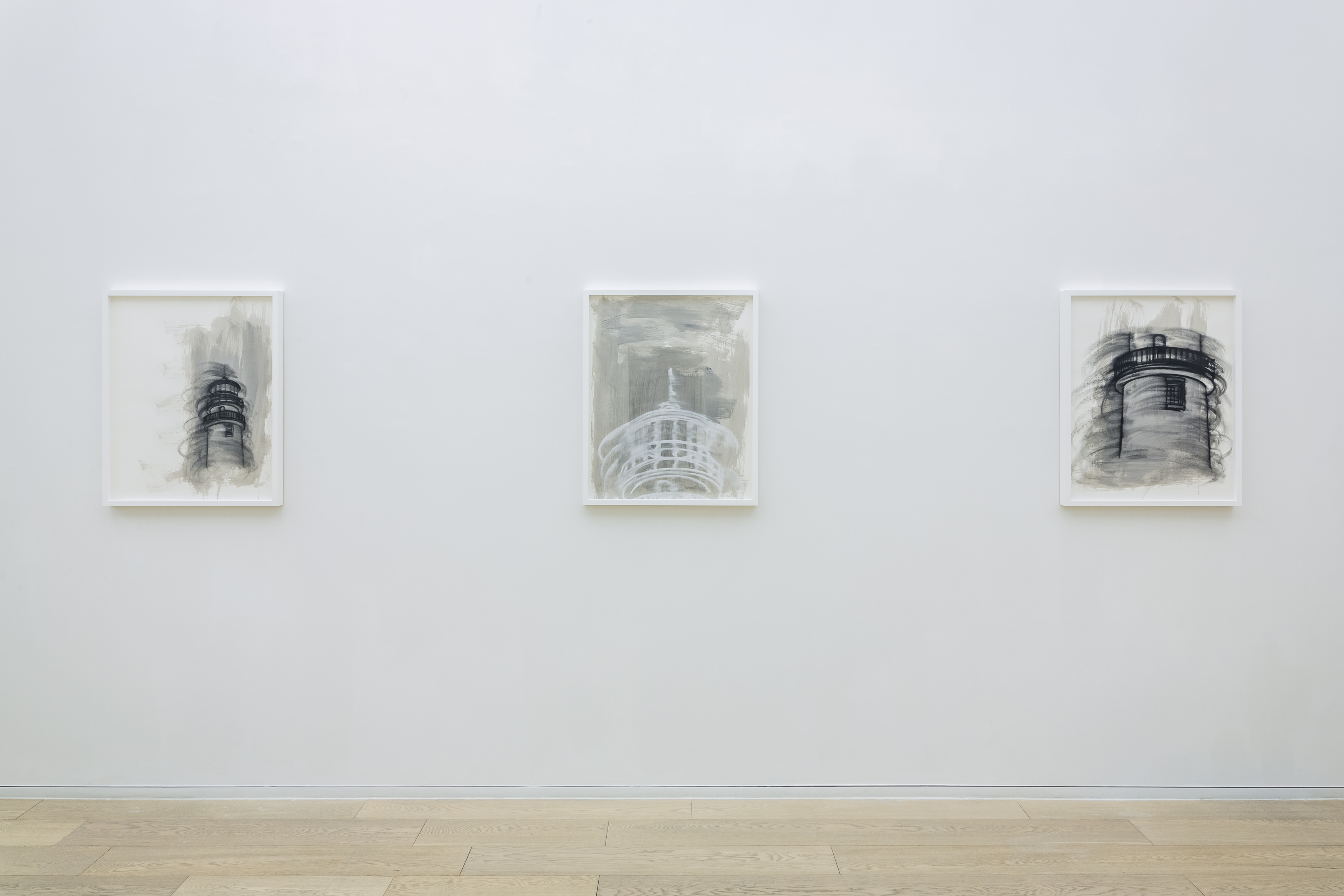
The watchtower is a metaphor for surveillance and the prison industrial complex in the United States. As a symbol, it looms ominously over African-American men, who historically have outnumbered white and Hispanic men in prison, and who have been disproportionately targeted by police in the United States. In contrast, the lighthouse functions as a guide for ships in the dark, and a point of arrival. Dancing in Darkness probes these contrasts. While the watchtower stands as a symbol of oppression and control, the lighthouse casts a guiding light, making visible the deep-rooted issues surrounding inequality and race in the United States. On a cursory glance, the details of the two cylindrical architectural structures depicted in the works on view resemble one another. The effect is dizzying and destabilising, echoing the sentiment felt by many today as the world grapples with histories of slavery and extractivist capitalism that have refused their historical purging.
Simmons once said he used to consider himself a visual DJ, taking influences and inspirations from all around him—pop culture, politics, music—and recontextualising and manipulating them. While the title, Dancing in Darkness, implies musicality, the depiction of watchtowers also calls to mind the well-known Bob Dylan song ‘All Along the Watchtower’, in which a joker tells a thief that, in the midst of confusion and no relief, ‘There must be some kind of way out of here’.
Written in the 1960s, a decade of protests and rioting, the song was rooted in the midst of change—of confusion and disillusion over America’s involvement in the Vietnam War, racial tension, and a fraying of public trust in the government. But it was also a time of hope, as the civil rights movement for justice and equality for African Americans took hold. Given the events unfolding in the United States today, Simmons’ paintings invoke a sense of history repeating itself. But even in darkness and confusion, waves of hope push forward.—[O]
Main image: Exhibition view: Gary Simmons, Dancing in Darkness, Simon Lee Gallery, Hong Kong (4 July–29 August 2020). Courtesy the artist and Simon Lee Gallery. Photo: Daniel Murray.



A respected voice in contemporary art discourse.
Focusing on ambitious storytelling and insightful art-world commentary. Ocula Magazine publishes in-depth interviews, critical essays and timely analysis on the artists, exhibitions and ideas driving the global art world.
Learn more about Ocula Magazine
Showcasing the best of the art world.
Ocula partners with galleries from around the world to highlight their artists, artworks and exhibitions. Gallery membership is by application and invitation, with each member vetted by an independent panel.
Learn more about Ocula Membership
Specialises in the sale of major artworks.
Led by a team with deep ties to the world’s leading auction houses, galleries and collectors. Ocula’s advisory team offers bespoke services to high-net-worth clients from around the world who are looking to acquire the best of contemporary and modern art.
Learn more about our team and services