





Auckland born artist, Julian Hooper is becoming increasingly well known for his highly individual paintings. Drawing on a vast store of personal memory and imagery, his work, while close to contemporary abstraction and traditional painting territories, is unique and often surprising. In this Ocula Insight, Hooper discusses his latest exhibition, Lazy Racer, his fifth solo show at Gallery 9 in Sydney.
You have an interesting background. Can we begin by talking about your journey into art?
Growing up we had relatives who were artists and close friends. They lived in a remote part of Northland and made paintings, batik and jewellery. I started drawing and painting with them when I was about 14 years old. They believed that painting was something you just did, like breathing. They didn’t like art that was about ideas. I never really questioned being an artist. I studied at Elam School of Fine Arts in the mid eighties and encountered a broader set of attitudes. Some earlier experiences became important to me, particularly my years as a kid in the Tokelau Islands with my parents who were doing anthropological fieldwork.
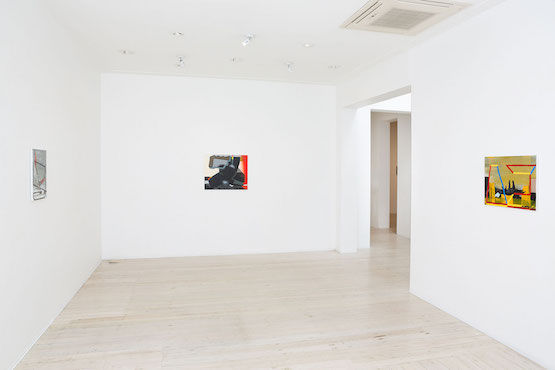
Turning to your creative process, there are many different references in your works. Where do you seek inspiration for the wide and varied ideas that make up your paintings?
Rather than seeking out specific material, I find stuff through a process of trawling through books and the Internet. Often I will process this material into quick line drawings to become familiar with the material, and to refer to when I’m painting. The initial source of imagery could be anywhere and I value the access that we have, yet my motivations are to make paintings that evoke something familiar and personal. Regional painting in the digital age.
And how do you go about pulling it all together? Do you have a fixed idea about what a painting will be before you begin, or does it evolve more organically?
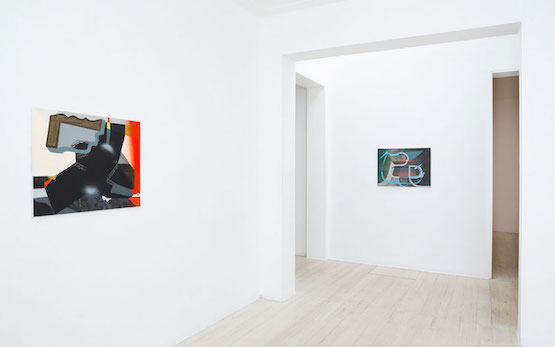
The images evolve in the process of making. I start each work by adding motifs and marks fairly randomly. I like working this way because it eliminates the problem of how to start, and of what to paint. I continue with a process of adding, editing, over-painting and erasing. I’m interested in how forms can travel away from their initial meaning and start to refer to something else. The curve of a hill line may become a building, or a jawbone may become a sinister wave. It can work like metaphor, it often has an expressive power, and it gets me away from what I think things should look like. I’m often lost for long periods of time in a painting. I think ideas and content are very important, but I like ideas to surprise me as I make the work. Eventually I will have strong associations with the content of each painting. Ideas help me resolve the work, but never to start the work.
How long does a typical painting take to complete, and how do you know when it is finished?
There is no typical duration. Some take days and some take years, maybe with a lot of reworking but perhaps just hanging around waiting to declare a direction. I know that my work is finished when I think it is resolved, but I have an idea about resolution that can allow for a degree of uncertainty in the image. When to stop is an intuitive decision every time.
Your work is currently on display in Necessary Distraction, a survey of contemporary New Zealand painting at Auckland Art Gallery. The press release states that ‘the artworks selected and commissioned … share a focus on material and form, and are deliberately open ended’, which feels very accurate in describing the experience of your work. Can you discuss the relationship between the viewer experience and your approach to painting?
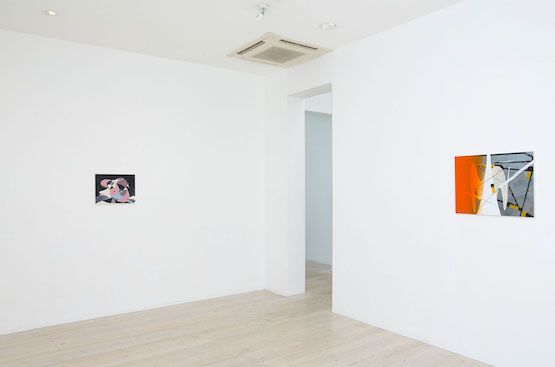
I want to share the way I see the world, but I also want to leave room for the viewer to be able to explore their own interpretation of the image. I discover my relationship to the work as it evolves and I hope the finished work unfolds for the viewer in a similar way. I see each work I make as a proposition for painting, with a built-in questioning about its own resolve or validity.
And what is it you hope a viewer takes from your work?
An experience that is visually interesting and somehow removed from set ideas and meanings. The viewers will find their own associations or contemplate the work on its own terms. Sometimes I hope to elicit the magical feeling of falling in love, or at least a crush.
Your new exhibition at Gallery 9 has an intriguing title—Lazy Racer. What’s it all about?
One of the sly things about art is that trying hard doesn’t always result in better work. Of course if you don’t work hard you wont get anywhere, but if your efforts aren’t balanced right the result will miss something. It’s extremely difficult to make a good painting. So many things have to come together, and some aspects can be elusive, especially when you are challenging your own understanding of things. It’s important to make time to daydream. It’s part of the whole ambitious plan. The title Lazy Racer plays with these ideas. I am also interested in how you might express a quality like laziness or indifference in a work, and still produce a painting that is rigorous and uncompromising.
Which leads me to the titles of the works—Beezer, Sluice, Friendly Fire, and Thriller to name a few. They seem as varied as your many sources. What is the process for titling your paintings?
Each title is like a motif, and enters into play with the other motifs in the work. I see the title as adding to, rather than solving, the enigma of the painting. I find titles much the same way as I find visual motifs, looking for something that surprises and locks into the image.
Do you have favorite piece in the exhibition and if so why?
No.
What else do you have planned for 2016?
At the moment I am working on a solo exhibition at Ivan Anthony Gallery, Auckland, in September this year. —[O]
Main image: Image: Julian Hooper. Courtesy the artist.
A respected voice in contemporary art discourse.
Focusing on ambitious storytelling and insightful art-world commentary. Ocula Magazine publishes in-depth interviews, critical essays and timely analysis on the artists, exhibitions and ideas driving the global art world.
Learn more about Ocula Magazine
Showcasing the best of the art world.
Ocula partners with galleries from around the world to highlight their artists, artworks and exhibitions. Gallery membership is by application and invitation, with each member vetted by an independent panel.
Learn more about Ocula Membership
Specialises in the sale of major artworks.
Led by a team with deep ties to the world’s leading auction houses, galleries and collectors. Ocula’s advisory team offers bespoke services to high-net-worth clients from around the world who are looking to acquire the best of contemporary and modern art.
Learn more about our team and services