





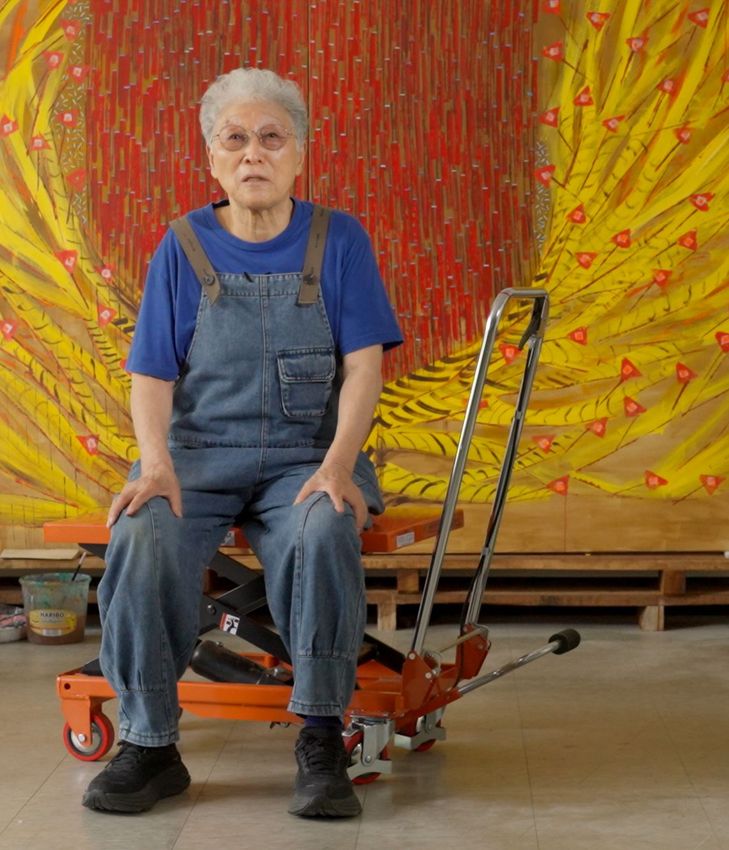
Kim Yun Shin in the Studio
The 90‑year‑old Korean artist invites Ocula into her studio in Paju, a city northwest of Seoul, on the eve of her Frieze Masters solo presentation with Lehmann Maupin. Save to My Ocula

‘Art is life, so why take a break?’, asks the 90-year-old Korean artist Kim Yun Shin.
I am sure many artists would agree. Frank Bowling recently celebrated his ninetieth birthday. Isabella Ducrot turned 93 in June and, at 87, David Hockney‘s only three years off becoming a nonagenarian. The difference is that they all paint. Very few artists in their tenth decade wield a chainsaw to carve wooden sculptures like Kim Yun Shin.
‘When the saw and I become one, everything is free,’ she says. ‘It’s just like my body now.’
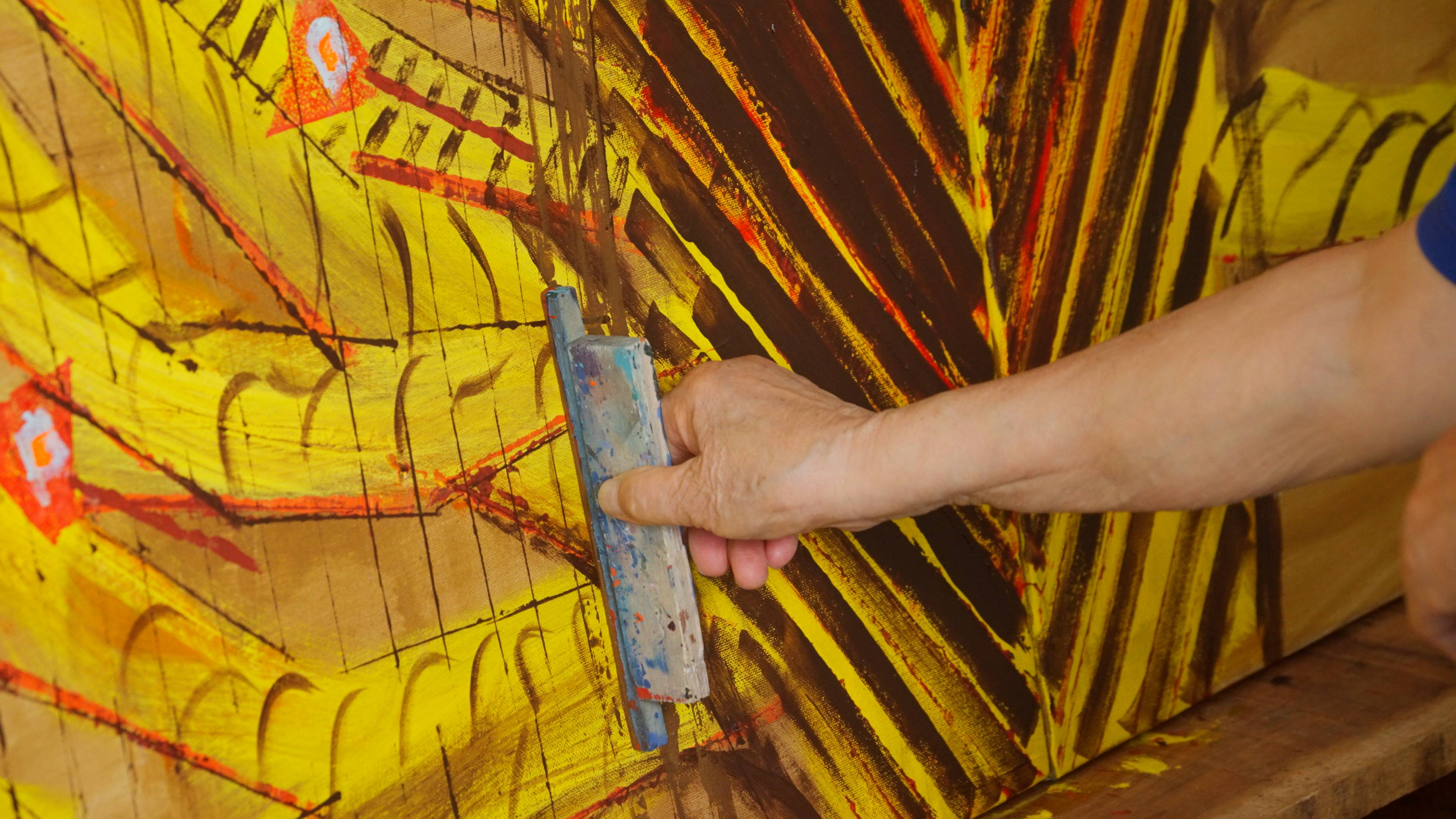
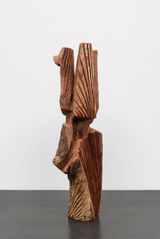
We’re standing in a storage room in Kim’s studio in Paju, a city northwest of Seoul, just a few miles from the Demilitarized Zone dividing the two Koreas. The archival bunker is crammed with large wooden sculptural works reminiscent of totem poles or saguaro—a tree-like cactus—resting upon wooden crates, while a chorus of their smaller relatives lines shelves three rows deep. A library of bubble-wrapped canvases fills the opposing wall—exemplars of the painting practice that has run parallel to the artist’s more physically arduous sculptural one.

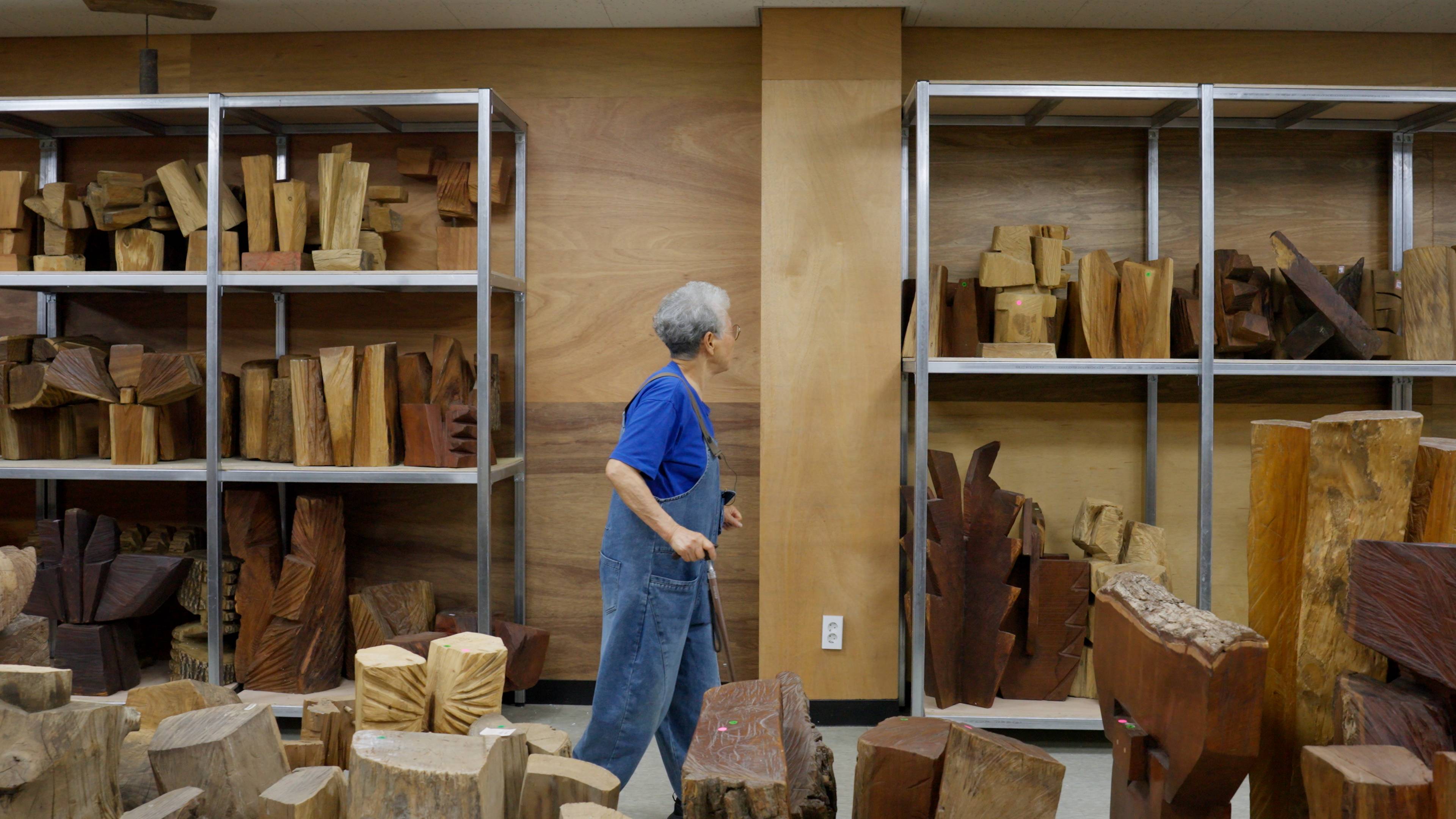
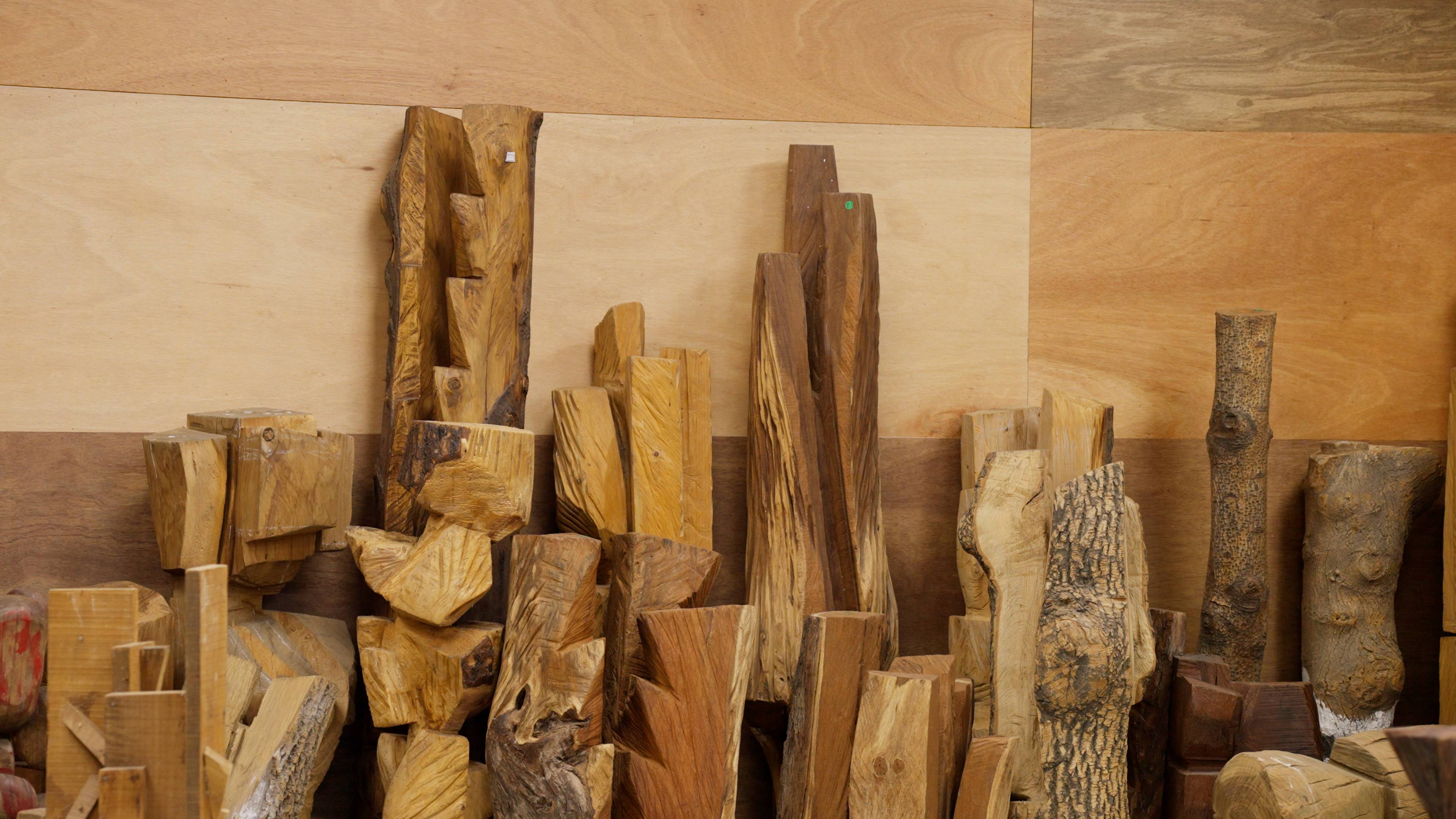
‘This was full,’ Kim tells us. ‘I’ve sent off about 300 pieces for exhibition in recent months. I’ll have to do more good work and fill it up again.’
It’s hard to believe there’s room for more. But Kim’s been developing her artistic practice for the past six decades between Seoul and her adopted hometown of Buenos Aires. Her work passed largely under the radar until last year, when she was the subject of a major survey at the Nam-Seoul Museum of Art. There, eight of the sculptures on show—four in wood, four in stone—caught the eye of Brazilian curator Adriano Pedrosa and were subsequently shipped to Venice to be included in Foreigners Everywhere, the 60th International Art Exhibition of La Biennale di Venezia.
“‘I believe I should leave behind a legacy that reflects how deeply I’ve explored my artistic pursuits.’”
‘I didn’t know what the Biennale was when Pedrosa sent over the paperwork,’ Kim says. ‘So I looked it up and found out it was an exhibition in Italy.’
In January, Lehmann Maupin and Kukje Gallery announced their co-representation of Kim, marking the artist’s first-ever commercial-gallery partnership. Both blue-chips will host solo exhibitions of Kim’s work in March 2025: Lehmann Maupin in London; Kukje Gallery in Seoul. This month, Lehmann Maupin are devoting their first Frieze Masters booth to Kim.
The chainsaw wasn’t always a studio staple. Rather, Kim bought the power tool in 1984 when she moved from Seoul to Buenos Aires, having fallen in love with Argentina after a fleeting visit to see her nephew. She maintained a studio there for 30 years, only recently returning to the studio in Korea where we meet her.
‘I was moved by the grand landscapes and horizons of Argentina, the innocence of the people and, especially, the trees. It had so many trees that were large and sturdy enough to require several men to encircle them entirely. I envied that.’
Up to that point, Kim had carved out a space for herself as a first-generation female sculptor in the post-war South Korean art scene. Kim and her family had emigrated to Seoul from her birthplace of Wonsan—a port city in present-day North Korea—following the Korean War (1950–53). She trained in sculpture at Hongik University in Seoul, graduating in 1959, before heading out to Paris in 1964 to enrol at the École Nationale Supérieure des Beaux-Arts’ Academy of Painting and Sculpture.
Returning to Seoul after her studies, she got to work on making wooden sculptures, starting with her seminal series ‘Stacking Wishes’ and ‘Add Two Add One Divide Two Divide One’ (both 1970s–present). Inspired by the wooden fittings of hanoks (traditional Korean houses), these earlier works are pieced together by creating interlocking joints or grooves.

‘Every morning when I was a child, my mother would take me up to the mountains at dawn,’ Kim says. ‘I would find a small rock and my mother would place a lit candle upon it and say a prayer. Once the candle had gone out, I would fetch another rock to place on top of the last, and my mother would light another candle.’
Zhuzhed up with acrylic paint, recent iterations of these series—a number of which are on view at Frieze—have become a central tenet of Kim’s practice, and one she started in earnest when she returned to Korea in 2023.
This evolution was prompted by a chance encounter with the Mapuche, an indigenous people living in the Patagonia region. Kim incorporated geometric patterns and colouration into her work as a means to combine the totemism of South America and Obangsaek, the traditional Korean colour spectrum of white, blue, black, yellow, and red.
‘This piece isn’t quiet,’ she says, stroking the surface of a gaudy-hued, T-shaped stump. ‘It’s full of something that overflows and explodes. [It’s] a strong representation of my thoughts.’
‘What I’m really trying to do here is make the work more permanent,’ she continues. ‘I’m going to leave “painted sculpture” in this world. I believe I should leave behind a legacy that reflects how deeply I’ve explored my artistic pursuits. That is my assignment.’
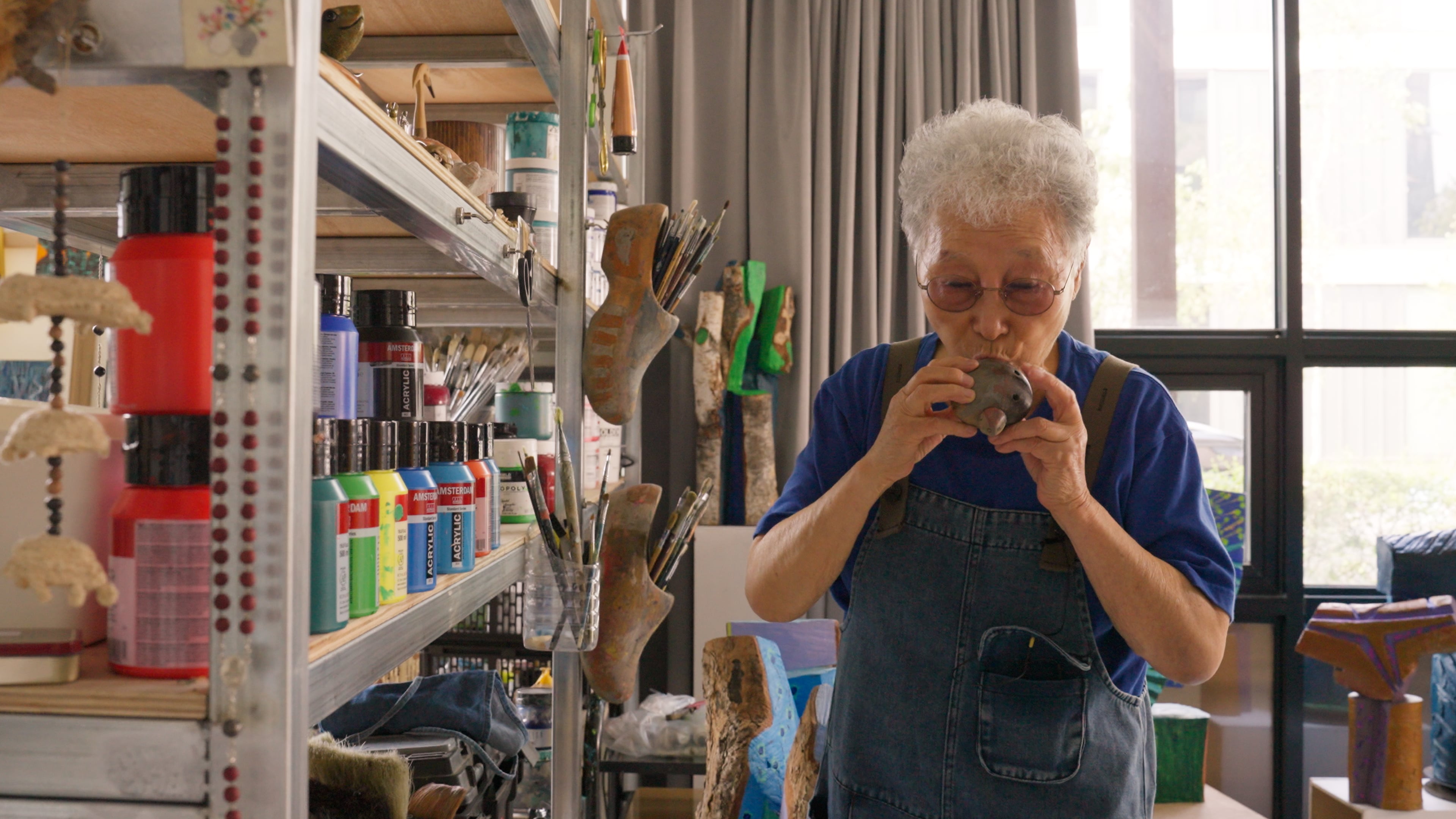
Before we leave, Kim ushers us over to a wooden dresser brimming with items that denote a life well travelled. A cactus bone: a gift from someone in Bolivia. An arrow, hollowed out and carved with the face of an eagle. A grizzly bear claw that native Americans would fashion into necklaces as a sign of bravery and strength.
On the lower shelf is a display of turtle sculptures: a collection which has grown as friends and family, from all corners of Kim’s nomadic life, have passed through her studio. Two hand-painted Mexican bobble-head turtles sit beside a slightly larger one that has a fist-size cowry shell for a body and tiny, wire-framed glasses perched on its head. A legless clay turtle doubles up as a high-pitched whistle, which Kim proceeds to pick up and demonstrate.
The thirty-odd items on show, we were assured, was not the full bale: ‘I haven’t finished unpacking them yet.’
‘I love turtles because they live long, their lifespan often exceeding 100 or even 200 years,’ Kim confides. ‘I also want to live forever.’ —[O]
Main image: Kim Yun Shin's studio. Photo: Sonongji Studio.








A respected voice in contemporary art discourse.
Focusing on ambitious storytelling and insightful art-world commentary. Ocula Magazine publishes in-depth interviews, critical essays and timely analysis on the artists, exhibitions and ideas driving the global art world.
Learn more about Ocula Magazine
Showcasing the best of the art world.
Ocula partners with galleries from around the world to highlight their artists, artworks and exhibitions. Gallery membership is by application and invitation, with each member vetted by an independent panel.
Learn more about Ocula Membership
Specialises in the sale of major artworks.
Led by a team with deep ties to the world’s leading auction houses, galleries and collectors. Ocula’s advisory team offers bespoke services to high-net-worth clients from around the world who are looking to acquire the best of contemporary and modern art.
Learn more about our team and services