Press Release

Ziad Antar photographs liminal places and things. His practice revolves around the ambivalence of the relationship between reality and its technological representation. He realises photo-sculptures or three-dimensional forms within the exhibition space through a succession of formalist paradoxes. Not unlike cast sculpture, photography is a direct imprint of reality. It offers a matrix from which counter-forms can be printed and therefore its process is comparable to that of moulding. At least, this is exactly what the artist’s experiments suggest, while playing with different forms of representation to create an image in between, that is, a sculptural transcription of a photograph at the limen of realism.

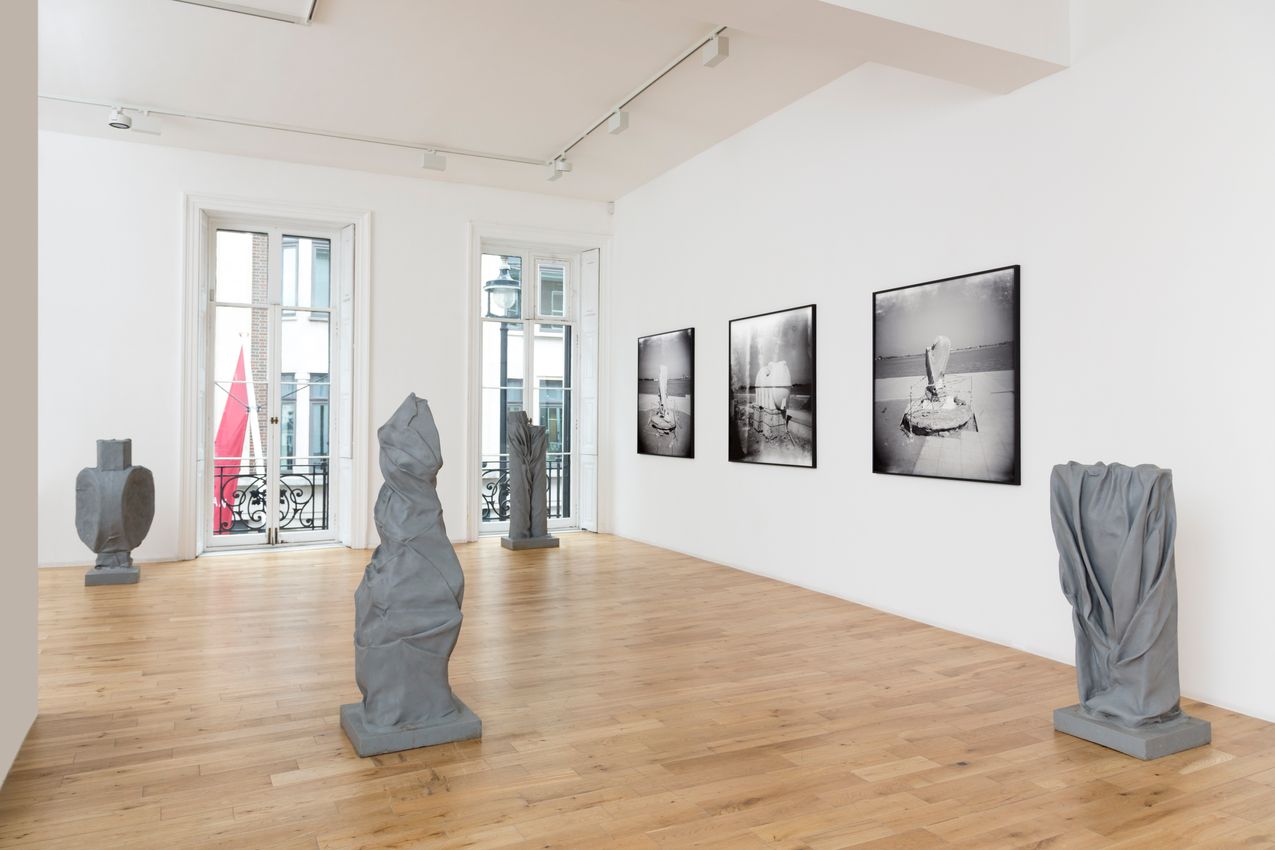
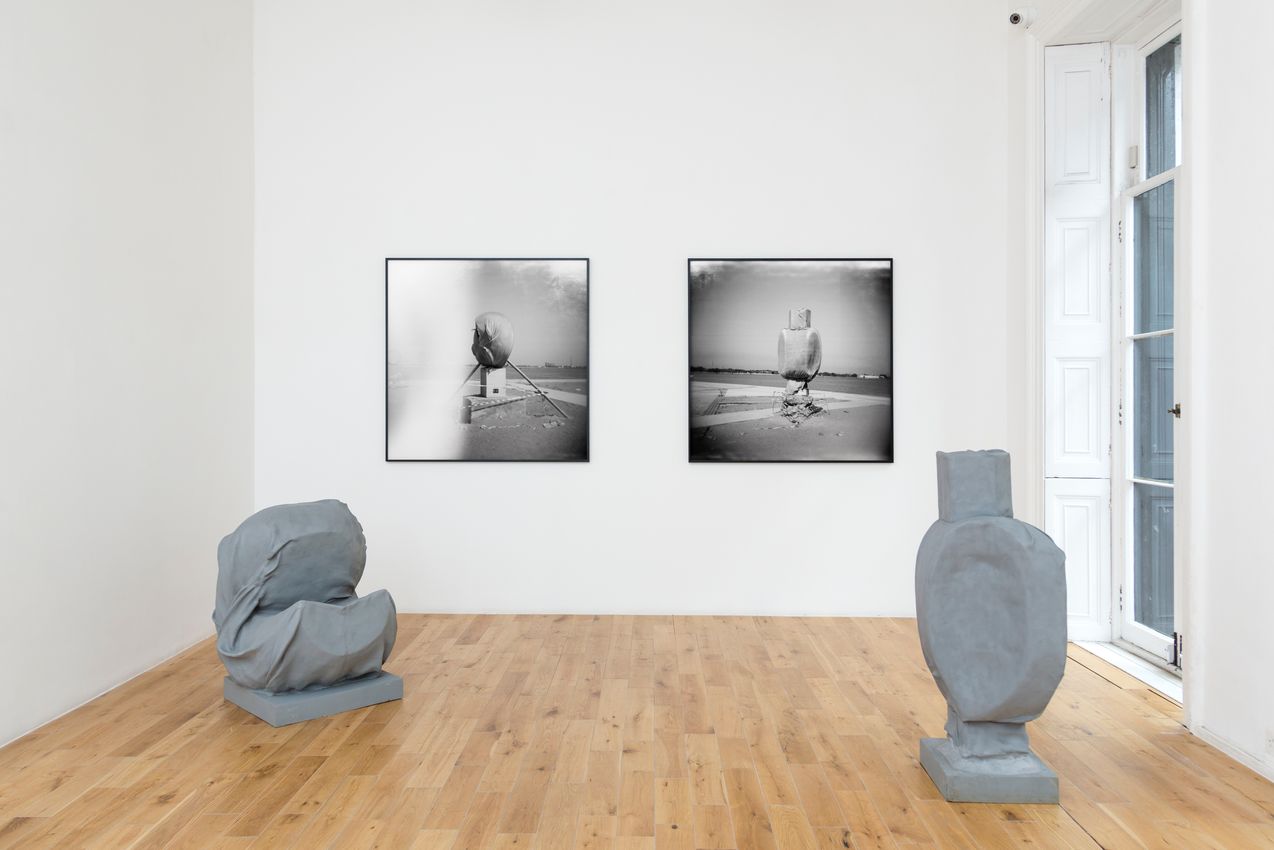
In Saudi Arabia, Ziad Antar has taken photographs of enigmatic sculptural forms on the Jeddah Corniche undergoing urban renovation. Made out of tarp and cordage, and not in the least concerned with aesthetics, these assemblages were installed to protect sculptures by Aref al Rayyes, Rabi Al-Akhras and, among others, Jean Arp, all of which had been commissioned in the 1980s. While these “camouflage” configurations may be reminiscent of Man Ray’s L’Énigme d’Isidore Ducasse and further evoke the informal vocabulary of contemporary sculpture, Ziad Antar has actually elevated their status to that of found art – or, in Raymond Hains’s words, ‘sidewalk sculptures’ – through the act of photographing them. In doing so, he has also humorously immortalized the gestures of the construction workers, who wrapped the public sculptures and thus involuntarily challenged the authority of modern art by giving the otherwise heteroclite ensemble an aesthetical unity negating the various Arab and Western artists’ abstract schemes. Once his photographs are taken, Ziad Antar has operated an additional translation from two-dimensional images back to three-dimensional objects in order to create new sculptural works and complete the cycle of formalist deductions and transfers, which informs the overall history of photo-sculpture. If the artist’s final sculptures have gained autonomy in the process, they nevertheless contain the memory of all the successive transformations that led to their actual shape from a modern paradigm to a vernacular, and ultimately contemporary, one.

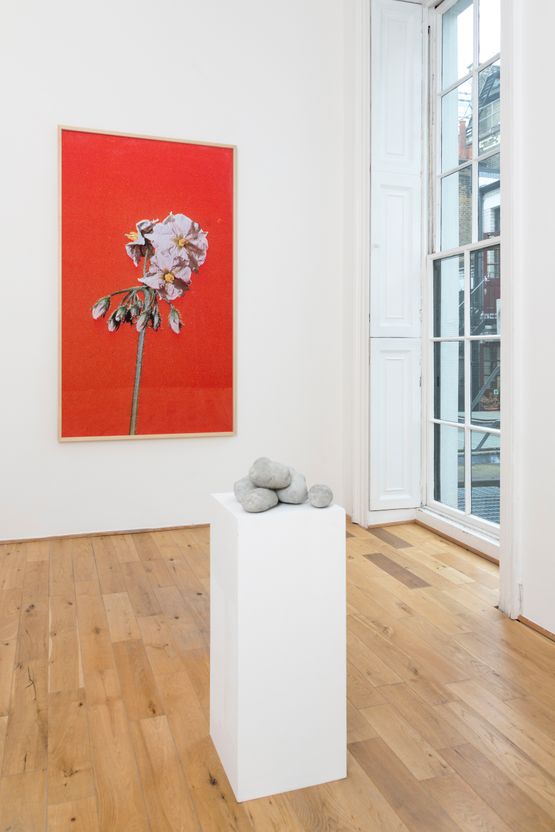
A similar sculptural process is at play in Solanum Tuberosum, but on a different subject transitioning from agriculture to nature, and back again. Ziad Antar has been interested in the culture of potatoes for a long time, having previously filmed and photographed Lebanese farmers working in the Beqaa Valley. For his new installation, he has created a dialogue between a photograph, a sculpture and a document: namely, the portrait of a farmer holding freshly picked potatoes; a heap of very realistic concrete sculptures of potatoes installed in a corner next to the photograph; and a scientific manual, in which various names of tubers can be found. Thus, representation, presentation and knowledge are articulated and their respective discursive regimes complemented, while a purely ecosophical reflection is also developed through this work.

Indeed, Ziad Antar’s ongoing research on the culture of potatoes, which he has been undertaking from Lebanon, his native country, to Belgium and the Netherlands, is further concerned with the history of human and economic exchanges through time. One of the most crucial roles of the artist today consists in writing counter-histories by investigating subjects, like the journey of potatoes of their agricultural exploitation, which have been so far neglected, if not completely ignored. They may be marginal, yet they are central to the understanding of our world.


- Pascal Beausse

Read More

Installation Views

About the Artist

Ziad Antar is a Lebanese filmmaker and photographer known for his short films that evoke a world of conflict through playful tones. After studying Agricultural Engineering at the American University of Beirut, he decided to pursue a career in video and arts.

View Artist Profile

Also Exhibiting at Almine Rech

About the Gallery
Almine Rech opened its doors on April 1st, 1997 in the 13th arrondissement in Paris. The gallery was founded on a minimal and conceptual axis, representing artists such as James Turrell, John McCracken and Joseph Kosuth. In addition to its stable of internationally recognised, mid-career and emerging artists, it has always been the gallery’s mission to continually seek out and include new artists in its programme. The gallery has held longstanding relationships with artists like John McCracken and James Turrell and has since started working with and representing artists such as Günther Förg, Alex Israel, Jeff Koons, Richard Prince, Julian Schnabel, Taryn Simon and DeWain Valentine, among others. In 2006 the gallery moved to a larger two-floor space in the Marais district and in 2008 inaugurated a second 1,000 square metre exhibition space in Brussels. In March 2013, Almine Rech launched its new Paris space at 64 rue de Turenne. In June 2014, Almine Rech opened a gallery in London on Savile Row, Mayfair. In October 2016, the gallery moved from Savile Row to a larger space on Grosvenor Hill, Mayfair. The 400 square metre gallery opened with a solo exhibition by Jeff Koons. Almine Rech Gallery also opened in Manhattan’s Upper East Side—the gallery’s first exhibition space in the US—at the end of October, 2016. The New York gallery’s inaugurating exhibition was Calder and Picasso.
View Gallery Profile
Address
11 Savile Row, 1st Floor
Mayfair
London
United Kingdom
(1)
London 11 Savile Row, 1st Floor, Mayfair
Almine Rech
11 Savile Row, 1st Floor, Mayfair, London, United Kingdom
+44 207 287 3644
http://www.alminerech.com
The art world in focus