Press Release

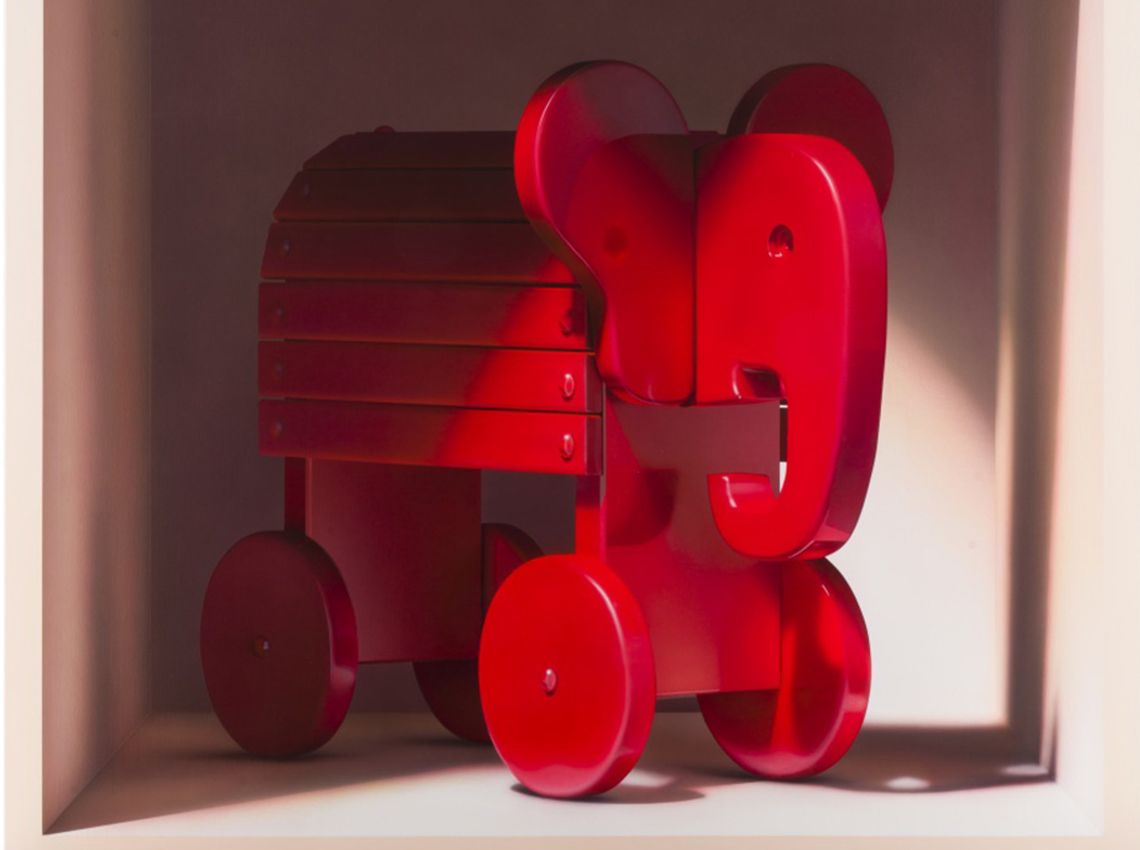
On the face of it, Mehdi Ghadyanloo’s current series of paintings is made up of aset of simple components: light and colour. The traditional components ofpainting. Plus boxes. Painted ones. Open to the front. Acting as a kind of frame.Traditional too you might say. And then, of course, there’s the deployment of all ofthese – light, colour, boxes – to create the illusion of an enclosed, three-dimensional space. Often toplit via a circular opening in the box. A spotlight ofsorts. And in the boxes, beneath the light are a series of brightly colouredchildren’s toys, and playground slides and rides (configured in ways that areinvented by the artist), all depicted as if, well, thanks to the artist’s skill atcreating trompe l’œil, fresh out of the box.

There’s a grinning, plush, child’s clown, its colourful outfit allaying any fears ofany It-like manifestation. A song of innocence if you like. Other boxes contain atoy elephant on wheels painted in a slickly glossy red, or a white, wooden horse ofsimilar design. Or a more modern playground horse made up of translucentplastic-looking silhouettes mounted on a coiled spring. Another variant offers akind of aluminium-looking unicycle from which rears a horse’s head. And thehandles that make it ridable. For all that they are enclosed, at times evenclaustrophobic, the boxes also offer a space of fantasy. A space of play. Amemorial to the joys of childhood. A form of nostalgia for those of us who areadults. Or hope for those of us who think the time for play is at an end.

Back in 1938, in a book titled Homo Ludens, the Dutch historian Johann Huizingaproposed that play was a cornerstone in the development of culture. In it, heproposed the following definition of his subject: ‘we might call it a free activitystanding quite consciously outside the “ordinary” life as being “not serious”, butat the same time absorbing the player intensely and utterly. It is an activityconnected with no material interest, no profit can be gained by it. It proceedswithin its own proper boundaries of time and space according to fixed rules and inan orderly manner. It promotes the formation of social groupings that tend tosurround themselves with secrecy and to stress their difference from thecommon world by disguise and other means. Each of these elements is one thatGhadyanloo enunciates. Our eyes follow the free movement of his slides, proposethe activation of the toys, move freely through what is, in the end a two-dimensional space. We are absorbed. And a little manipulated. We follow thesuggestion of rules for these games that the artist sets out. Albeit subtly.

And it’s a mix of regulation and freedom that governs the artist’s moves too. ‘Forme it’s more like architecture,’ he says. ‘You put an element, make it bigger,smaller, change the light and change the colour and everything. It’s a process.You love something like you like a toy, and to make it yours, you need to modify itin terms of shape, height, curves, colours, light, shadow, shine, contrast, andeverything. It’s like many factors of design and challenge for me. When I haveeverything and start painting the idea, when I finish the painting, like a blueprintfor an architectural building, when it’s finished, again it starts another processbecause you see it in reality. You start to modify, change it, and it’s a never-ending process.’ Of play.

There is a play here too with art-historical precedents: with Giorgio Morandi’s stilllives, the fantastic architectures and play of light and shade in the works ofGiorgio de Chirico, a hint of the playfulness and self-contained worlds ofMarcel Duchamp’s Boîte-en-Valise (1935-41), the fantastical slides and laddersof Dutch artist Constant Nieuwenhuys’s city of play, New Babylon (1956–1974), animagined postwar utopia in which people were liberated by freedom rather thanoppressed by work. These themes come together in the Escheresque paintingThe Untold Artwork (2022), a labyrinth of large slides and diminutive stairs andladders, full of luminous pinks and greens and rainbow patterns. It’sreminiscent too of Andy Warhol’s lurid palette and fascination with the everyday(one might imagine this work with the colourful slides and lurking toy horses tobe a eulogy to plastic; and plasticity). Yet there’s also a slightly sinisterundertone lurking in the shadows – why the gulf in scale between snakes andladders? Where does this fantastical architecture of play actually lead us?What does this work say about theconstraintsoftherealandtheescapismof the imaginary? How does one escape the box?

Yet despite these prompts towards art-historical speculation (there’s no reasonto think that the artist is aware of all these precedents), that’s not to say thatthere isn’t a lot of Ghadyanloo’s own experience in there too. His works displaysome of the influence of Sufi philosophy between the interiorisation of his boxesand the dances and pirouettes of his slides. His own childhood in Iran took placeunder the shadow of the Iran–Iraq War (1980–1988) when, as the artist puts it, joymeant, above all, one’s relatives returning safely home. His children’s childhoodis taking place in a world in which ‘play’ is increasingly the preserve of the digitaland virtual spheres. As much as Ghadyanloo’s boxes are spaces of play, they arealso spaces that express his control – of the direction and intensity of light, of themovements suggested by the toys and architectures and of the stage-like spaceof his boxes. An antidote in some ways to a world that seems increasingly out ofcontrol, with earthquakes in Turkey, war in Ukraine and the aftermath of a globalpandemic. Boxed yet free, descriptions of journeys and hints of possibleoutcomes, his works describe a space that is at once limited and full of potential.Scenes of hope rising out of despair.

Press release courtesy Almine Rech. Text: Mark Rappolt.

Read More
About the Artist

Mehdi Ghadyanloo lives and works in Germany.After growing up near the agricultural fields in the suburbs of Tehran, Ghady-anloo studied at Tehran University’s College of Fine Arts and graduated with a BA in 2005. Subsequently, he earned an MA in film studies from Tehran’s Teachers College (Tarbiyat-e Modarres).

View Artist Profile

Also Exhibiting at Almine Rech

About the Gallery

Almine Rech London will showcase curated presentations of works by artists from the 20th and 21st centuries and will be open Tuesday through Friday, from 10am to 6pm, with Monday and Saturday visits available by appointment.

View Gallery Profile
Address
11 St George Street
Hanover Square
London
United Kingdom
Opening Hours
Tuesday – Friday
10am – 6pm
The gallery will be open on Mondays and Saturdays by appointment only
(1)
London 11 St George Street, Hanover Square
Almine Rech
11 St George Street, Hanover Square, London, United Kingdom
+44 207 287 3644
http://www.alminerech.com

Opening hours
Tuesday – Friday
10am – 6pm
The gallery will be open on Mondays and Saturdays by appointment only
The art world in focus