Press Release

The Italian art scene of the 1960s was both very active and well informed of foreign developments. Jasper Johns and Rauschenberg had exhibitions in Italy as early as 1958, and some of their artworks were reproduced in the first issue of Azimuth, the review launched by Castellani and Manzoni in 1959. Yves Klein, John Cage and Pierre Restany were present in Milan at the time, weighing in on the debate on Informalism, a defining issue of 1950s modernism. The discussion was imbued with an end-of-art atmosphere, indissociable from a discourse of renunciation and radicality: ancient art has ceased to exist and art must start over again for it to cease existing.

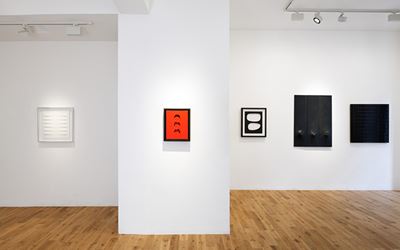
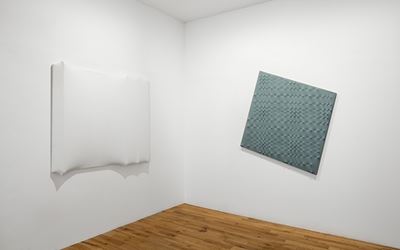
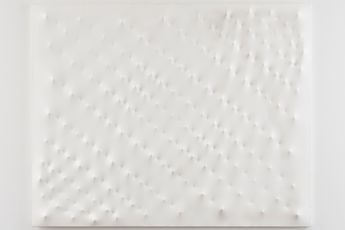
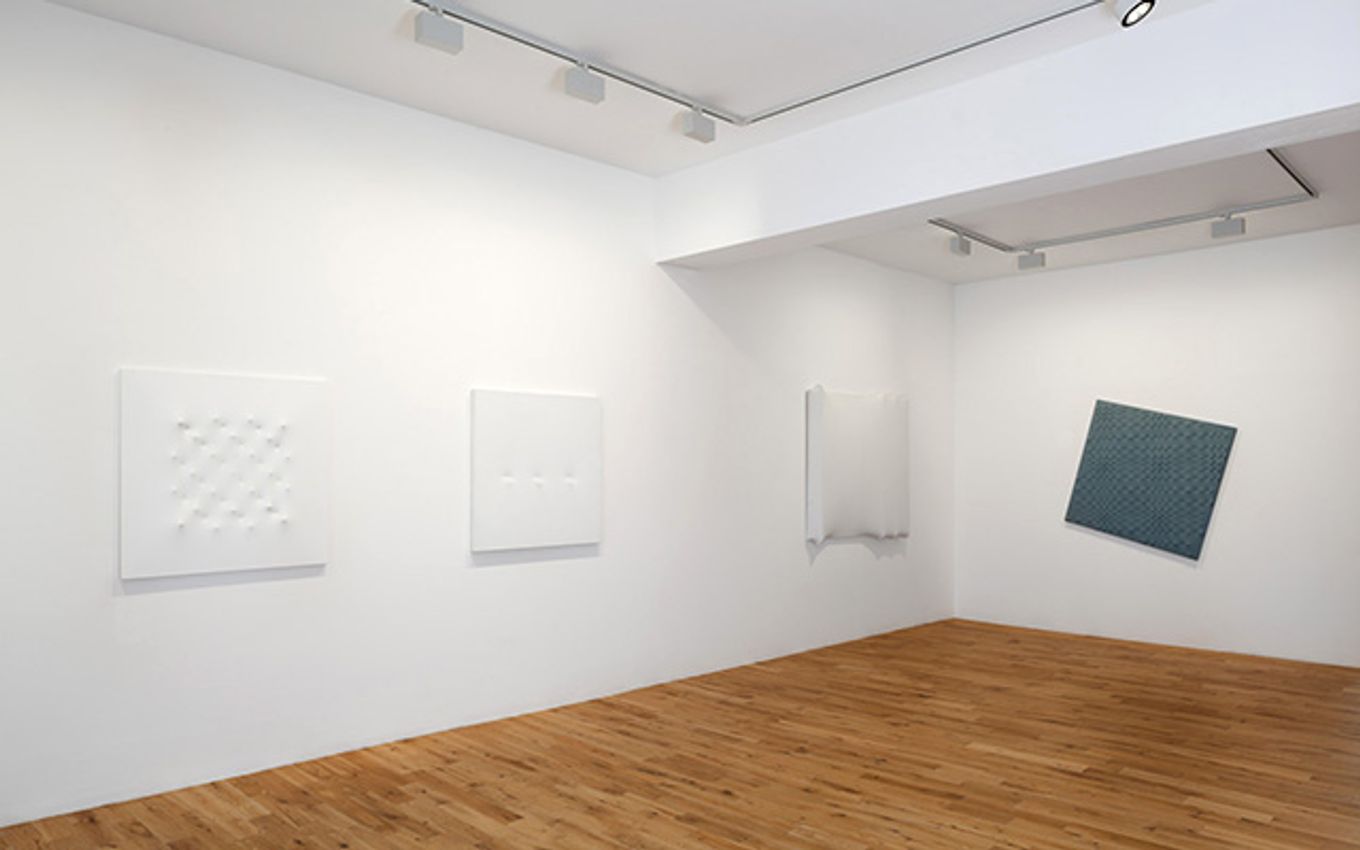
The artists present in the exhibition-manifesto ‘Pittura Oggetto’ are all heirs to Lucio Fontana’s cut canvas. Through his gesture the work becomes an object, an installation; it takes into account the void (notably in Dadamaino), space, light, the venue and the spectator’s physical experience. Castellani retains the use of the canvas but uses nails to play with its elasticity. For his part, Bonalumi uses arches to distort the frame, giving the surface an architectural quality.

For these artists it is no longer a question of situating oneself in space, but of structuring space so as to render it perceptible and to experience it personally. These surface experiments as elements of the composition no longer belong to the field of either painting or sculpture. ‘Since they cannot acquire architecture’s monumentality, they are the reflection of that total inner space stripped of contradictions to which we aspire’ (Enrico Castellani, in the review Zero no. 3, 1961).

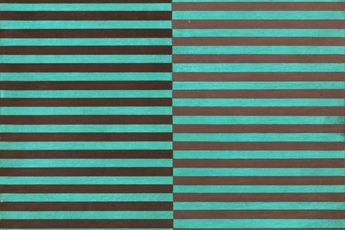
In order to reach a treatment of time analogous to that of space, they all developed a repetitive system based on the use of monochromy.

In an essay from 1960 on these ‘achromes’ and entitled ‘Libera dimensione’, Manzoni gives voice to the Italian formulation of Frank Stella’s literalism ‘What you see is what you see’: ‘Una superficie bianca che è una superficie bianca e basta’. For all these artists it was a matter of pursuing their shared objective, namely, turning attention away from the ‘artist’ and his ‘masterpiece’ and promoting instead the increased solicitation of the spectator.

Photo © 2014 Andy Stagg

Installation Views

Artists Exhibiting

Also Exhibiting at Almine Rech

About the Gallery
Almine Rech opened its doors on April 1st, 1997 in the 13th arrondissement in Paris. The gallery was founded on a minimal and conceptual axis, representing artists such as James Turrell, John McCracken and Joseph Kosuth. In addition to its stable of internationally recognised, mid-career and emerging artists, it has always been the gallery’s mission to continually seek out and include new artists in its programme. The gallery has held longstanding relationships with artists like John McCracken and James Turrell and has since started working with and representing artists such as Günther Förg, Alex Israel, Jeff Koons, Richard Prince, Julian Schnabel, Taryn Simon and DeWain Valentine, among others. In 2006 the gallery moved to a larger two-floor space in the Marais district and in 2008 inaugurated a second 1,000 square metre exhibition space in Brussels. In March 2013, Almine Rech launched its new Paris space at 64 rue de Turenne. In June 2014, Almine Rech opened a gallery in London on Savile Row, Mayfair. In October 2016, the gallery moved from Savile Row to a larger space on Grosvenor Hill, Mayfair. The 400 square metre gallery opened with a solo exhibition by Jeff Koons. Almine Rech Gallery also opened in Manhattan’s Upper East Side—the gallery’s first exhibition space in the US—at the end of October, 2016. The New York gallery’s inaugurating exhibition was Calder and Picasso.
View Gallery Profile
Address
11 Savile Row, 1st Floor
Mayfair
London
United Kingdom
(1)
London 11 Savile Row, 1st Floor, Mayfair
Almine Rech
11 Savile Row, 1st Floor, Mayfair, London, United Kingdom
+44 207 287 3644
http://www.alminerech.com
The art world in focus