




JOAN MITCHELL
1925-1992, United StatesJoan Mitchell was an influential American artist known for her emotionally charged and gestural abstract paintings.
A key figure in the second generation of Abstract Expressionism, Mitchell’s practice blended intense colour, energetic mark-making, and a deep connection to landscape and memory.
Early Years
Joan Mitchell was born in 1925 in Chicago. Her mother was a poet and her father a physician, fostering in her both a literary sensibility and intellectual curiosity. She studied at Smith College and the School of the Art Institute of Chicago, graduating in 1947, before continuing her training in New York and Paris. Early exposure to both poetry and painting would profoundly inform her lyrical, non-figurative compositions.
In the 1950s, Mitchell emerged in the New York art scene, exhibiting with artists such as Willem de Kooning and Franz Kline. She was among the few women associated with the Abstract Expressionist movement, and she maintained a strong, distinctive voice within it. In 1955, she moved to France, eventually settling in Vétheuil, where she would live and work for the rest of her life.
Joan Mitchell Artworks
Mitchell’s art is characterised by large-scale canvases marked by expressive brushwork and vivid colour. While non-representational, her paintings are deeply rooted in the sensory and emotional qualities of nature and memory.
Early Works: New York and Gestural Expression (1950s–1960s)
Mitchell’s early works developed in the context of New York’s Abstract Expressionist movement during the 1950s. She quickly became known for her bold handling of paint and her ability to create space through gesture alone. Works like Hemlock (1956) and Ladybug (1957) show a dynamic push and pull across the canvas, with gestural strokes that imply movement and depth.
While her peers often focused on existential intensity, Mitchell drew upon landscape and personal memory, producing paintings that conveyed emotion through the rhythm of mark-making and the energy of colour. Her compositions from this period often appear turbulent or dense, yet they maintain a sense of balance and control.
Late Works: Vétheuil and the French Landscape (1970s–1990s)
After settling in France in the late 1950s, Mitchell’s paintings evolved in both scale and tone. Influenced by the light and landscape around her home in Vétheuil—once home to Claude Monet—she began producing works that felt more open and atmospheric.
In the 1980s, following the loss of close friends, Mitchell created one of her most celebrated series, La Grande Vallée (1983–1984), using vibrant colour and sweeping forms to express grief, memory, and transcendence. Her brushwork remained assertive, but her late paintings often evoke the ephemeral qualities of sky, garden, and water, translated through abstraction.
In these later works, Mitchell’s practice shifted towards polyptychs—multi-panel compositions that allowed for a rhythmic unfolding across the canvas, akin to stanzas in a poem or movements in music.
How has Joan Mitchell influenced contemporary art?
Mitchell’s work has had a profound influence on generations of contemporary artists, particularly women painters exploring abstraction. Her integration of personal memory, emotion, and landscape within a rigorous abstract language paved the way for more lyrical and subjective approaches to painting. Artists such as Cecily Brown, Amy Sillman, and Julie Mehretu have cited her as an influence. Her legacy also persists institutionally, with the Joan Mitchell Foundation supporting contemporary artists through residencies and grants.
What were Joan Mitchell’s influences?
Mitchell’s influences ranged from modern French painters to literature and music. She deeply admired the work of Paul Cézanne, Vincent van Gogh, and Claude Monet, whose explorations of landscape and light resonated with her own sensibility. Literary influences were equally strong; she often referred to the impact of poetry on her thinking, particularly that of T.S. Eliot and Rainer Maria Rilke. The cadence of music, especially jazz, also informed her sense of rhythm and structure within painting.
Awards and Accolades
- Chevalier of the Order of Arts and Letters, France (1989)
- Honorary Doctorate, School of the Art Institute of Chicago (1991)
Exhibitions
Joan Mitchell has been the subject of both solo exhibitions and group exhibitions at important institutions. Below is a selection of exhibitions featuring work by the artist.
Solo Exhibitions
- Joan Mitchell, Fondation Louis Vuitton, Paris and San Francisco Museum of Modern Art (2021–2022)
- Joan Mitchell: I carry my landscapes around with me, Baltimore Museum of Art (2022)
- Joan Mitchell: Worlds of Colour, National Gallery of Australia, Canberra, Australia (2021)
- Joan Mitchell: Selected Works, Museo de Arte Contemporáneo de Monterrey, Mexico (2012)
- Joan Mitchell in New Orleans: Paintings, New Orleans Museum of Art (2010)
- Joan Mitchell, Whitney Museum of American Art, New York (2002)
- Joan Mitchell: Retrospective, Musée des Beaux-Arts de Nantes (1994)
Group Exhibitions
- Action, Gesture, Paint: Women Artists and Global Abstraction 1940–1970, Whitechapel Gallery, London (2023)
- Epic Abstraction: Pollock to Herrera, The Met Breuer, New York (2018)
- Women of Abstract Expressionism, Denver Art Museum (2016)
- The Forever Now: Contemporary Painting in an Atemporal World, Museum of Modern Art, New York (2014)
- American Vanguards: Graham, Davis, Gorky, de Kooning, and Their Circle, Addison Gallery of American Art (2012)
- Les Femmes s’en Mêlent, Centre Pompidou, Paris (2010)
- Abstraction: A New Identity, MoMA, New York (1981)
- New York Painting and Sculpture: 1940–1970, The Metropolitan Museum of Art, New York (1970)
Website
Joan Mitchell’s work is represented by the Joan Mitchell Foundation, whose website can be found here.
Critical Reception
Mitchell’s work has been widely covered by major art and cultural publications including Ocula, Frieze, The Brooklyn Rail, T_he New York Times_ and The Guardian.
Ocula | 2025


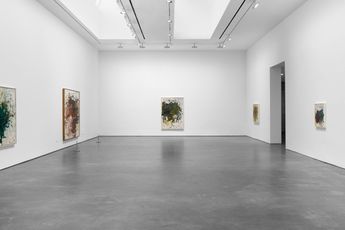
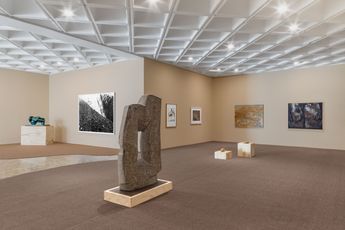
Explore Joan Mitchell's Exhibitions






Joan Mitchell in Ocula Magazine




Explore and Follow Artists Shaping Contemporary Art
A respected voice in contemporary art discourse.
Focusing on ambitious storytelling and insightful art-world commentary. Ocula Magazine publishes in-depth interviews, critical essays and timely analysis on the artists, exhibitions and ideas driving the global art world.
Learn more about Ocula Magazine
Showcasing the best of the art world.
Ocula partners with galleries from around the world to highlight their artists, artworks and exhibitions. Gallery membership is by application and invitation, with each member vetted by an independent panel.
Learn more about Ocula Membership
Specialises in the sale of major artworks.
Led by a team with deep ties to the world’s leading auction houses, galleries and collectors. Ocula’s advisory team offers bespoke services to high-net-worth clients from around the world who are looking to acquire the best of contemporary and modern art.
Learn more about our team and services