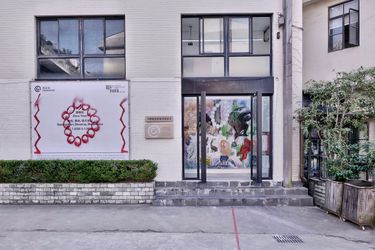
Cc Foundation & Art Centre is honoured to present Superstition, Blessing, Modernism, a solo exhibition by artist Yilun Zhou from 7 November 2020 to 1 March 2021.
The exhibition, centred around three independent keywords ‘Superstition, Blessing, Modernism,’ presents the artist’s new body of ‘magic’ paintings that are accompanied by a set of sculptures. Semantically deconstructing and parodying iconography and re-interrogating modernist painting against the backdrop of the globalised consumerism, the artist hopes to bless the viewer with the ‘superstition’ in his work.
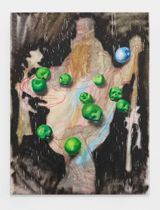
The concept was originated from his personal experience: he got lucky at a poker game with friends one day. He attributed his good luck to a painting that he bought that day. In fact, Zhou is not religious, but he believes in the agency of specific patterns and symbols, even though have no practical functions, they are beautiful and magical, empowering people with spiritual consolation. Therefore, the protrusive subject in each painting is a rosary. The rosary blesses the event depicted in the backgrounds, be it two hugging lovers, or a pleasant vacation, or a comfortable office, or beautiful nature, or traditional art, or a modernist design, or folklore, or a religious ceremony.
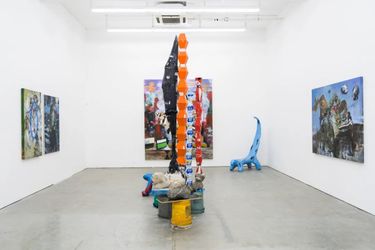
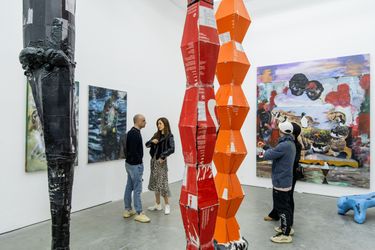
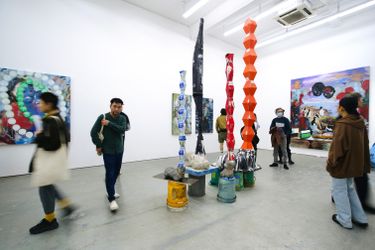
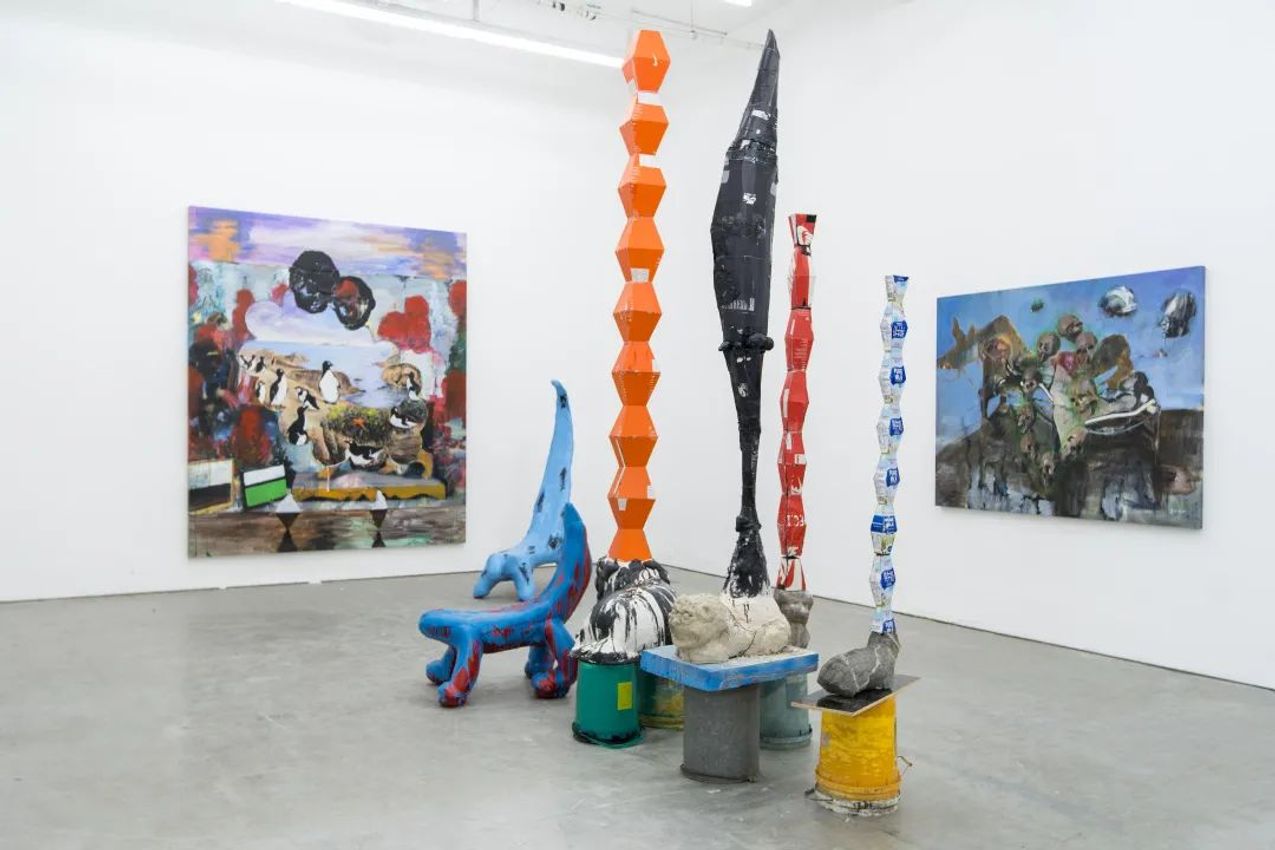
In the exhibition, nine paintings are spaced apart, shaping a ring around five cylindrical sculptures in homage to Brancusi. Meanwhile, the ring compositions in the paintings are in response to the soaring sculptural columns in the center of the exhibition space to conjure an energetic ritualistic site of ‘superstition.’ Zhou’s paintings continue his idiosyncratic style, as well as his whimsical imagery to entice the viewer into his mysterious narratives. Skeleton, an ominous motif that frequently appears in Zhou’s recent paintings, is simply consumed as a decoration by the artist. It perhaps not only alludes to the inevitable tragic ending of Modernism, but also attests an earmark of Italian art historian Germano Celant’s (1940-2020) ‘un-expressionism’ in contemporary art, where artists appropriate various signs and symbols but empty out their connotations.
Modernism was associated with utopian visions of human life as well as a belief in self-criticism and progress. Aesthetically, it rejected sculptural illusion or trompe l’oeil in painting. Flatness and abstraction came to be the dominant styles in the early 20th century in the West. Zhou revisits the devices of trompe l’oeil and integration of sculptural elements in painting by depicting balls and rosaries to create visual illusions. He sometimes attaches objects directly on the pictorial surface.
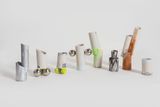
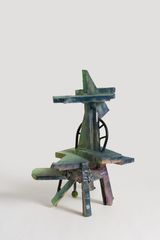
Zhou’s inquiry into the historical realm of Modernism is not without cynicism. His questioning of the problematic notion of ‘primitivism’ is a perfect example. Modernists, such as Picasso, Gauguin and Matisse, ‘invented’ primitivism to authorise themselves as connoisseurs of collecting and categorizing the marginalised, the minoritised, the forgotten, and the displaced people, cultures and folk arts with colonial attitudes. Zhou appropriates this notion, but instead of re-creating the inferior and the less refined experience of Others, he teaches himself to design and make vernacular, improvised, and eccentric DIY furniture/sculpture of his own to dismantle hierarchies of taste and to embrace visceral pleasure in creativity.
In our contemporary time, capitalism, technology and their resulted consumerism have metamorphosed art production and visual culture. In his 2008 essay The American Tornado, Celant reflects on the proliferation of art as decorative luxury products and the demise of critical art: ‘What was the result of thought and analysis, both critical and aesthetic, and offered insight into future developments has now become an object whose only positive outcome is an entity that can be discussed solely in terms of money... [This object is] organized in the expanded chain of museums, some of which pursued growth in order to become the Disneyland of the visual realm.’
In retrospect, humans need ‘superstition.’ Any existence that can be believed may be considered a ‘superstition.’ In 2020, a precarious year, ‘superstition’ in the real world is of a greater significance. Zhou counts on art for auspices, in a hope to offer blessings to everyone and the whole world with his paintings that most closely resemble ‘magic.’


Zhou Yilun was born in 1983 in Hangzhou, China. He graduated from the Oil Painting Department of China Academy of Art in 2006. He currently lives and works in Hangzhou. Zhou’s practice often includes the remake of everyday objects that seem to have become superfluous - from internet pictures to decorative gadgets and furniture. In a lighthearted and unrestricted manner, his work is often a parody of symbols and images in which the artist critically explores the potency of medium. Through dismissing, upsetting, and improvising the relationships between forms and contents, he reexamines forms of production overarched by the monolith of modernism.
Founded in 2004, Beijing Commune is now located in 798 Art Factory, Beijing. Its initial programs were mainly group shows exploring various currents in contemporary art while now it primarily focuses on solo shows to carry on the in-depth research.
Room 101, Bldg.
15, M50 Art Industrial Park
50 Moganshan Road
Shanghai
Tues to Sun
10:00 - 18:00
About Cc Foundation
Cc Foundation is a non-profit organisation initiated by Shanghai-based collector and entrepreneur David Chau in 2015, committing to promoting diversity, inclusivity, and cultural equality in the field of contemporary art on a global scale.
The foundation's project space in Shanghai is a platform for emerging Chinese and international artists to present their own narratives and to engage with both local and global audiences, in a hope to ignite conversations from heterogeneous viewpoints.

A respected voice in contemporary art discourse.
Focusing on ambitious storytelling and insightful art-world commentary. Ocula Magazine publishes in-depth interviews, critical essays and timely analysis on the artists, exhibitions and ideas driving the global art world.
Learn more about Ocula Magazine
Showcasing the best of the art world.
Ocula partners with galleries from around the world to highlight their artists, artworks and exhibitions. Gallery membership is by application and invitation, with each member vetted by an independent panel.
Learn more about Ocula Membership

Specialises in the sale of major artworks.
Led by a team with deep ties to the world’s leading auction houses, galleries and collectors. Ocula’s advisory team offers bespoke services to high-net-worth clients from around the world who are looking to acquire the best of contemporary and modern art.
Learn more about our team and services