




Lee Ufan
b. 1936, South KoreaLee Ufan is a seminal figure in contemporary art, known for a rigorous yet meditative minimalism that rethinks how viewers encounter materials, space, and time. A leading theorist and artist of Japan’s Mono‑ha movement in the late 1960s, he also became a pivotal voice in Korean Dansaekhwa and has been the subject of major retrospectives in Europe, Asia, and the United States, including the landmark exhibition Lee Ufan: Marking Infinity at the Solomon R. Guggenheim Museum in New York in 2011.
Early life and Education
Lee Ufan was born in 1936 in Haman County, South Gyeongsang Province, in what is now South Korea, and came of age amid Japanese colonial rule and the Korean War. He studied painting at the College of Fine Arts at Seoul National University, while also training in calligraphy and poetry, before relocating to Japan in 1956. In Tokyo, he later studied philosophy at Nihon University, immersing himself in both Eastern and Western thought. His early exposure to political upheaval and displacement, combined with philosophical study, underpins his sustained preoccupation with distance, encounter, and the ethics of perception. Today, Lee lives and works between Kamakura, Japan, and Paris, France, and maintains an international practice that spans several continents
Artistic Practice and Philosophy
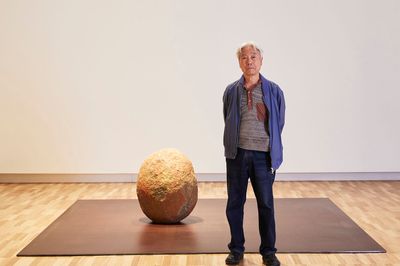
Lee’s practice encompasses painting, sculpture, installation, and extensive critical writing, and is grounded in an “ethics of restraint” that favours sparse interventions over expressive excess. He frequently juxtaposes raw stones with industrial materials such as steel plates, glass, and rubber, placing them in carefully calibrated relationships that draw attention to weight, balance, and the contingencies of a given site. Philosophically, his work is shaped by East Asian thought (including Zen and Confucian traditions) and European phenomenology, focusing on encounter, interval, and what he calls “the world as it is.” Rather than treating artworks as autonomous objects, Lee understands them as open situations in which materials, space, and viewers co‑exist on equal terms. This orientation has made him a key reference point in discussions of global minimalism and postwar abstraction.
Painting Process and Key series
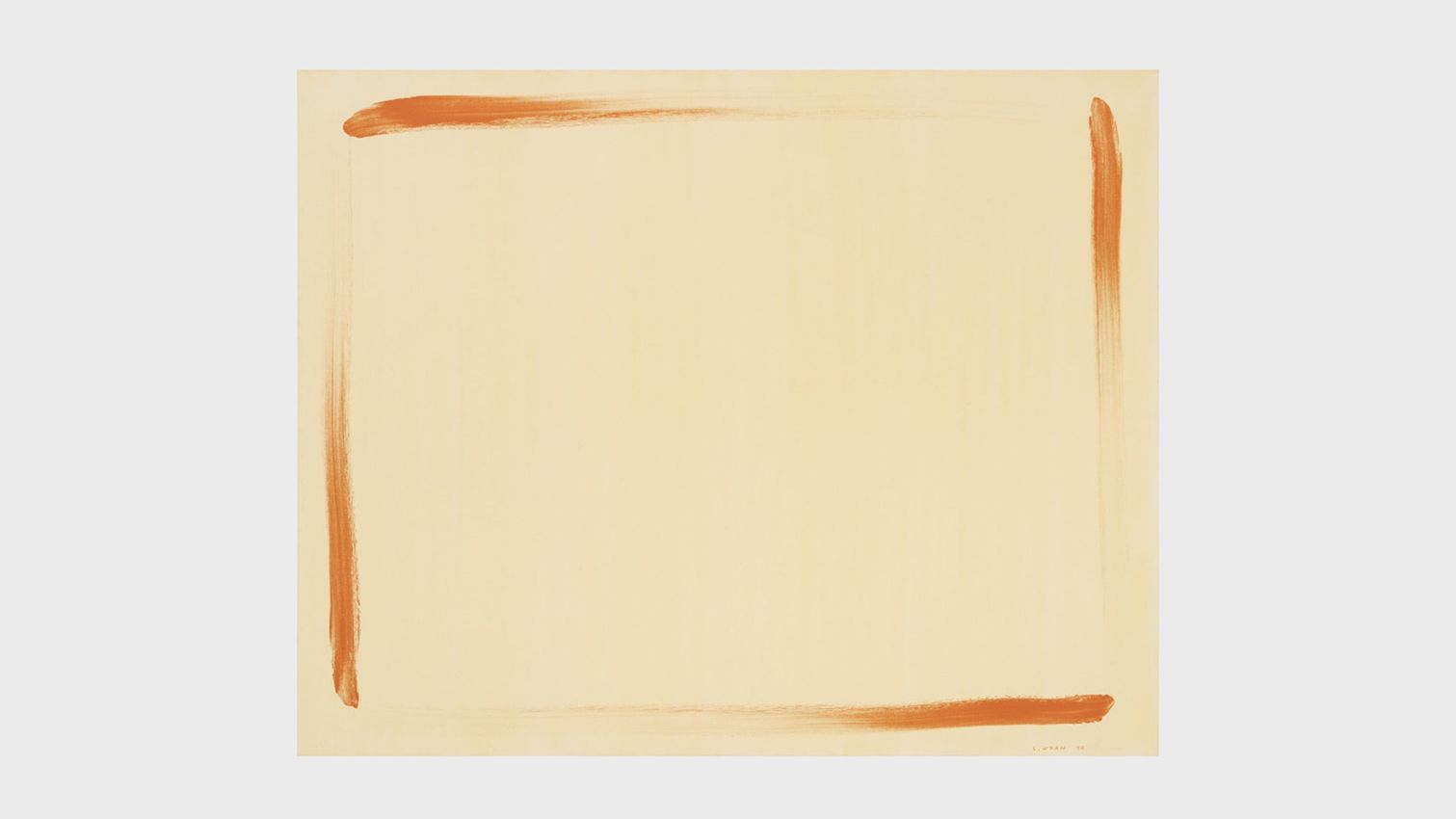
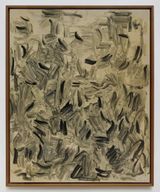
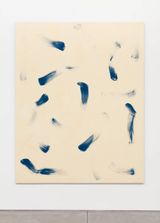
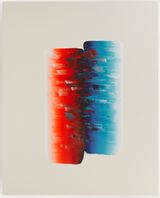
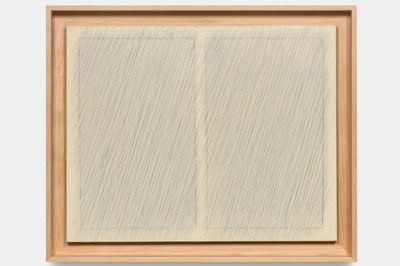
In painting, Lee is best known for the long‑running series From Point and From Line, begun in the early 1970s. Using a brush heavily loaded with a single colour, he applies repeated points or vertical strokes on a white ground, allowing the pigment to gradually fade until the brush runs dry, then resumes the action in measured rows. This repetitive, disciplined process turns each canvas into a record of duration, bodily rhythm, and the gradual exhaustion of gesture rather than a field of expressive marks. Critics have linked these works both to post‑minimal seriality and to Korean Dansaekhwa, where repetitive brushwork and monochrome surfaces embody the passage of time and meditative labour.
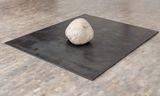
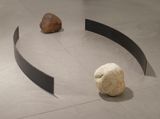
In sculpture and installation, his ongoing Relatum series (a title borrowed from philosophical terminology for “that which is in relation”) consists of dispersed arrangements of stones and manufactured elements, often left to lean, rest, or balance according to their own weight. Works from Relatum disrupt systems of measurement or architectural order, prompting viewers to register subtle shifts in gravity, scale, and bodily orientation. Later series such as Dialogue extend these concerns to painting‑based installations, with a few large, viscous brushstrokes placed directly on the walls of an otherwise empty room, activating the surrounding void.
Mono‑ha, Dansaekhwa and writing
From the late 1960s, Lee emerged as the principal theorist and one of the key artists of Mono‑ha, a Japanese movement that foregrounded “things” in their given state rather than images or narratives constructed by the artist. In essays such as “From Object to Being” (1969) and other critical texts, he formulated a philosophy of encounter in which materials, site, and viewer form a relational field that resists domination by the artist’s will. Mono‑ha’s use of unaltered materials and its scepticism toward modern progress have been read as responses to the collapse of colonial orders and to widespread student and anti‑authoritarian protests in Japan at the time.
In parallel, as his work gained prominence in Seoul in the 1970s, Lee became closely associated with the Korean Dansaekhwa (monochrome) movement, where his iterative, time‑based paintings resonated with artists exploring restraint, repetition, and material presence. Over his career he has published more than a dozen books of philosophy, criticism, and poetry, reinforcing his status as an artist‑philosopher whose writings are frequently cited in museum catalogues and critical essays.
Seminal moments and Major milestones
Several key moments have defined Lee Ufan’s international trajectory.
- In the late 1960s and early 1970s he gained visibility through exhibitions in leading Tokyo galleries and museums, as well as participation in the 1971 Paris Youth Biennale, which helped introduce Mono‑ha to European audiences and led him to establish a studio in Paris.
- Throughout the 1970s and 1980s, his From Point and From Line series consolidated his reputation across Japan and Korea, positioning him as a central figure in postwar Asian abstraction.
- In 2010, the Lee Ufan Museum, designed by Tadao Ando, opened on Naoshima in Japan’s Seto Inland Sea, dedicated to a dialogue between the artist’s work, architecture, and landscape.
- The following year, the Guggenheim’s retrospective Lee Ufan: Marking Infinity (2011) marked his first major U.S. survey, filling the museum’s rotunda and annex galleries with nearly five decades of work; it drew significant critical attention in outlets including Artforum and The New York Times.
More recently, the opening of Lee Ufan Arles, a private museum in the historic centre of Arles, France, has created a permanent European base for his work, underscoring his status as a transnational artist whose practice spans Asia and the West.
Alongside these institutional milestones, Lee’s participation in the Venice Biennale (including representing Korea in the 1990s and subsequent projects), his presence in major collections, and his ongoing collaborations with galleries such as Pace, Lisson, and others have further cemented his influence on contemporary art discourse.
Awards and Accolades
- Officier of the Ordre des Arts et des Lettres, France (2013)
- Praemium Imperiale for Painting, Japan (2001)
- UNESCO Prize for the Promotion of the Arts (2000)
Exhibitions
Lee Ufan has been the subject of major solo exhibitions and included in important group exhibitions at museums around the world.
Solo Exhibitions
- Lee Ufan, Dia Beacon, Beacon, New York ( 2026)
- Lee Ufan, SMAC San Marco Art Centre, Venice, a major presentation of work organised in collaboration with Dia Art Foundation and scheduled during the 2026 Venice Biennale period (Collateral Event)
- Lee Ufan: Quiet Resonance, Art Gallery of New South Wales, Sydney (2024)
- Lee Ufan, Hamburger Bahnhof, Berlin (2023)
- Lee Ufan: 15th Anniversary of the National Art Center, National Art Center, Tokyo (2022)
- Lee Ufan, Dia: Beacon, New York (2019)
- Relatum-Stage, Serpentine Galleries, London (2018)
- Marking Infinity, Solomon R. Guggenheim Museum, New York (2011)
- The Art of Margins, Yokohama Museum of Art, Yokohama, Japan (2005)
Group Exhibitions
- Minimal, Bourse de Commerce – Pinault Collection, Paris (2024–2025);
- Keep Changing, Connect with Everything, Continue Forever, Daegu Art Museum, Daegu, South Korea (2025)
- Icônes, Punta della Dogana, Venice (2024)
- STARS: Six Contemporary Artists from Japan to the World, Mori Art Museum, Tokyo, (2020)
- Formes Simples, Centre Pompidou-Metz, Metz, France (2014)
- Tokyo 1955–1970: A New Avant-Garde, Museum of Modern Art, New York (2012)
- In Praise of Doubt, Punta della Dogana – Francois Pinault Foundation, Venice (2011)
- Void in Korean Art, Leeum, Samsung Museum of Art, Seoul (2007)
Website
Lee Ufan’s website can be found here.
Critical Reception
Lee Ufan’s practice has been covered in leading magazines, including Apollo, Artnet, and Frieze. In 2015, Katie Fallen spoke with the artist for an Ocula Conversation.
Lee Ufan FAQs
Who is Lee Ufan?
Lee Ufan is a Korean‑born, Japan‑based artist, writer, and philosopher known for minimalist paintings, sculptures, and installations that stage precise encounters between materials, space, and viewers. A central figure in the Mono‑ha (“School of Things”) movement in Japan and closely linked to Korean Dansaekhwa, he has significantly shaped postwar art in both countries and across the global contemporary canon. His work has been celebrated in major retrospectives and dedicated museums, including the Lee Ufan Museum on Naoshima and Lee Ufan Arles in France.
What is Lee Ufan’s connection to the Mono‑ha movement?
Lee Ufan is widely regarded as the leading theorist and one of the key artists of Mono‑ha, a Tokyo‑based movement active from the late 1960s into the early 1970s. Mono‑ha artists used raw materials such as stone, glass, wood, and earth in minimally altered configurations to foreground the relationships between “things,” space, and perception rather than personal expression. Through influential essays and critical texts, Lee articulated the movement’s philosophical foundations, drawing on phenomenology and structuralism to argue for art as an encounter with “the world as it is.”
What are Lee Ufan’s most famous works and series?
Lee Ufan is best known for his From Point and From Line painting series and his long‑running Relatum sculptures and installations. In From Point and From Line, begun in the early 1970s, he applies repeated brushstrokes or dots until the pigment fades, turning each canvas into a record of time, gesture, and the gradual exhaustion of movement. The Relatum works, initiated in the late 1960s, juxtapose natural stones with industrial elements like steel plates or glass panes, emphasising balance, weight, and the contingent relations between objects, architecture, and viewers.
Where can I see Lee Ufan’s art today?
Lee Ufan’s works are held in major museum collections worldwide, including Tate, the Guggenheim, and numerous institutions across Asia and Europe. Dedicated spaces such as the Lee Ufan Museum on Naoshima (opened 2010), Space Lee Ufan at Busan Museum of Art (opened 2015), and Lee Ufan Arles in France offer sustained encounters with his sculptures, paintings, and site‑responsive installations. His work is also regularly featured in solo and group exhibitions at museums and galleries, as well as in long‑term installations at venues like Dia Beacon and leading global galleries.
What is the philosophy behind Lee Ufan’s minimalist style?
Lee Ufan’s work is grounded in East Asian philosophy (including Zen Buddhism and Confucianism) and European phenomenology, which together emphasise emptiness, interval, and relational experience. He advocates an “ethics of restraint,” limiting his interventions so that materials, surroundings, and viewers co‑create the artwork rather than being dominated by the artist’s will. For Lee, art is less about self‑expression than about opening a reflective space where people can sense “the world as it is” through subtle shifts in distance, time, and perception.
Ocula | 2026

Explore Lee Ufan's Exhibitions On Now




















Lee Ufan in Ocula Magazine







Explore and Follow Artists Shaping Contemporary Art
A respected voice in contemporary art discourse.
Focusing on ambitious storytelling and insightful art-world commentary. Ocula Magazine publishes in-depth interviews, critical essays and timely analysis on the artists, exhibitions and ideas driving the global art world.
Learn more about Ocula Magazine
Showcasing the best of the art world.
Ocula partners with galleries from around the world to highlight their artists, artworks and exhibitions. Gallery membership is by application and invitation, with each member vetted by an independent panel.
Learn more about Ocula Membership
Specialises in the sale of major artworks.
Led by a team with deep ties to the world’s leading auction houses, galleries and collectors. Ocula’s advisory team offers bespoke services to high-net-worth clients from around the world who are looking to acquire the best of contemporary and modern art.
Learn more about our team and services