




MARK GROTJAHN
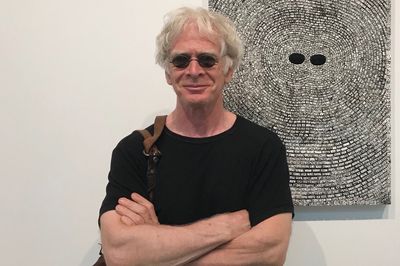
b. 1968, United StatesMark Grotjahn is a contemporary American artist known best for his gestural and geometric paintings, drawings, and sculptures that combine abstract and figurative elements.
Grotjahn graduated with a BFA from the University of Colorado Boulder and went on to receive his MFA from the University of California, Berkeley in the 1990s. While studying for his MFA, he began his first major series of artworks, titled ‘Sign Exchange’ (1993–1998), in which he faithfully painted local store signs in Los Angeles. He would arrange with the relevant store-owners to swap his paintings for the original signs, thereby creating a twist in which the painting was displayed in the shop-front while the actual sign was available for exhibition.
During the late 1990s, Grotjahn began working on a series of densely worked coloured-pencil drawings, and later oil paintings, that investigated perspective and vanishing points. Untitled (Three-Tiered Perspective) (1997), for example, is a coloured-pencil drawing that depicts two stacks of horizontal bands, with elongated triangles that recede into a vanishing point above and below. To create works like this, the artist devised a system that was driven by both chance and rules; he would first map out a triangular radius in black pencil, then complete the work with a pencil selected at random from a pre-chosen set of colours.
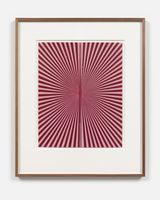
Grotjahn’s methodical approach fed ‘Butterfly’ (2001–2008), his next significant series of paintings. The series—exhibited in shows at institutions such as the Hammer Museum in Los Angeles (2005) and the Los Angeles County Museum of Art (2018)—comprises geometric coloured-pencil drawings and oil paintings. A typical ‘Butterfly’ artwork features a vertical line with a vanishing point on either side, from which triangular bands of colour radiate. The colour scheme and the number of perspectives vary, ranging from the two-perspective, monochromatic Untitled (Green Butterfly) (2002) to the multi-coloured, multi-perspectival Untitled (large coloured butterfly white background 10 wings) (2004).
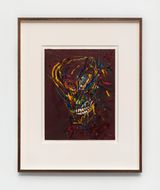
In 2003, Grotjahn began ‘Face’, a series that continued his interest in perspective while incorporating an investigation of form and symmetry. ‘Face’ consists of paintings that each appear to depict the geometrical structures of the face: almond-shaped eyes, elongated noses, round nostrils, and mouths. They are executed by applying and building up energetic strokes of paint upon cardboard, which in turn is mounted on canvas. Around this time, the artist also began making masks from salvaged cardboard boxes, attaching paper tubes and other appendages to evoke human features. In 2010, he began casting his ‘Masks’ in bronze and painting over them in thick impasto. In 2014 the Nasher Sculpture Center in Dallas presented the first museum exhibition of these sculptures.
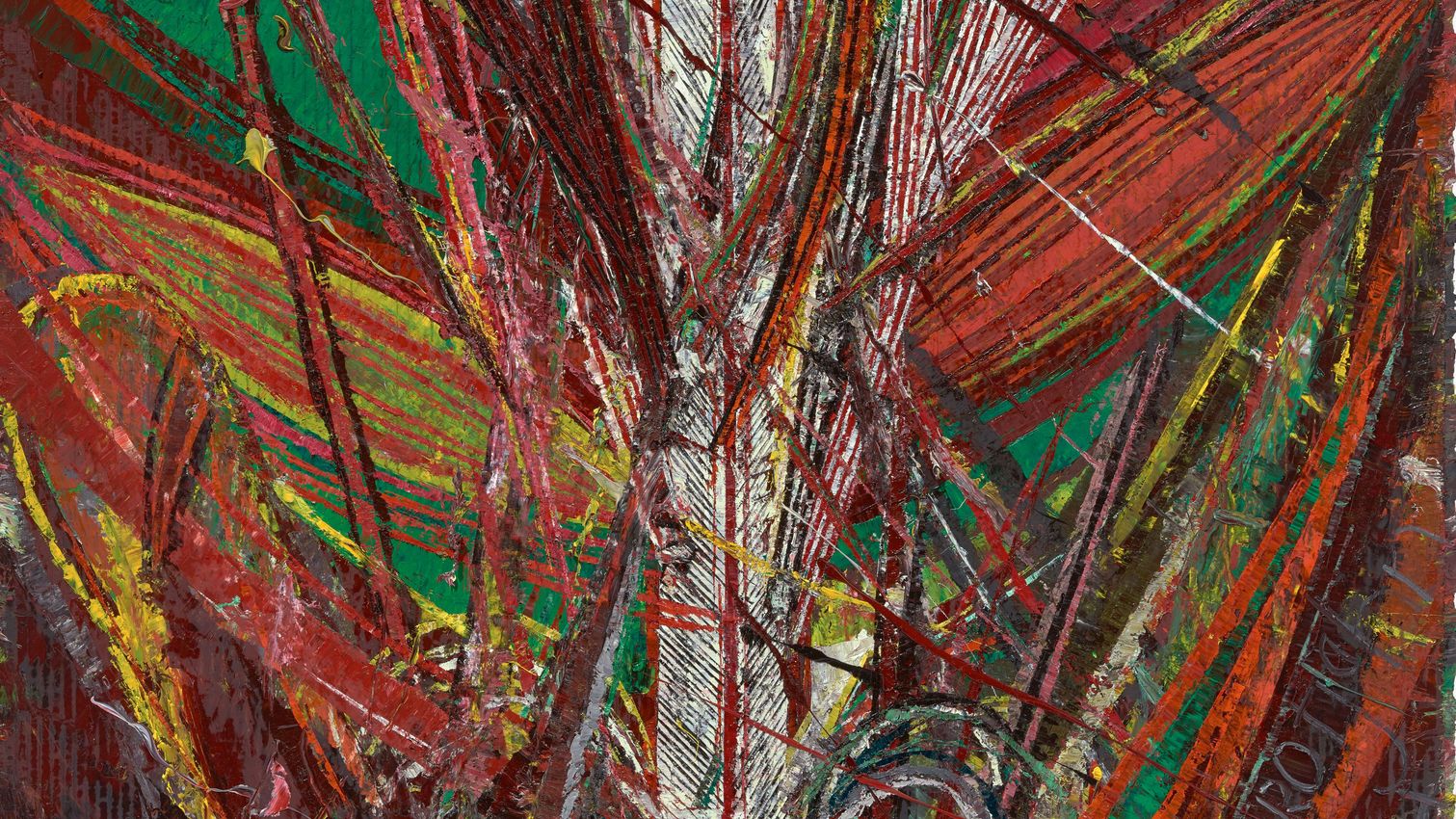
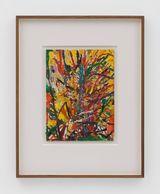
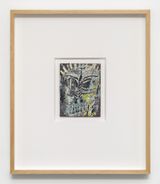
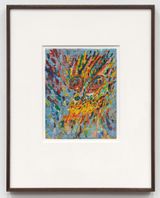
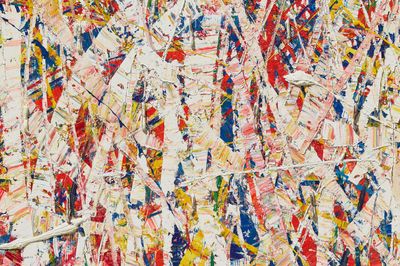
Grotjahn continues to explore mark-making and abstraction in his interconnected series ‘New Capri’, ‘Capri’, and ‘Free Capri’. Compared to his ‘Face’ paintings, these more recent bodies adopt a more experimental and spontaneous approach, using the paintbrush and palette knife to create marks evocative of Abstract Expressionist paintings. ‘New Capri’ (2016–ongoing) includes small-scale paintings on cardboard framed behind glass, while in ‘Capri’ (2016–ongoing) horizontal and vertical lines intersect one another on canvas. In ‘Free Capri’ (2018–ongoing), a grid of tally marks overlaps with underlying vibrant and expressive lines.
Ocula | 2019






Explore Mark Grotjahn's Exhibitions








Explore and Follow Artists Shaping Contemporary Art
A respected voice in contemporary art discourse.
Focusing on ambitious storytelling and insightful art-world commentary. Ocula Magazine publishes in-depth interviews, critical essays and timely analysis on the artists, exhibitions and ideas driving the global art world.
Learn more about Ocula Magazine
Showcasing the best of the art world.
Ocula partners with galleries from around the world to highlight their artists, artworks and exhibitions. Gallery membership is by application and invitation, with each member vetted by an independent panel.
Learn more about Ocula Membership
Specialises in the sale of major artworks.
Led by a team with deep ties to the world’s leading auction houses, galleries and collectors. Ocula’s advisory team offers bespoke services to high-net-worth clients from around the world who are looking to acquire the best of contemporary and modern art.
Learn more about our team and services