‘Will the painting survive the extraordinary multiplication of screens? How can it resist the dispersed practices of contemporary art?’–Daniel Dezeuze
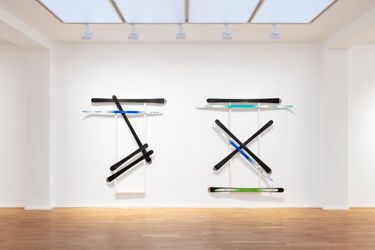
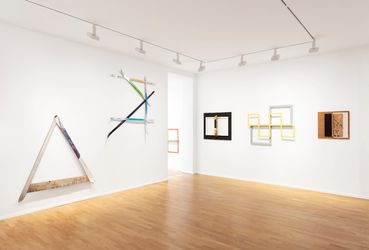
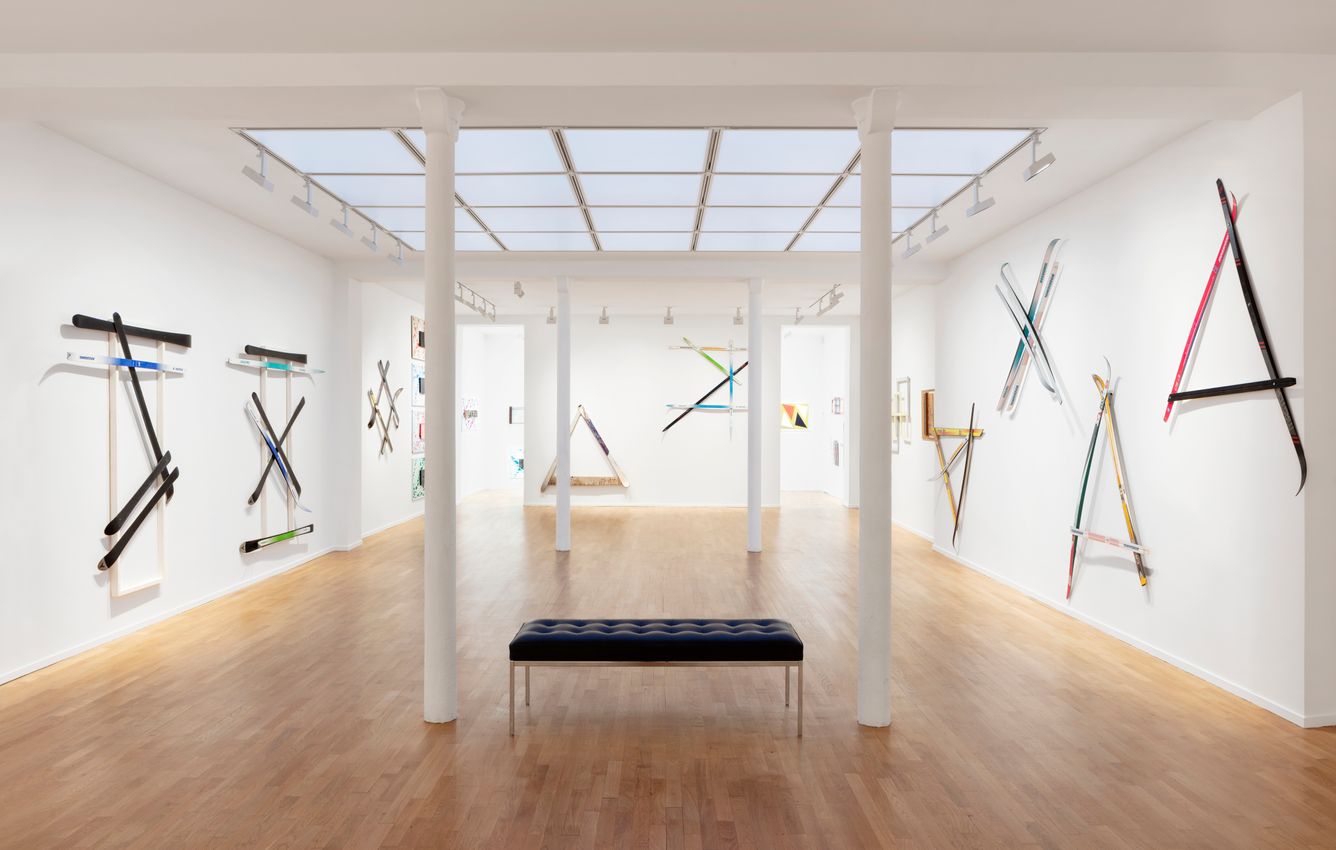
Daniel Dezeuze returns to Galerie Templon this season with a series of hybrid works lying at the intersection of painting and sculpture. Imbued with a more radical outlook than ever, Écrans/Tableaux: Variations continues to question the role, history and practice of painting and sets the stage for a new exploration, marked by the triumph of digital and proliferation of screens.
The dichotomy between screens and paintings has fascinated Dezeuze since the 1960s. When he was teaching at the University of Toronto, Dezeuze discovered the work of celebrated theorist Marshall McLuhan, a pioneer in research on new mass media and the growing incursion of screens. Daniel Dezeuze recognised in MacLuhan’s ideas his own intuition that technology was in the process of revolutionising painting. A founding member of the Supports/Surfaces avant-garde group, he worked on the deconstruction of traditional painting codes by removing the stretcher from the canvas, which he turned against the wall to play with the notions of full and empty.
With Écrans/Tableaux: Variations, Dezeuze takes us into a universe of supports that are repurposed and taken in new directions with a particular focus on the third dimension. These assemblages become enigmatic calligraphies and paintings. For Daniel Dezeuze, the discreet omnipresence of the screen in his work refers not only to the symptoms of a dematerialised, elusive society, dancing to the tune of the moving image, algorithms, artificial light and colour. His work goes further and provides a glimpse of an art capable of pushing back its own codes and reinventing itself: ‘my journey lies within the historical space of the painting, which is both a real object and an object of knowledge. For me, the love of painting involves a restrained sensuality, revitalised formalism and an artistic attempt that is open in its variations.’
Born in 1942 in Alès, Daniel Dezeuze lives and works in the southern French port town of Sète. His work has been widely exhibited since the 1970s in France and internationally. In 2008, he exhibited the entire span of his work at the Musée Paul Valéry in Sète. More recently, the FRAC Languedoc Roussillon in Montpellier held a major exhibition of his drawings in 2015. His work has also been exhibited in the Cherry and Martin Gallery in Los Angeles and New York’s Canada Gallery (2014), MAMAC in Nice (2012), Centrale Electrique in Brussels (2009) and Musée Fabre in Montpellier (2009). In 2017, he took part in the group exhibitions Supports/Surfaces, The Origins at the museum Carré d’art in Nîmes and The Surface of the East Coast, From Nice to New York at Le 109 art centre in Nice. The Musée de Grenoble organised a major retrospective of his art in 2018.
His oeuvre is now influencing an entire new generation of American painters and receiving renewed critical attention from across the Atlantic.


Born in 1942 in Alès, France, Daniel Dezeuze was one of the founding members of the Supports/Surfaces group in the 1970s. His work seeks to explore and question the concepts that underpin painting, galleries and space. The artist appropriates a wide variety of techniques, offering a reinterpretation of American art, both abstract and minimalist, while constantly experimenting with what are seen as basic materials: net, metal gauze, wood, fabric and metal.


The gallery was founded in 1966 by Daniel Templon, who was then only 21. It first opened rue Bonaparte, in Saint-Germain-des-Prés in Paris, before moving in 1972 to its current location, rue Beaubourg, in the Marais, close to the Pompidou Centre, which opened in 1977. Daniel Templon first gained recognition by exhibiting conceptual and minimal artists such as Martin Barré, Christian Boltanski, Donald Judd, Joseph Kosuth, Richard Serra. In the seventies and eighties, Daniel Templon was one of the pioneers of the contemporary art and introduced many important American artists to the French public: Dan Flavin, Ellsworth Kelly, Willem de Kooning, Frank Stella, Andy Warhol. The gallery quickly became one of the references in contemporary art in France. In 1972, Daniel Templon and Catherine Millet co-founded the monthly art magazine ART PRESS.

A respected voice in contemporary art discourse.
Focusing on ambitious storytelling and insightful art-world commentary. Ocula Magazine publishes in-depth interviews, critical essays and timely analysis on the artists, exhibitions and ideas driving the global art world.
Learn more about Ocula Magazine
Showcasing the best of the art world.
Ocula partners with galleries from around the world to highlight their artists, artworks and exhibitions. Gallery membership is by application and invitation, with each member vetted by an independent panel.
Learn more about Ocula Membership

Specialises in the sale of major artworks.
Led by a team with deep ties to the world’s leading auction houses, galleries and collectors. Ocula’s advisory team offers bespoke services to high-net-worth clients from around the world who are looking to acquire the best of contemporary and modern art.
Learn more about our team and services