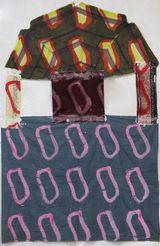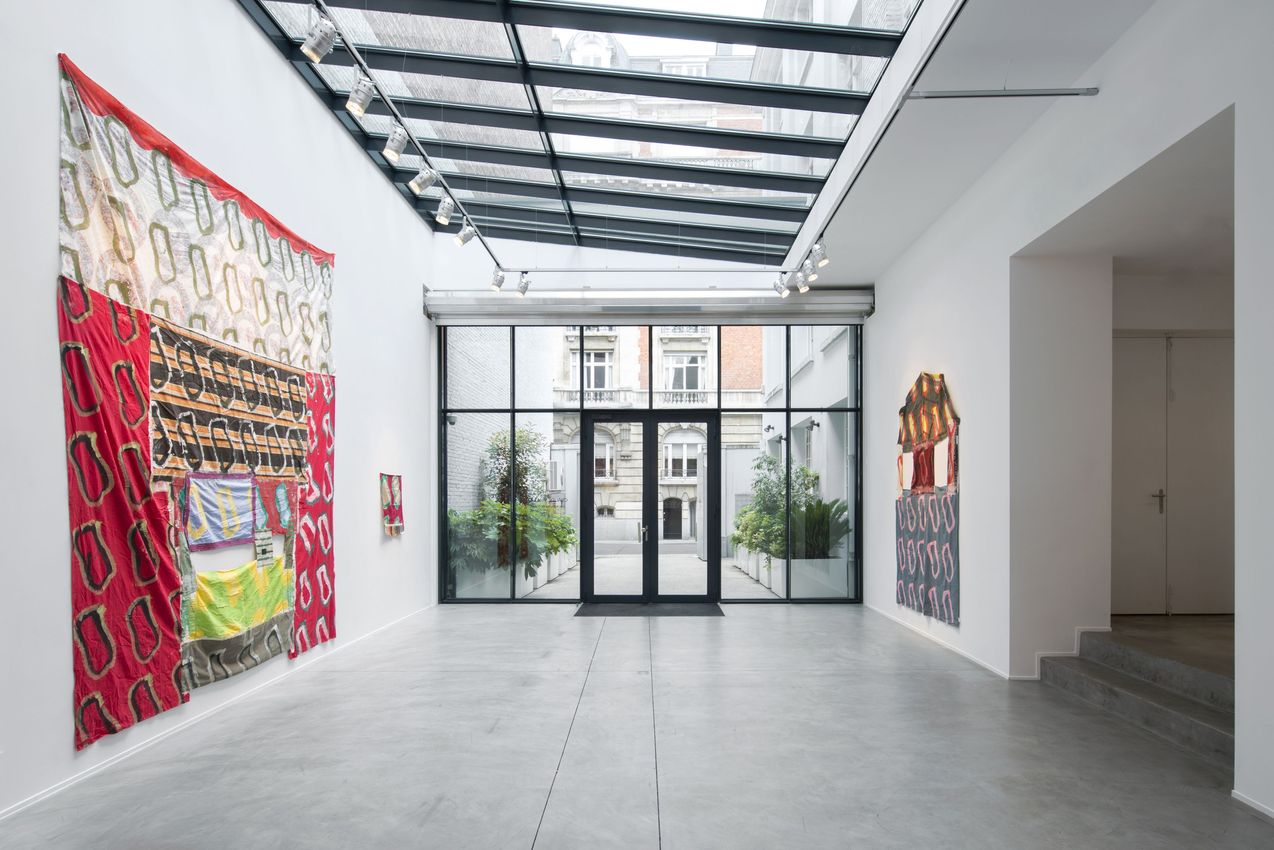
Galerie Templon, who has been working with Claude Viallat since 1973, is presenting a series of previously unseen works by the artist in its Brussels space. Les echelles de Nîmes highlights a lesser-known side of the founder of the Supports/Surfaces movement’s work, the pieces playing with volume and space, far from all conventional representations of how art is displayed.
Yves Michaud recalls that Claude Viallat ‘often paints on surfaces that are actually flattened or enlarged envelopes of spaces.’ In Les echelles de Nîmes, moving between positive and negative, canvas straps and emptiness, Claude Viallat’s unmistakable signature small bone shape is no longer evenly painted. With these pieces, the artist once again explores the theme of the ladder, an element (painting or object, made of rope, canvas or gauze) that links ground to wall, often used in the Supports/Surfaces movement, particularly by Daniel Dezeuze.
The name of the series refers to the artist’s Echelles de Venise from 1976, a period when Claude Viallat’s artistic approach became more complex: the material is broken up by an assemblage of fabrics with a variety of origins, the support and its seams dictating the composition and structure of the canvas.
Created in Nîmes-where the artist was born in 1936 and continues to live and work-the new pieces show the extraordinary vitality, the unstoppable creative urge of an artist who works in his studio every day. The exhibition provides yet another demonstration of Claude Viallat’s ability to reinvent himself: he works from that same, always identical abstract form he has been repeating for fifty years, in a ceaseless process where the support plays a determining role, yet every painting is unique.
Claude Viallat is one of the founders of the Supports/Surfaces avant-garde artistic movement that emerged in the early 1970s, propounding both art theory and politics. Figures in the movement included Vincent Bioulès, Louis Cane, Daniel Dezeuze, Jean-Pierre Pincemin and Noël Dolla. They called for a fresh approach to art that questioned traditional materials such as the canvas and the stretcher. Viallat began working on industrial tarpaulins without stretchers, covering them with the same endlessly-repeated abstract shape. Reproduced using a stencil, in a variety of colours and on different surfaces (upholstery fabrics, rugs, recycled materials), the motif eradicates the notion of ‘subject’ and enables Claude Viallat to explore the meaning of the creative gesture and the status of the work of art.
Claude Viallat has been a leading figure on the contemporary art scene for the last fifty years. He represented France at the Venice Biennale in 1988. Today, Claude Viallat is an artist who cannot be ignored. His approach is all the more current in the light of the emergence of a new movement in American art that is examining his heritage (low-status materials, repetitions, the error as operating principle, exploring new surfaces) as well as the renewed interest in vernacular and artisanal practices evident in international contemporary art. His works are featured in numerous public collections, including at the Musée National d’Art Moderne de la Ville de Paris, Mnam–Centre Pompidou, and Moma in New York. The Musée Fabre in Montpellier held a major retrospective of his work in the summer of 2014. A major installation Claude Viallat first created in 1982 will be exhibited this year at Art Basel Unlimited 2018.
Claude Viallat was born in 1936 in Nimes, France, where he continues to live and work. He is one of the founders of the Supports/Surfaces movement in the 1970s, which called for art to renew itself through a deconstruction of traditional materials. Viallat started to work on industrial tarp, endlessly repeating the same abstract pattern, resembling a small bone, which became his signature. Stencilled repeatedly onto a range of supports, the pattern asks us to reflect on the meaning of the creative act and the status of the work of art.
The gallery was founded in 1966 by Daniel Templon, who was then only 21. It first opened rue Bonaparte, in Saint-Germain-des-Prés in Paris, before moving in 1972 to its current location, rue Beaubourg, in the Marais, close to the Pompidou Center, which opened in 1977. Daniel Templon first gained recognition by exhibiting conceptual and minimal artists such as Martin Barré, Christian Boltanski, Donald Judd, Joseph Kosuth, Richard Serra. In the seventies and eighties, Daniel Templon was one of the pioneers of the contemporary art and introduced many important American artists to the French public: Dan Flavin, Ellsworth Kelly, Willem de Kooning, Frank Stella, Andy Warhol. The gallery quickly became one of the references in contemporary art in France. In 1972, Daniel Templon and Catherine Millet co-founded the monthly art magazine ART PRESS.

A respected voice in contemporary art discourse.
Focusing on ambitious storytelling and insightful art-world commentary. Ocula Magazine publishes in-depth interviews, critical essays and timely analysis on the artists, exhibitions and ideas driving the global art world.
Learn more about Ocula Magazine
Showcasing the best of the art world.
Ocula partners with galleries from around the world to highlight their artists, artworks and exhibitions. Gallery membership is by application and invitation, with each member vetted by an independent panel.
Learn more about Ocula Membership

Specialises in the sale of major artworks.
Led by a team with deep ties to the world’s leading auction houses, galleries and collectors. Ocula’s advisory team offers bespoke services to high-net-worth clients from around the world who are looking to acquire the best of contemporary and modern art.
Learn more about our team and services