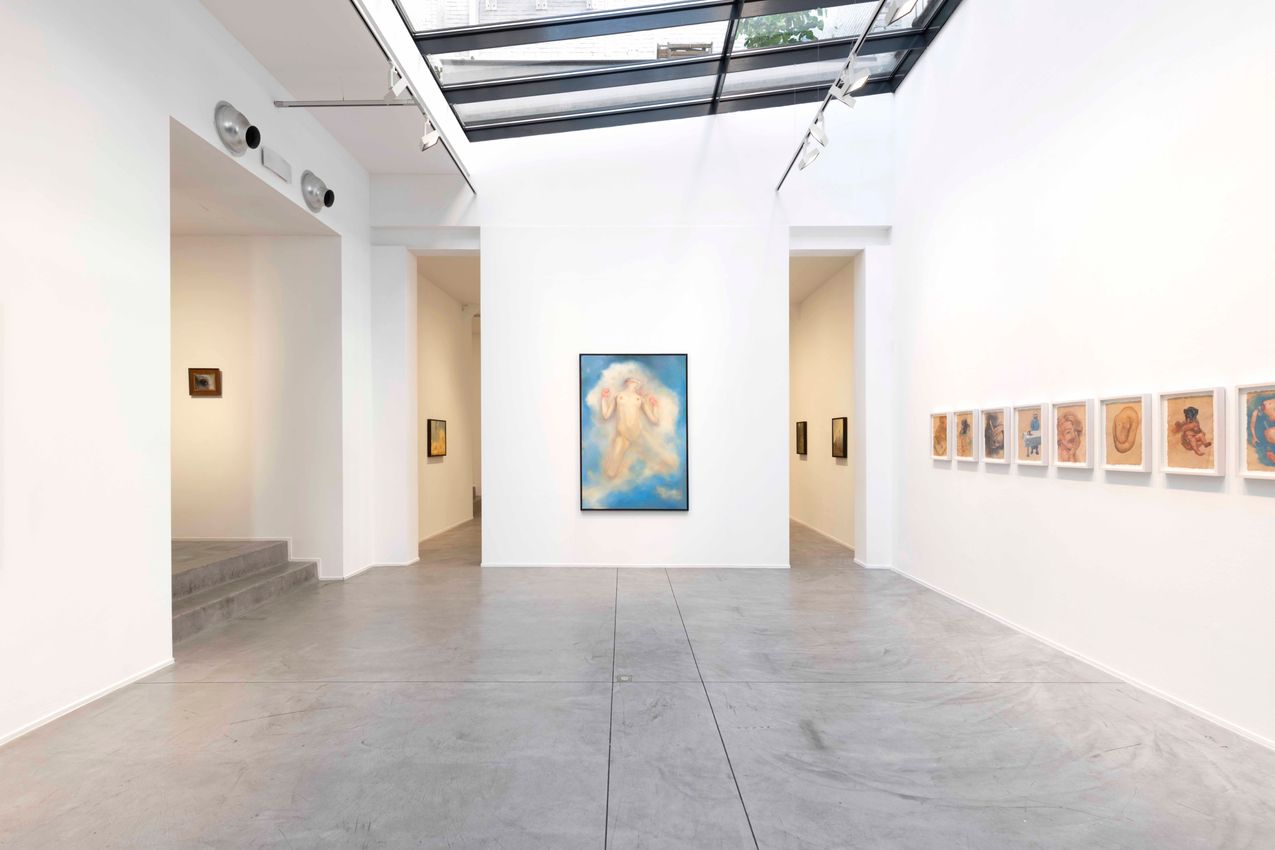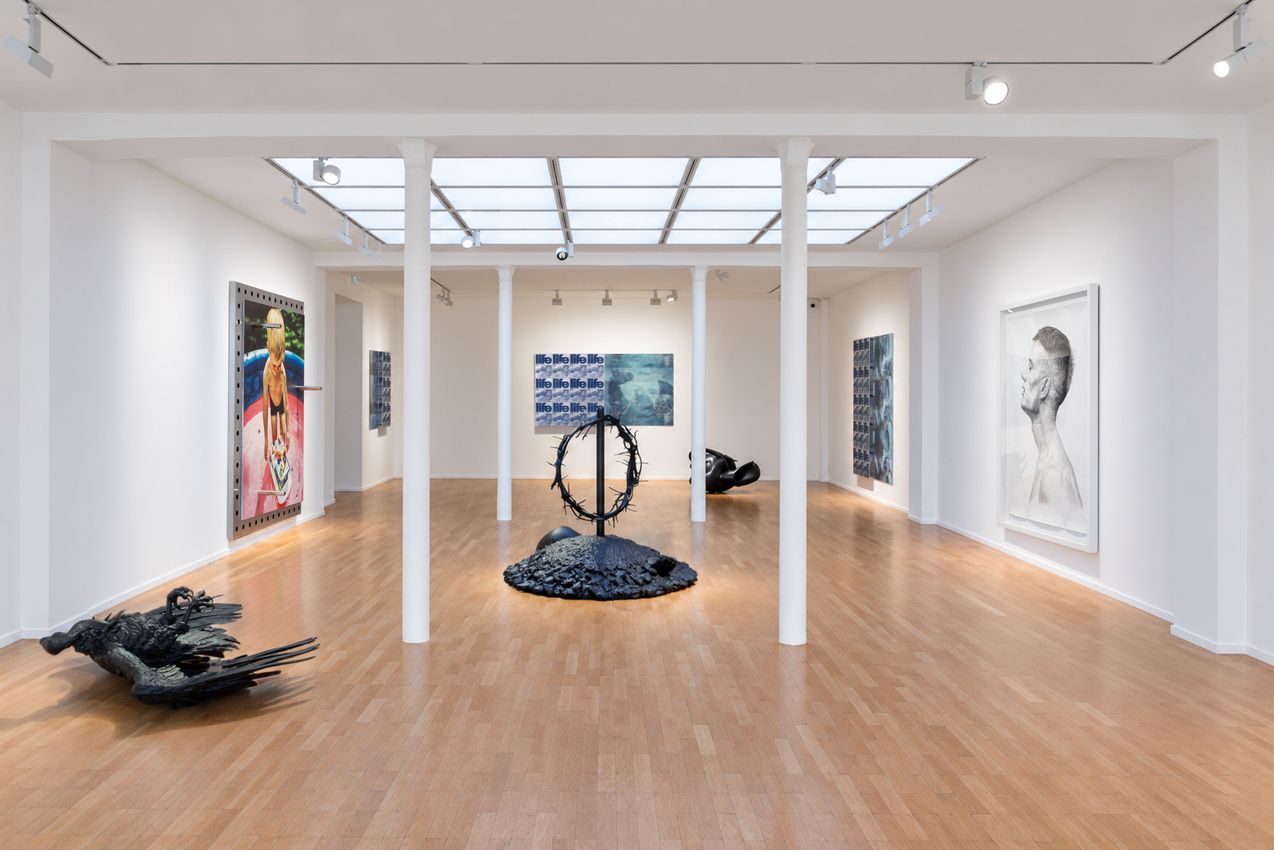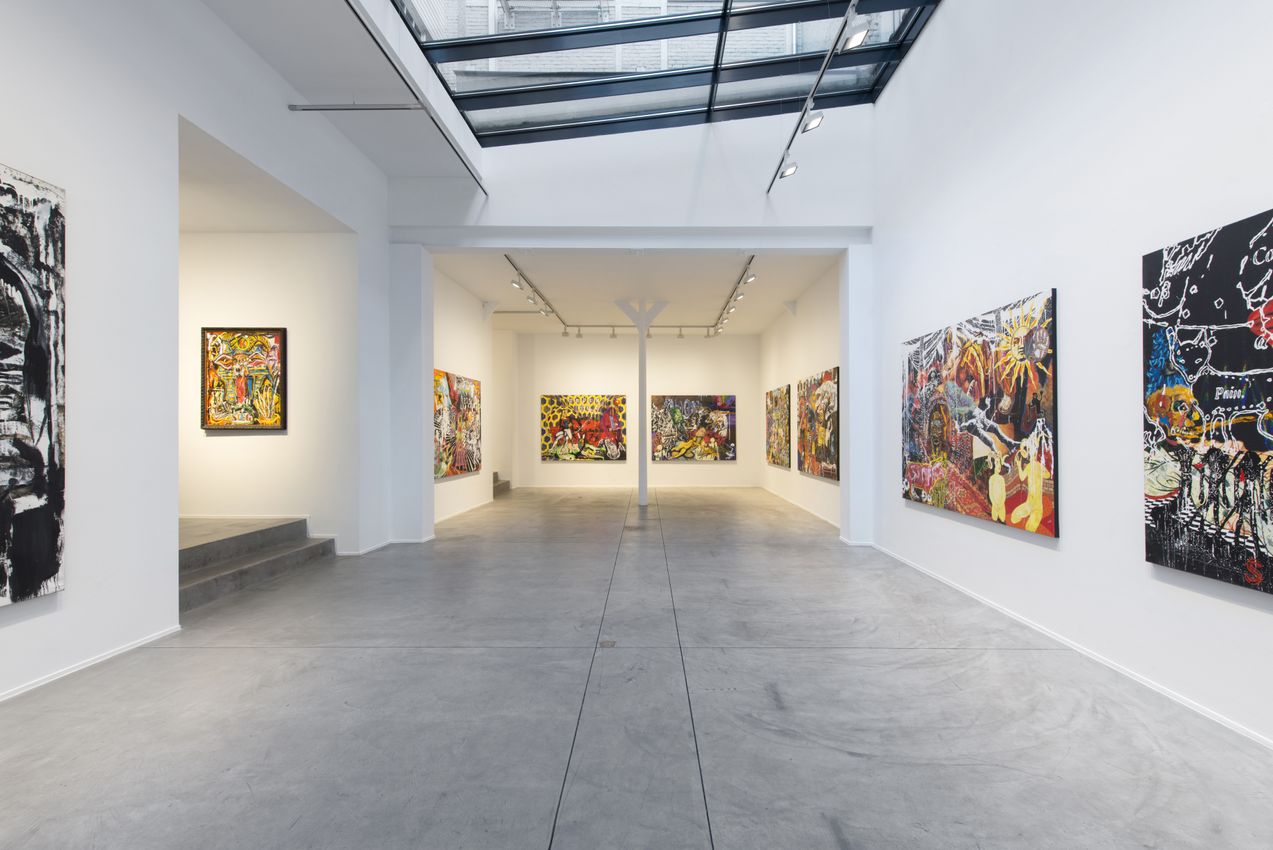
For the first time at Galerie Templon, young maverick painter Orsten Groom is presenting a series of canvases as spectacular as they are unclassifiable. The work offers a guttural, offbeat interpretation of history through the iconoclastic prism of images.
Untitled SIEG MHUND KALUMNIATOR, the exhibition features an evolving series of large-format canvases, like mural frescoes, centring on Freud and Moses, as well as an improbable canine pun. Describing his practice as ‘post-historical cave art’, Orsten Groom proceeds by concatenating iconographic references, from Egyptian bas-reliefs to Andy Warhol. He interweaves his jubilant compositions with effects created by superimposition and perspective, revealing complex and unexpected connections on works to be enjoyed with 3D glasses.
Born in 1982 in Guyana, Orsten Groom is a multidisciplinary artist of Russian-Polish origins. At the age of 20, he suffered a ruptured aneurysm while studying at the Beaux-Arts in Paris which left him amnesic and epileptic. During his convalescence he learned that he was a painter and returned to art school, studying with French painters François Boisrond and Jean-Michel Alberola. From that moment on, he positioned himself as a fiercely independent artist, developing a protean body of work that reaches beyond painting to embrace music, sculpture, film and poetry. In 2020, the Centre d’Art ACMCM (A Cent Mètres du Centre du Monde) in Perpignan held the very first retrospective dedicated to his work.
In 2021, he took advantage of the Covid-induced siege situation to open the Cabinet Chrome Dinette with Olivier Kaeppelin, an undercover private showroom at a secret Parisian address.
The SIEG MHUND KALUMNIATOR exhibition presents the painter Orsten Groom at the Templon gallery for the first time, with the CHROME DINETTE series. This evolving body of work of large canvases dedicated to Freud and Moses (under the aegis of Frank Zappa and villainous poodles) frames–according to Orsten Groom - History in its entirety, from its monotheistic birth to the collapse of 1939, as Freud publishes his testament book:
The Man Moses and the Monotheistic Religion.
Freud announces there in fanfare that Moses was never a Jew but an Akhenaten emulator, whom the Hebrews murdered after they left Egypt to replace him with a prophetic and iconoclastic Doppelganger. Freud dies the same year of a jaw cancer.
But his ultimate manuscript turns up to be a bizarre story dedicated to his favorite poodle: Topsy Chow-Chow, who also suffered from jaw cancer and on whom Freud apparently made a typical and fatal psychoanalytical transfer...
The patriarch of psychoanalysis (the cure by the word) thus perishes by the mouth, alike his dog after having dedicated his last book to the stuttering prophet of the primal iconoclasm - in a bizarre buccal agreement.
CHROME DINETTE thus concatenates nearly 5000 years of History and history of forbidden images, according to two pictorial principles: the laws of Egyptian Bas-relief and the Freudian definition of hallucination: sharp, flat and hyper-realistic.Orsten Groom undertakes this particular thickness of the surface where figures from the biblical narrative and the Freudian corpus come to frolic, by a variety of writings going from the well- named “transfer” to multiple pictorial techniques, in a hypnotic stuff that the artist proposes to confront with 3D glasses.
This grotesque investigation of History and the iconoclastic status of images owes its title to an astonishing coincidence noted by Orsten Groom in a Frank Zappa song entitled Sofa (Divan in German), which stunningly features poodles singing in German (Freud’s idiom) this wild cosmic imprecation: ‘Ich bin der Chrome Dinette’.
In his investigation about language, orality and awry mouths in the mode of slander (in the cursed sense of ‘bad speech’), Orsten Groom points out that Sigmund’s first name itself is to hold Mund and Hund–Mouth and Dog)–as a play on words. SIEG MHUND thus barks the victory of the dog’s mouth over History–painting as a language against the unconscious.
The CHROME DINETTE series, on-going and experimental, proposes fifteen large canvases, followed by some COMMANDMENTS: ten small formats dictated for the Brussels exhibition.


The gallery was founded in 1966 by Daniel Templon, who was then only 21. It first opened rue Bonaparte, in Saint-Germain-des-Prés in Paris, before moving in 1972 to its current location, rue Beaubourg, in the Marais, close to the Pompidou Center, which opened in 1977. Daniel Templon first gained recognition by exhibiting conceptual and minimal artists such as Martin Barré, Christian Boltanski, Donald Judd, Joseph Kosuth, Richard Serra. In the seventies and eighties, Daniel Templon was one of the pioneers of the contemporary art and introduced many important American artists to the French public: Dan Flavin, Ellsworth Kelly, Willem de Kooning, Frank Stella, Andy Warhol. The gallery quickly became one of the references in contemporary art in France. In 1972, Daniel Templon and Catherine Millet co-founded the monthly art magazine ART PRESS.

A respected voice in contemporary art discourse.
Focusing on ambitious storytelling and insightful art-world commentary. Ocula Magazine publishes in-depth interviews, critical essays and timely analysis on the artists, exhibitions and ideas driving the global art world.
Learn more about Ocula Magazine
Showcasing the best of the art world.
Ocula partners with galleries from around the world to highlight their artists, artworks and exhibitions. Gallery membership is by application and invitation, with each member vetted by an independent panel.
Learn more about Ocula Membership

Specialises in the sale of major artworks.
Led by a team with deep ties to the world’s leading auction houses, galleries and collectors. Ocula’s advisory team offers bespoke services to high-net-worth clients from around the world who are looking to acquire the best of contemporary and modern art.
Learn more about our team and services