



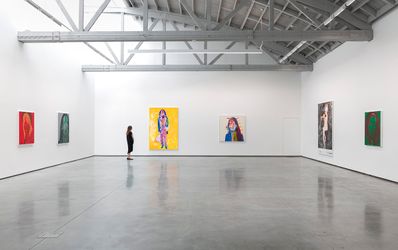
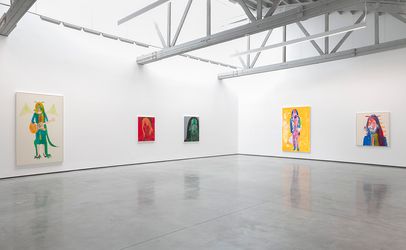
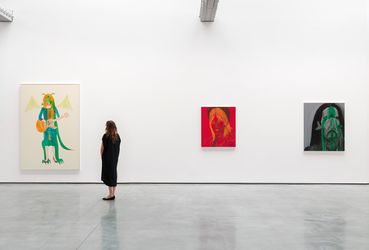
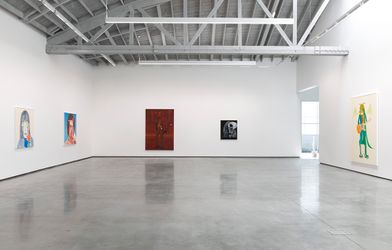
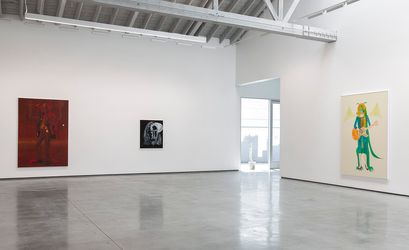
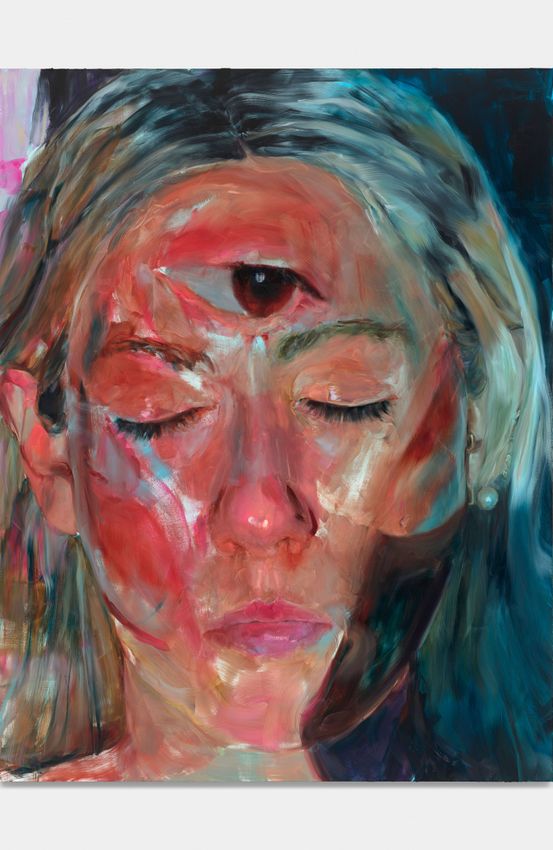
David Kordansky Gallery is pleased to present its first exhibition of paintings by Jason Fox. The show will be on view at the gallery from May 26 through July 11, 2020.
Starting on Tuesday, May 26 the gallery will be open by appointment only. Virtual visits and programs are also available here. Please contact our team here or email sales@davidkordanskygallery.com.
For more than 30 years, Jason Fox has been creating a personal, idiosyncratic, and risk-taking vision of painting. His work has evolved organically, with a cast of recurring characters slowly shifting over time. Fox’s earliest paintings—which appeared frequently at Feature Inc., among other galleries—moved against the grain of the appropriation-based and conceptual methodologies dominant in the 1990s. These works were filled with imaginary beings informed by his simultaneous interests in the sweep of art history and pop cultural touchstones like Marvel comic books and rock album covers. Over the last few years, however, he has begun to incorporate recognisable figures from cultural life.
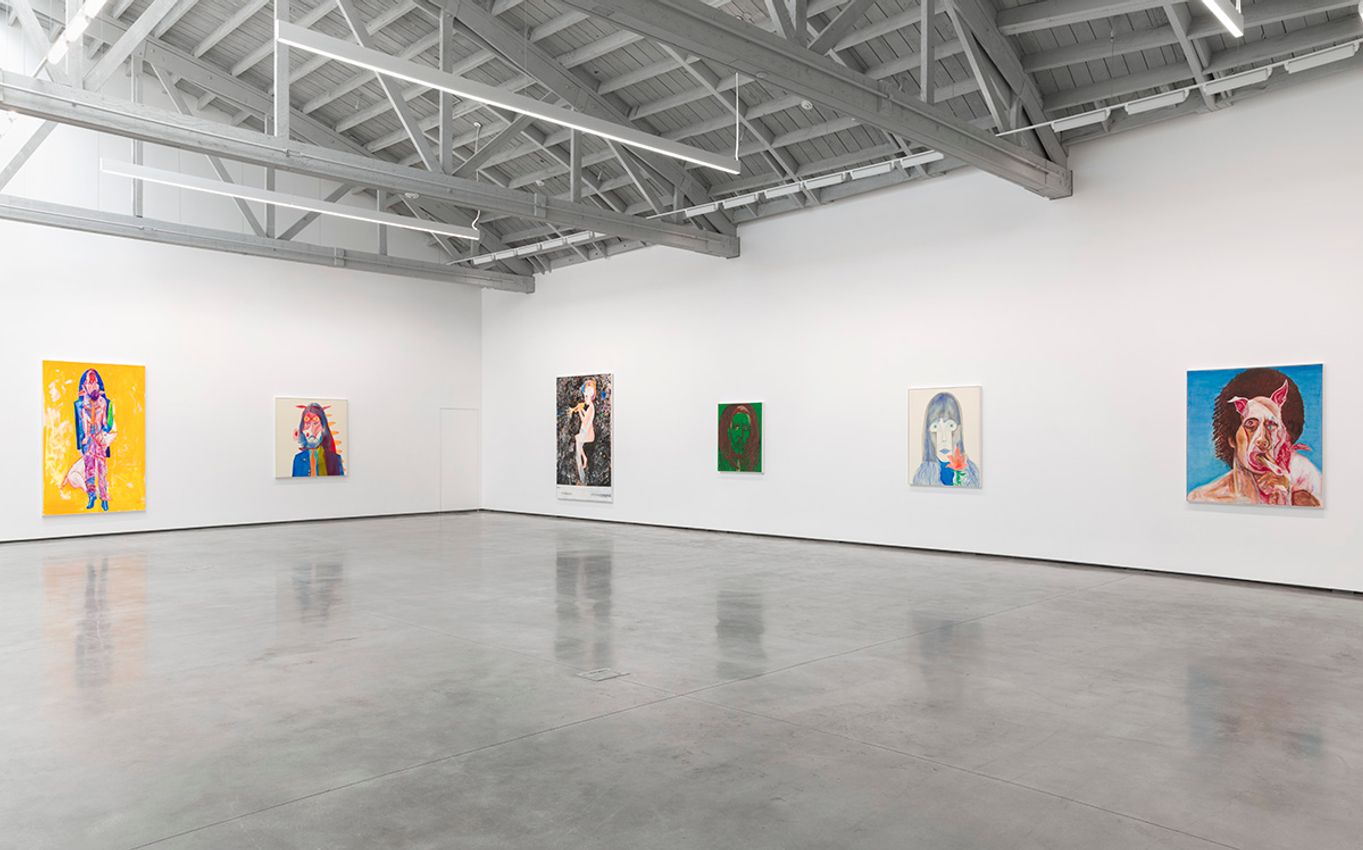
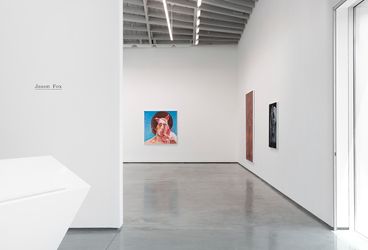
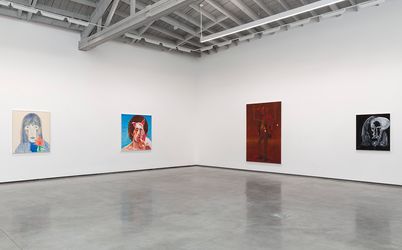
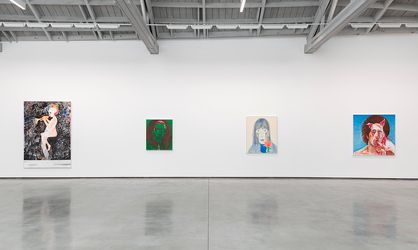
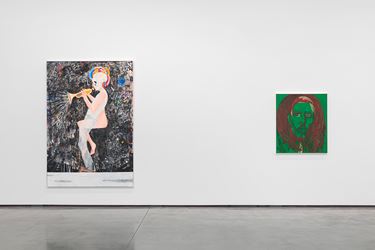
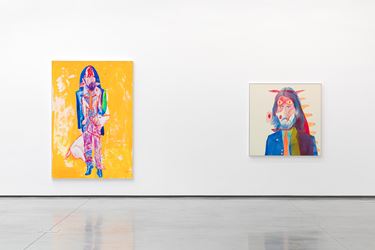
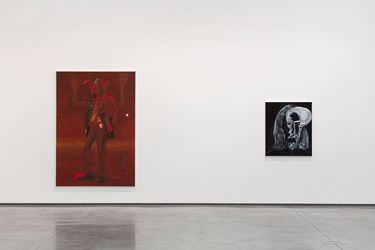
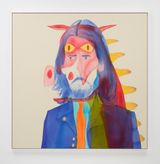
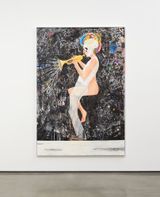
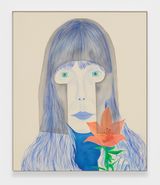
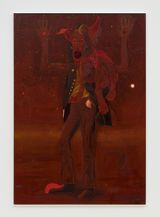
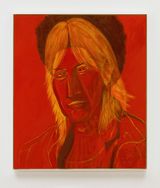
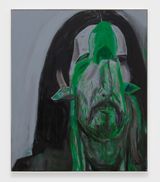
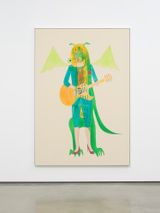
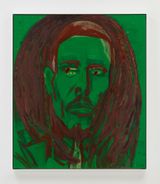
Fox’s recent obsessions are all on view in this group of new works, in which hybridised portraits of people like Bob Marley, Joni Mitchell, and Barack Obama are woven together with images of the artist’s own dog or mythological beings like dragons (a relatively new addition). On occasion, he constructs even more elaborate tableaux, with full-length figures surrounded by patterns, splatters, and rough brushwork. Each of these juxtapositions is both personal and formal in nature; Fox wields a sophisticated array of compositional and painterly techniques, constructing cubist arrangements of colour, plane, line, and texture whose abstraction moves them in the direction of pure visual experience.
While his subjects’ respective roles in society might prompt questions about why Fox would choose to press them into such intimate relation, it quickly becomes clear that the painting process itself is his project’s engine, and that his choice of imagery is tinged with Dadaist humour. The recognisability that first captures the viewer’s attention morphs, over time, into a mysterious presence that maintains the gaze by virtue of its strangeness rather than its familiarity. Like Jasper Johns’s flags, the portraits function as armatures for experiments in the material properties of pigment and medium. Fox employs oil and acrylic paints, as well as pencil, lending the canvases a disarmingly informal aura; after extended viewing, this informality is gradually replaced with an awareness of the seriousness and commitment of his endeavour.
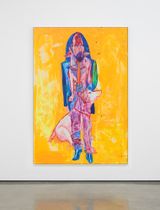
In several large-scale paintings of George Harrison fused with the artist’s ubiquitous dog, the full range of Fox’s imagination comes into focus. Leviathan finds the subjects placed before a mottled gold background that also contains a pair of ghostly pale silhouettes. Harrison’s face is embedded in the upturned head of the dog, who in fact appears twice, stacked within the length of ‘the quiet Beatle’s’ slim blue body. The composition is a virtuoso study in transparency and opacity, with the hues of each of the figures informing the others; even one of the barely-there silhouettes, seemingly a mirror image of Harrison, is given a hint of clarity where it intersects with the embodied Harrison’s arm and relinquishes its brushy white for an aqueous green.
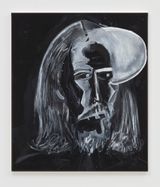
Moments like these can be found throughout the show. They attest to the richness of Fox’s paintings as objects, the intensity of his relationship to them, and the faith he places in the often solitary acts of making and viewing art. By establishing a concentrated thematic range, he paradoxically allows himself access to the breadth of human experiences, taking on memory, mortality, domesticity, fame, obsession, poetry, and violence. 66, for example, fuses at least two busts: Harrison (again) has been crossed with a death’s head that appears to push out from behind his own skull. Executed in grisaille on a monochrome black background with a kind of sketchy punk elegance, it is morbid and funny, with Fox inserting it in a dialogue with a diverse group of interlocutors. The spirits of Francis Bacon, Picasso, and Cézanne all hover around it. But the painting is finally irreducible to anyone but Jason Fox, who responds to the precipitous state of the world around him by searching out the sources of his affinities and passions, and by allowing paint—and the ongoing history of painting—to tell the tale.
Jason Fox (b. 1964, Yonkers, New York; lives and works in Poughkeepsie, New York) has recently been the subject of solo exhibitions at Almine Rech Gallery, Brussels (2018) and CANADA, New York (2017). Recent group exhibitions include Samaritans, Eva Presenhuber Gallery, New York (2019); Animal Farm, Brant Foundation Art Study Center, Greenwich, Connecticut (2017); Rien faire et laisser rire, Galerie Rodolphe Janssen, Brussels (2013); and Contemporary Surrealist Drawings from Rotterdam, Collection Boijmans Van Beuningen, Institut Néerlandais, Paris (2012).


For almost thirty years, Jason Fox has painted pictures that inhabit the charged psychological spaces within American culture, as well as within the medium of painting itself. Exhibiting frequently at Feature Inc., among other galleries in the 1990s, he moved against the grain of prevailing appropriation-based and conceptual methodologies. His idiosyncratic, risk-taking paintings then and since have been filled with imaginary beings informed by modernist art, autobiographical reflection, and mythological symbolism, and a recurring cast of characters from comics, fantasy cinema, and popular music. As such, Fox produces pictures that condense broad propensities in the collective imagination into intimate images whose every brushstroke and colour choice carries emotional weight. These unlikely but arresting pictures—suffused with Dadaist humour—make the most of painting’s ability to register organic, intuitively rendered changes in form and perspective. In many works from the last few years, Fox fuses portraits of well-known figures as well as images of his dog, demons, and angels. These hybridised beings appear to morph before the viewer’s eyes, communicating a sense of the fluidity with which they take shape on the canvas. This makes his work as personal and introspective as it is accessible, immediately recognisable, and culturally resonant.
David Kordansky Gallery is one of the most dynamic venues for contemporary art, and is internationally regarded as a leading gallery of its generation.

A respected voice in contemporary art discourse.
Focusing on ambitious storytelling and insightful art-world commentary. Ocula Magazine publishes in-depth interviews, critical essays and timely analysis on the artists, exhibitions and ideas driving the global art world.
Learn more about Ocula Magazine
Showcasing the best of the art world.
Ocula partners with galleries from around the world to highlight their artists, artworks and exhibitions. Gallery membership is by application and invitation, with each member vetted by an independent panel.
Learn more about Ocula Membership

Specialises in the sale of major artworks.
Led by a team with deep ties to the world’s leading auction houses, galleries and collectors. Ocula’s advisory team offers bespoke services to high-net-worth clients from around the world who are looking to acquire the best of contemporary and modern art.
Learn more about our team and services