





LUC TUYMANS
b. 1958, BelgiumLuc Tuymans is a pioneering Belgian artist whose muted, enigmatic paintings have profoundly shaped contemporary art’s engagement with memory, history, and image-making since the 1990s.
Early Years
Born in Mortsel, a suburb of Antwerp, in 1958, Luc Tuymans grew up in post-war Belgium, a context that would later fuel his critical investigation of national identity and historical trauma. He initially studied at the Sint-Lukas Hogeschool in Brussels and the École Nationale Supérieure des Arts Visuels de La Cambre, before completing his studies at the Royal Academy of Fine Arts in Antwerp.
Disillusioned with painting in the early 1980s, Tuymans turned briefly to film—an influence that remains palpable in the cropped perspectives and cinematic sequencing of his later artworks. He returned to painting in 1985, developing the distinctive visual language that would characterise his practice: figurative yet elusive, with a palette drained of colour and content filtered through layers of ambiguity.
Artworks
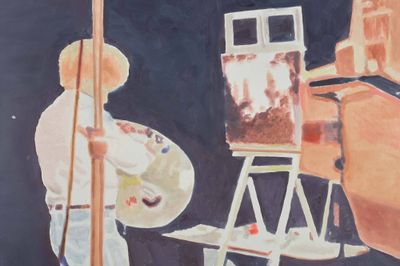
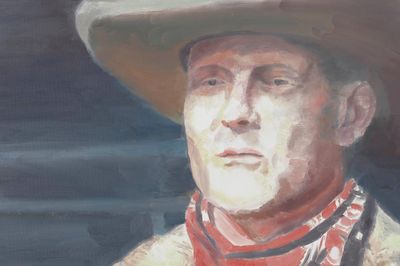
Luc Tuymans creates artworks that probe the relationship between painting and history, often based on photographic or cinematic source material. His muted colour palette and blurred, washed-out surfaces lend his paintings an uncanny quality—what he describes as “authentic forgery.” Through this approach, Tuymans raises questions about truth, memory, and the visual language of power in contemporary art.
Painting from Memory
Luc Tuymans first gained recognition for paintings that addressed historical trauma—not through direct representation, but through suggestion and omission. His early works, such as Gas Chamber (1986) and Our New Quarters (1986), reference sites and symbols associated with the Holocaust, yet they do so in ways that feel eerily removed. Instead of portraying graphic horror, Tuymans renders these scenes pale and indistinct, prompting viewers to question the ethics of representation and the unreliability of memory. By painting from faded photographs or second-hand images, he emphasises how mediated history becomes—and how images can both reveal and obscure the past.
The Banality of Power
During the 1990s and 2000s, Tuymans shifted focus from historical atrocities to the subtle manifestations of political power in everyday life. In the series Mwana Kitoko (2000), he examines Belgium’s colonial history by depicting fragmented and softened images from King Baudouin’s 1955 visit to the Congo. These artworks expose the disturbing elegance with which domination is often packaged. Similarly, in works like The Secretary of State (2005), Tuymans paints powerful figures in such a way that their identities dissolve into abstraction, highlighting the impersonal nature of authority. His art reveals how the mechanisms of control can appear deceptively mundane.
Contemporary Icons
In later series, Tuymans turns his attention to contemporary symbols, exploring how image saturation and media culture shape modern perception. In Corporate (2010), the artist focuses on the aesthetics of glass façades and office interiors, subtly critiquing the cold surfaces of corporate power. The Shore (2012) examines architectural motifs and guarded perimeters, evoking themes of exclusion and surveillance. Though these artworks retain his characteristic restraint, they exhibit a sharper, more digital sensibility—mirroring the sleek, data-driven world they depict. Through these works, Tuymans continues to question the role of contemporary art in a society saturated with images and distorted realities.
Awards and Accolades
- Medal of Honor, International Congress of Contemporary Painting (ICOCEP), Porto, Portugal (2019)
- Represented Belgium at the Venice Biennale (2001)
- the Coutts Contemporary Art Foundation Award, Zurich (2000)
- Flemish Culture Award for Visual Arts (1993)
Exhibitions
Luc Tuymans has been the subject of both solo and group exhibitions at important institutions. A selection of important exhibitions are provided below.
Solo Exhibitions
- Luc Tuymans, Basilica di San Giorgio Maggiore, Venice (2025)
- Luc Tuymans: L’Orphelin, Musée du Louvre, Paris (2024)
- Luc Tuymans: The Past, UCCA Center for Contemporary Art, Beijing (2024)
- Luc Tuymans: La Pelle, Palazzo Grassi, Venice (2019)
- Luc Tuymans: Prémonitions, Lille Métropole, musée d’art moderne, d’art contemporain et d’art brut, Villeneuve d’Ascq, France (2016)
- Nice. Luc Tuymans, The Menil Collection, Houston (2013)
Group Exhibitions
- The Atomic Age: Artists Put to the Test by History, Musée d’Art Moderne de Paris (2024)
- Le monde comme il va, Pinault Collection – Bourse de Commerce, Paris (2024)
- Capturing the Moment, Tate Modern, London (2023)
- Take Care: Art and Medicine, Kunsthaus Zurich (2022)
- Theater of Operations: The Gulf Wars 1991–2011, MoMA PS1, New York (2019)
- The Absent Museum, Wiels Centre d’Art Contemporain, Brussels (2017)
Critical Reception
Luc Tuymans’ work has been widely discussed in publications such as Apollo, Art Basel, and The Art Newspaper.
Luc Tuymans FAQs
What is Luc Tuymans best known for?
Luc Tuymans is best known for his subtly charged paintings that interrogate how history is remembered and mediated through images. His signature aesthetic—muted tones, soft focus, and eerie detachment—transforms photographs and film stills into artworks that feel both intimate and estranged. Tuymans often addresses contentious themes such as the Holocaust, colonialism, and political ideology, but always indirectly. This ambiguity invites reflection on how contemporary art can confront historical trauma without resorting to spectacle or sentimentality.
How does Luc Tuymans make his paintings?
Luc Tuymans begins with photographic source material—often banal, historical, or media-derived—which he crops, manipulates, or rephotographs to create visual distance. He then executes each painting quickly, typically in a single day, using a limited, desaturated palette and thin washes of oil paint. This method allows him to preserve spontaneity while underscoring the artwork’s conceptual remove. His approach is deliberately anti-monumental, lending his artworks a fragile, ephemeral quality that echoes the fleeting nature of memory and perception in contemporary life.
What are some major themes in Luc Tuymans’ art?
Luc Tuymans’ artworks explore themes of memory, loss, image culture, and historical distortion. He often addresses weighty subjects—such as Nazism, Belgian colonialism, and political authority—by portraying peripheral or seemingly innocuous details, forcing viewers to confront uncomfortable truths indirectly. Tuymans is also deeply interested in how technology mediates experience, from analogue photography to digital screens. This makes his contemporary art practice especially relevant in a post-truth era, where the boundary between reality and representation is increasingly unstable and contested.
Ocula | 2025




Explore Luc Tuymans' Exhibitions





Luc Tuymans in Ocula Magazine






Explore and Follow Artists Shaping Contemporary Art
A respected voice in contemporary art discourse.
Focusing on ambitious storytelling and insightful art-world commentary. Ocula Magazine publishes in-depth interviews, critical essays and timely analysis on the artists, exhibitions and ideas driving the global art world.
Learn more about Ocula Magazine
Showcasing the best of the art world.
Ocula partners with galleries from around the world to highlight their artists, artworks and exhibitions. Gallery membership is by application and invitation, with each member vetted by an independent panel.
Learn more about Ocula Membership
Specialises in the sale of major artworks.
Led by a team with deep ties to the world’s leading auction houses, galleries and collectors. Ocula’s advisory team offers bespoke services to high-net-worth clients from around the world who are looking to acquire the best of contemporary and modern art.
Learn more about our team and services