



Press Release

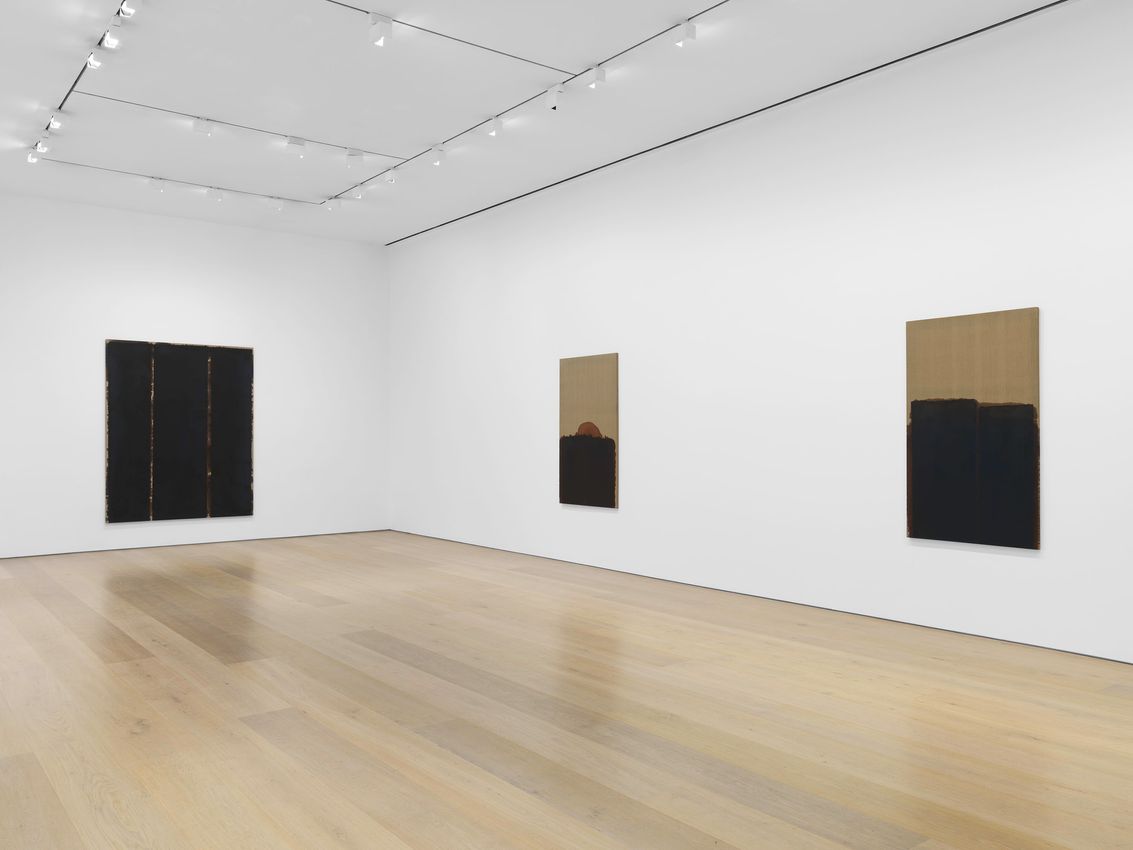
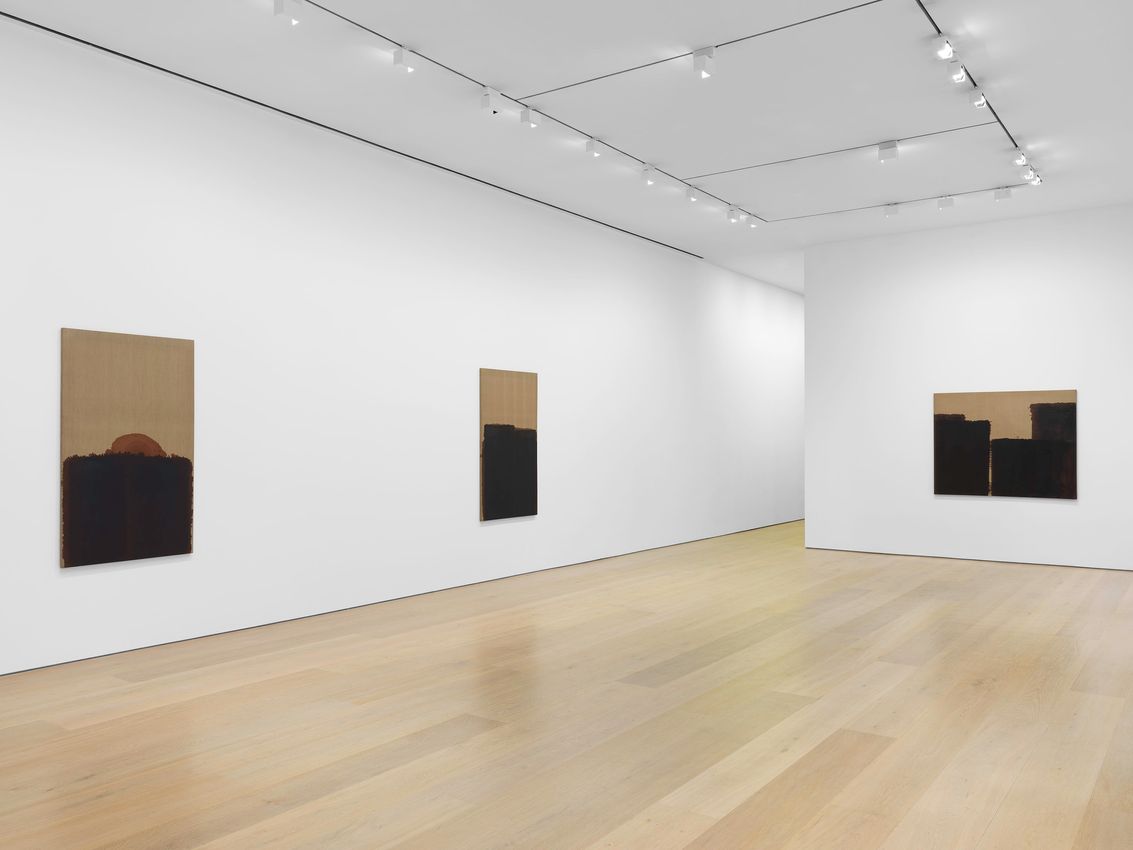
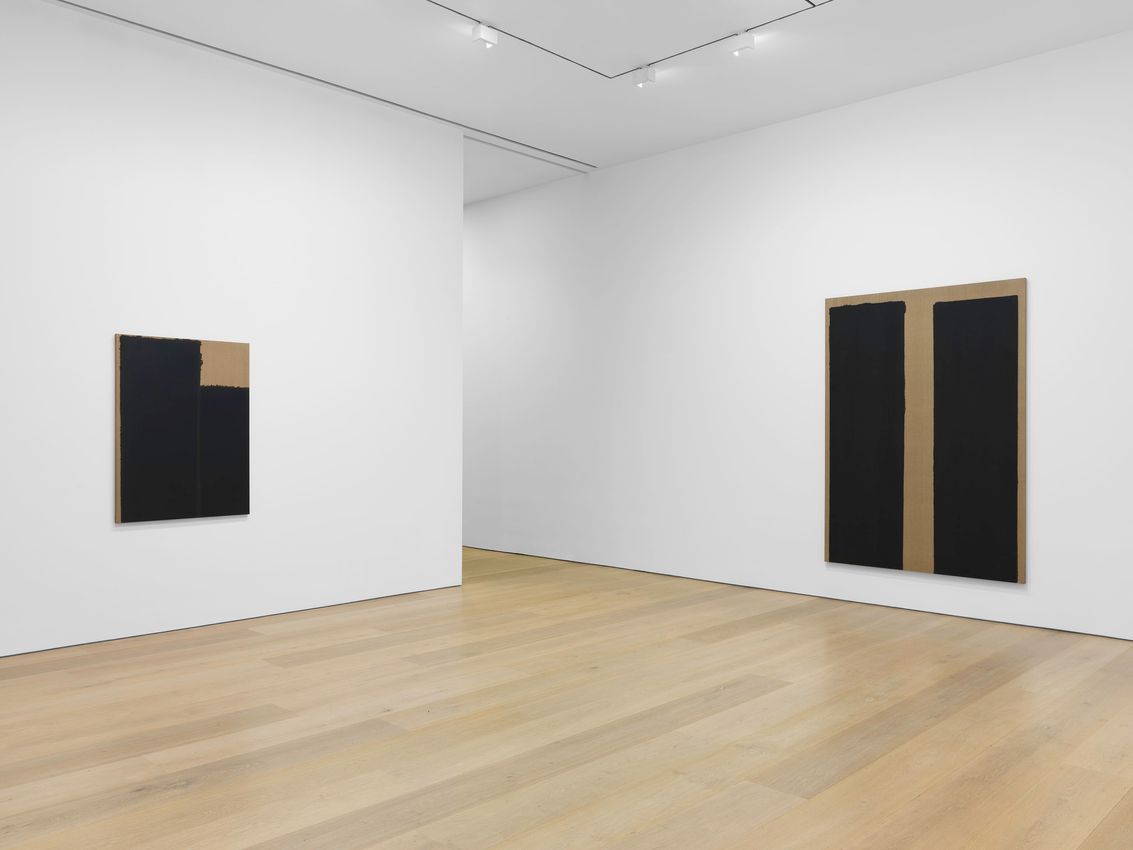
David Zwirner is pleased to present an exhibition of paintings by Yun Hyong-keun, on view at the gallery’s 537 West 20th Street location in New York. Focusing on the artist’s work from the late 1980s and 1990s, the exhibition will feature a selection of Yun’s distinctive abstract paintings from this late period in his career.

One of the most significant Korean artists of the twentieth century, Yun is widely recognised for his signature abstract compositions, which engage with yet transcend Eastern and Western art movements and visual traditions. Using a restricted palette of ultramarine and umber, Yun created his compositions by adding layer upon layer of paint onto raw canvas or linen, often applying the next coat before the last one had dried. He diluted the pigments with turpentine solvent, allowing them to seep into the fibres of the support, staining it in a similar way to traditional ink on Korean mulberry paper. Working directly on his studio floor, he produced simple arrangements of intensely dark, vertical bands surrounded by untouched areas. The division was softened by the blurred edges caused by the uneven rates of absorption of oil and solvent, and the compositions often developed over several days, even months, with the artist adding additional layers or letting the pigments bleed out gradually.

Yun is associated with the Dansaekhwa (monochrome painting) movement, the name given to a group of influential Korean artists from the 1960s and 1970s who experimented with the physical properties of painting and prioritized technique and process. Yun met Donald Judd during Judd’s visit to Seoul in 1991, and both artists immediately felt a connection with each other’s work. Judd hosted the first exhibitions of Yun’s paintings in the United States in 1993 at his Spring Street studio in New York, and the following year at the Chinati Foundation in Marfa, Texas.

The paintings in the exhibition reflect a subtle evolution from Yun’s earlier canvases. The abstract forms in his works from the early 1990s become larger and darker. In the middle of the 1990s the lines in some of Yun’s paintings become tighter and straighter, and the edges of his forms appear less diffuse and more defined. While his art shows clear affinities to Minimalism, it also recalls the sublimity of Barnet Newman’s zip paintings, and the balance and diffuseness of Mark Rothko’s canvases. At the same time, Yun’s work exhibits the sophistication and restraint of traditional Korean scholarly painting, while also reflecting the artist’s unique sensitivity to colour and material. As Yun wrote in 1976, ‘Nature, however you look at it, is always unadorned, fresh, and beautiful. I wonder if my paintings could capture the beauty of nature. No, it would be impossible. Even so, I want to make paintings that, like nature, one never tires of looking at. That is all that I want in my art. Canvas is still made just from those old and familiar materials: cotton and hemp. Looking at it, I always feel its warmth and familiarity. This affinity comes from the absolute simplicity and freshness of the natural fibre. This in itself is a work of art.’1

Yun Hyong-keun (1928-2007) was born in Miwon-ri, Chungcheongbuk-do, Korea and received his BFA from the School of Fine Arts at Hongik University, Seoul, in 1957. This presentation marks the artist’s second solo exhibition with David Zwirner since the gallery began representing his work in New York, in 2016.

Yun has been the subject of solo exhibitions at prominent institutions worldwide, including the Total Museum of Contemporary Art, Seoul (1994); Stiftung für konkrete Kunst, Reutlingen, Germany (1997); Musée d’Art moderne et contemporain de Strasbourg, France (2002); and Art Sonje Museum, Gyeongju, Korea (2001). Other notable solo exhibitions have been held at Inkong Gallery, Seoul (1989); Locks Gallery, Philadelphia (1991); Galerie Humanité, Nagoya, Japan (1991-1992; which traveled to Galerie Humanité Tokyo; Gallery Suzukawa, Hiroshima, Japan; and Gallery Yamaguchi, Osaka, Japan); Jean Brolly Gallery, Paris (2002); Blum & Poe, New York; and PKM Gallery, Seoul (both 2015). In 2018, the National Museum of Modern and Contemporary Art in Seoul hosted a major solo exhibition of the artist’s work that travelled to the Palazzo Fortuny in Venice (on view from May 11 through November 24, 2019).

His work has been included in the São Paulo Biennial (1969 and 1975); the 46th Venice Biennale (1995); and the Gwangju Biennale (2000).

Work by the artist is represented in permanent collections internationally, including the Art Institute of Chicago; Chinati Foundation, Marfa, Texas; Fukuoka Asian Art Museum, Fukuoka, Japan; Glenstone, Potomac, Maryland; Leeum, Samsung Museum of Art, Seoul; National Museum of Modern and Contemporary Art, Korea; Tokyo Metropolitan Art Museum; and Tate, UK.

1 Yun Hyong-keun, ‘A Thought in the Studio,’ in Yun Hyong-keun (Seoul: PKM Gallery, 2015), p. 10

Read More

Installation Views

About the Artist

Yun Hyong-keun (윤형근) was a prominent figure of the modern Korean art movement known as Dansaekhwa, whose monumental, abstract artworks were theoretically rooted in traditional Korean ideals and are stylistically evocative of modern Western abstraction. The term Dansaekhwa (or ‘monochrome painting’) refers to a visual style maintained by a loose constellation of Korean artists who created radically experimental paintings between the 1960s and 80s (other major figures include Lee Ufan, Park Seo-bo, and Chung Sang-hwa). Having lived through one of the most devastating eras of Korean history—tainted by successive periods of occupation, domestic turmoil, and postwar dictatorship—Yun channelled his traumas into his artistic practice and became a champion of the modern Korean art canon.

View Artist Profile

Also Exhibiting at David Zwirner

About the Gallery
Since opening its doors in 1993, David Zwirner has been home to innovative, singular, and pioneering exhibitions across a variety of media and genres. The gallery has helped foster the careers of some of the most influential artists working today, and has maintained long-term representation of a wide-ranging, international group of artists and estates. Based in New York with spaces in Chelsea and the Upper East Side, David Zwirner expanded to Europe in 2012 with a gallery in an eighteenth-century Georgian townhouse in London’s Mayfair district, and opened its first gallery in Asia in January 2018 in Central Hong Kong.
View Gallery Profile
Address
537 West 20th Street
New York
United States
Opening Hours
Tuesday – Saturday
10am – 6pm
(1)
New York 537 West 20th Street
David Zwirner
537 West 20th Street, New York, United States
+1 212 517 8677
http://www.davidzwirner.com

Opening hours
Tuesday – Saturday
10am – 6pm
The art world in focus
