




GEORG BASELITZ
1938-2026, GermanyA pioneering figure in post-war contemporary art, Georg Baselitz is known for his provocative and psychologically charged paintings, sculptures and prints that subvert artistic conventions and grapple with Germany’s fractured identity.
Early Years
Born Hans-Georg Kern in 1938 in the village of Deutschbaselitz, Saxony, Georg Baselitz grew up in East Germany during the aftermath of World War II. His early life was shaped by the trauma of war and authoritarian rule, themes that would later manifest in his art.
In 1956, Baselitz began his formal art training at the Academy of Fine and Applied Art in East Berlin but was expelled for ‘political immaturity’ after producing work that defied the strict socialist realist doctrine imposed by the East German regime. He soon moved to West Berlin, enrolling at the Hochschule der Künste, where he immersed himself in Expressionism, Art Brut, and the work of the Old Masters. In 1961, he adopted the name ‘Baselitz’ after his birthplace, severing ties with his given name and signalling a reinvention of his identity as an artist.
Artworks
Georg Baselitz’s art is defined by its bold inversion of form, expressive brushwork and unflinching confrontation of historical memory. His iconic upside-down paintings, first introduced in 1969, proposed a new visual grammar for painting influencing the trajectory of contemporary art.
Early Paintings: Disruption and the Figure
In the early 1960s, Baselitz forged a radical path with paintings that challenged abstraction and rejected the constraints of socialist realism. His Pandemonium series, made in collaboration with Eugen Schönebeck, used grotesque imagery and expressionist distortion to confront the moral collapse of post-war society. In The Big Night Down the Drain (1962–63), a crude figure performs an unsettling act of self-exposure, drawing censorship and scandal. His acclaimed The Heroes series (1965–66), including works like Rebel and The Great Friends, depicts battered, oversized male figures stumbling through desolate landscapes—representations of a broken national psyche. These emotionally charged artworks mark Baselitz’s formative contribution to figurative painting, combining raw visual energy with cultural critique.
Inversion as Language
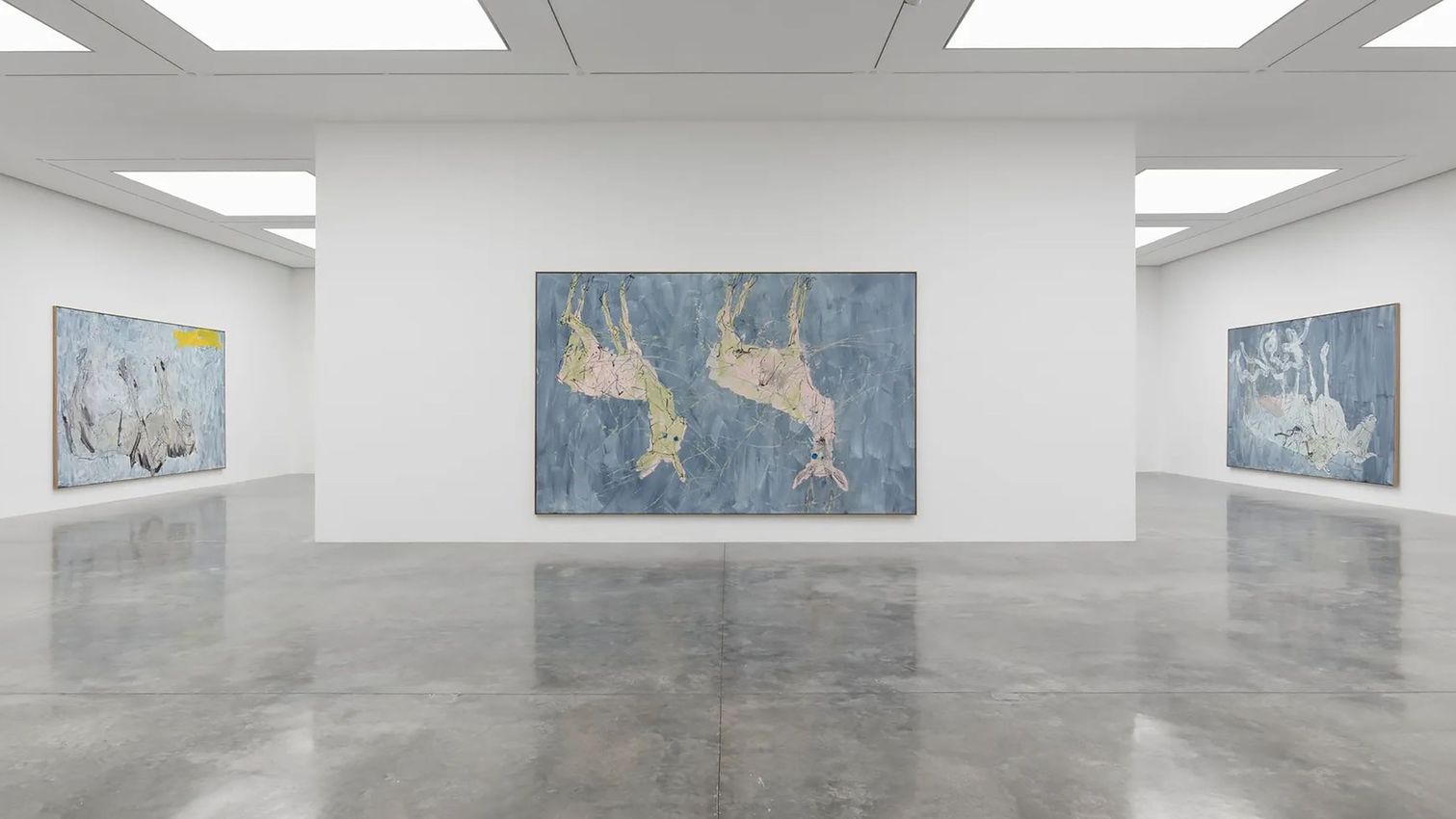
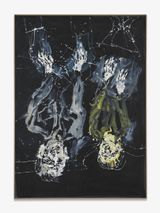
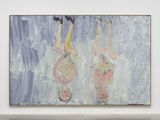
In 1969, Baselitz made a pivotal conceptual shift: he began turning his subjects upside-down. This technique—first seen in The Wood On Its Head (1969)—was a deliberate break from narrative painting, designed to foreground the material and compositional aspects of his artworks. Inverted imagery, such as Nude Elke (1976) and Mrs Baselitz in Orange (1976), complicates perception and asks the viewer to engage more deeply with brushwork, texture, and surface. This approach allowed Baselitz to explore form free of storytelling constraints, transforming how artists and audiences engage with representation. Over time, inversion became his signature language, allowing him to revisit traditional subjects like portraiture and landscape while simultaneously critiquing art historical canons. Baselitz’s inverted paintings continue to shape his output today, reflecting a sustained interest in destabilising visual norms within contemporary art.
Sculpture and Carving Identity
In the late 1970s, Baselitz shifted his attention to sculpture, applying his disruptive sensibility to three-dimensional form. Using chainsaws and axes, he carved large wooden figures that rejected finesse in favour of direct, forceful expression. His controversial Model for a Sculpture (1979), presented at the German Pavilion at the 1980 Venice Biennale, features a roughly carved figure with an upraised arm, sparking debate about the artist’s engagement with national symbolism. Baselitz’s sculptures—such as Dresdner Frauen – Die Elbe (1990), a tribute to wartime survivors, and Louise Fuller (2014), a towering bronze dancer—draw on German folk art and non-Western carving traditions. These works amplify his long-standing interest in identity, memory and the body, extending his painting practice into physical space. Rough-hewn and often monumental, his sculptures underscore his belief in the primacy of gesture, material, and the artist’s hand in the making of contemporary art.
Public Commissions
Include:
- Zero Dom (2015), a monumental sculpture installed at the Städel Museum, Frankfurt
- Volksmund (2011), bronze figures placed outside the German Bundestag in Berlin
Awards and Accolades
Include:
- Golden Lion for Lifetime Achievement, Venice Biennale (2022)
- Officer of the French Legion of Honour (2012)
- Praemium Imperiale for Painting, Japan Art Association (2004)
- Honorary Professorship the Royal Academy of Arts, London (1999)
Exhibitions
Georg Baselitz has been the subject of both solo and group exhibitions at important institutions. A selection of important exhibitions are provided below.
Solo Exhibitions
- Georg Baselitz: Late Work, Kunsthaus, Zurich, Switzerland (2023)
- Georg Baselitz: Sculptures 2011–2015, Serpentine Galleries, London (2023)
- Baselitz – The retrospective, Centre Pompidou, Paris (2021)
- Baselitz Academy, Gallerie dell’Accademia, Venice (2019)
- Baselitz / Six Decades, Fondation Beyeler, Riehen/Basel; Hirshhorn Museum and Sculpture Garden, Washington, DC (2018)
- Back Then, In Between and Today, Haus der Kunst, Munich (2014)
Group Exhibitions
- Balance, Hamburger Bahnhof, Berlin (2022)
- German Art After 1960: The Fisher Collection, San Francisco Museum of Modern Art (2016)
- Postwar: Art between the Pacific and the Atlantic 1945 – 1985, Haus der Kunst, Munich (2016)
- Bad Thoughts, Stedelijk Museum, Amsterdam (2014)
- Exquisite Corpses: Drawing and Disfiguration, Museum of Modern Art, New York (2012)
Critical Reception
Georg Baselitz’s art has been widely discussed in leading publications, including ARTnews, Artnet News, and The Financial Times.
Georg Baselitz FAQs
What is Baselitz’s most preeminent series?
Georg Baselitz’s most preeminent series is The Heroes (1965–66), a group of expressive, large-scale paintings portraying wounded and dishevelled male figures in military attire. These artworks are emblematic of post-war disillusionment and reflect the artist’s grappling with Germany’s fractured identity. Works such as Rebel and The Great Friends depict solitary figures caught between ruin and resilience, challenging romanticised notions of masculinity and heroism. Rendered in gestural brushstrokes and earthy tones, the series established Baselitz as a provocative force in contemporary art and remains a cornerstone of his career, frequently exhibited in leading galleries and institutional retrospectives around the world.
Why did Baselitz turn his paintings upside-down?
Baselitz began inverting his compositions in 1969 to separate content from form, allowing the viewer to engage primarily with the painterly surface rather than the subject. This technique—first seen in The Wood On Its Head—was a radical strategy to destabilise traditional representation. By flipping the image, Baselitz shifted attention to brushwork, colour and composition, removing narrative clarity and resisting political or symbolic interpretation. Inversion became a conceptual tool that has since defined his practice, influencing generations of contemporary artists. The upside-down paintings challenge how art is read, positioning Baselitz as a pioneer in postmodern visual language.
What influences Baselitz’s art?
Baselitz’s art is shaped by a wide spectrum of influences, including German Expressionism, Art Brut, Renaissance painting and non-Western art traditions. Artists such as Edvard Munch, Ernst Ludwig Kirchner, and Jean Dubuffet informed his early interest in raw, emotive mark-making. He also draws from classical sources like Grünewald and Italian Mannerism, which he reinterprets through distortion and inversion. African sculpture and German folk carvings notably influenced his approach to sculpture in the 1980s, particularly in works carved directly from wood. Baselitz synthesises these diverse references into a singular visual language that confronts memory, trauma, and cultural identity.
Sherry Paik | Ocula | 2025
Explore Georg Baselitz's Exhibitions On Now




View Georg Baselitz's Artworks



















Georg Baselitz in Ocula Magazine









Explore and Follow Artists Shaping Contemporary Art
A respected voice in contemporary art discourse.
Focusing on ambitious storytelling and insightful art-world commentary. Ocula Magazine publishes in-depth interviews, critical essays and timely analysis on the artists, exhibitions and ideas driving the global art world.
Learn more about Ocula Magazine
Showcasing the best of the art world.
Ocula partners with galleries from around the world to highlight their artists, artworks and exhibitions. Gallery membership is by application and invitation, with each member vetted by an independent panel.
Learn more about Ocula Membership
Specialises in the sale of major artworks.
Led by a team with deep ties to the world’s leading auction houses, galleries and collectors. Ocula’s advisory team offers bespoke services to high-net-worth clients from around the world who are looking to acquire the best of contemporary and modern art.
Learn more about our team and services