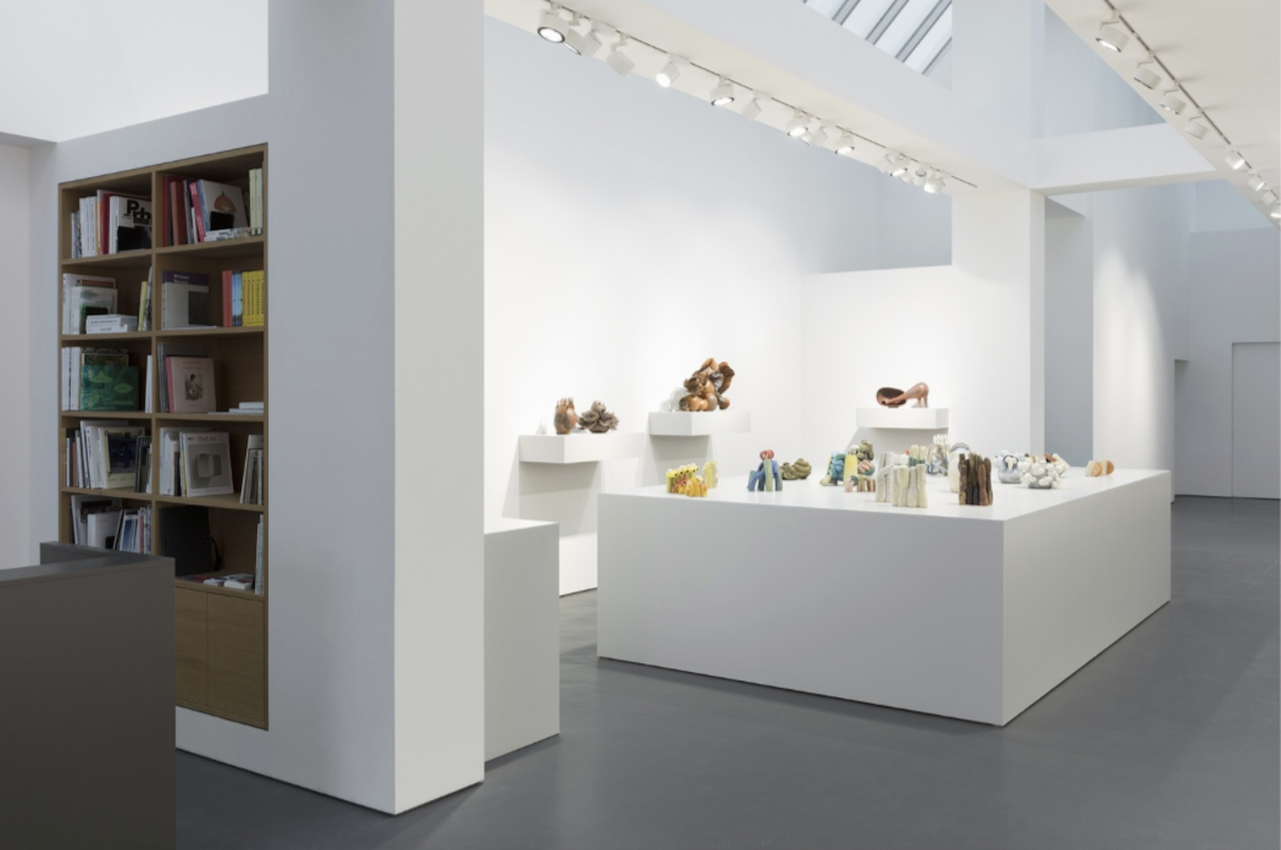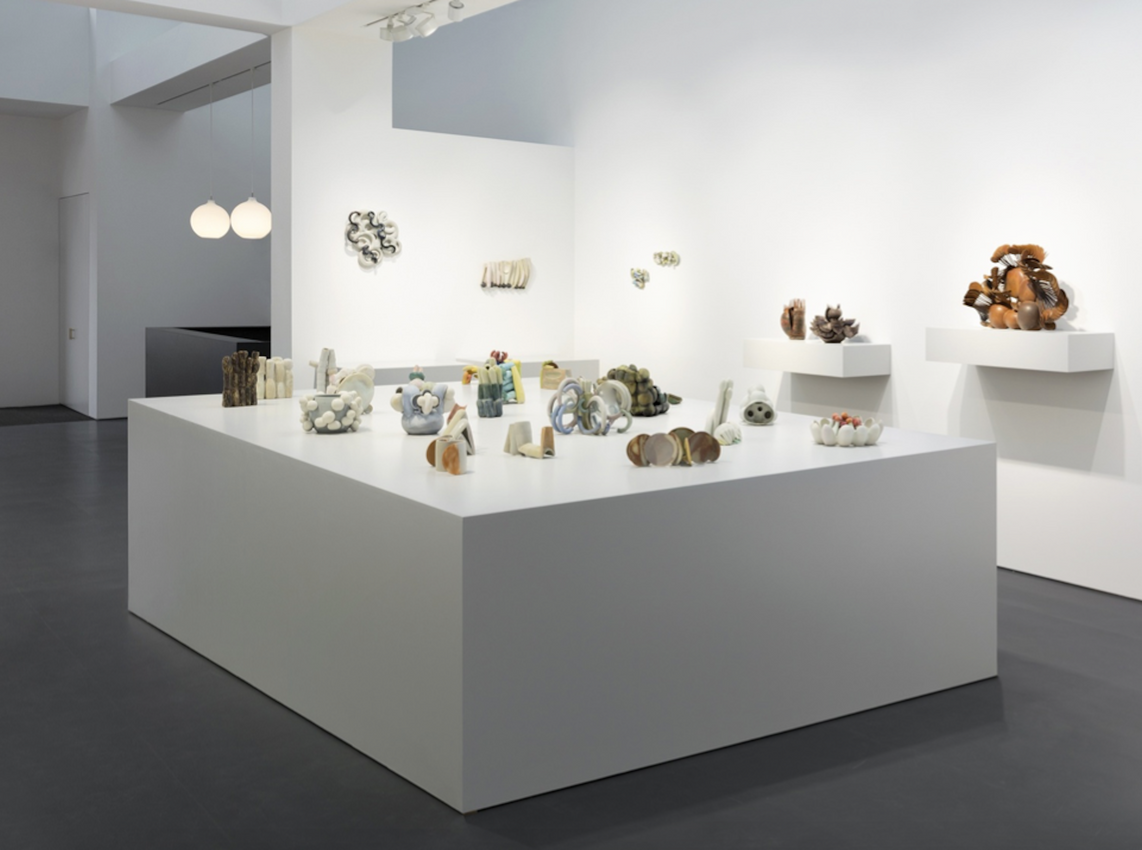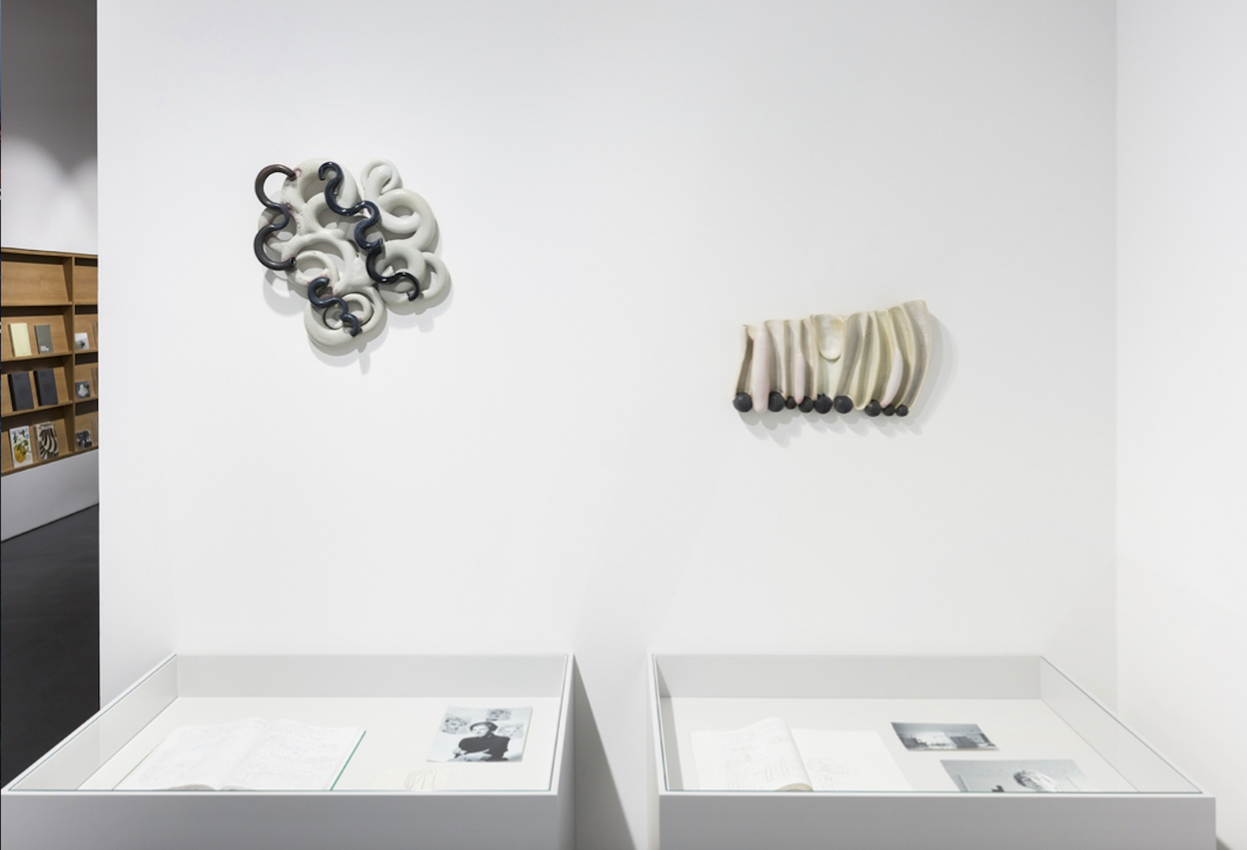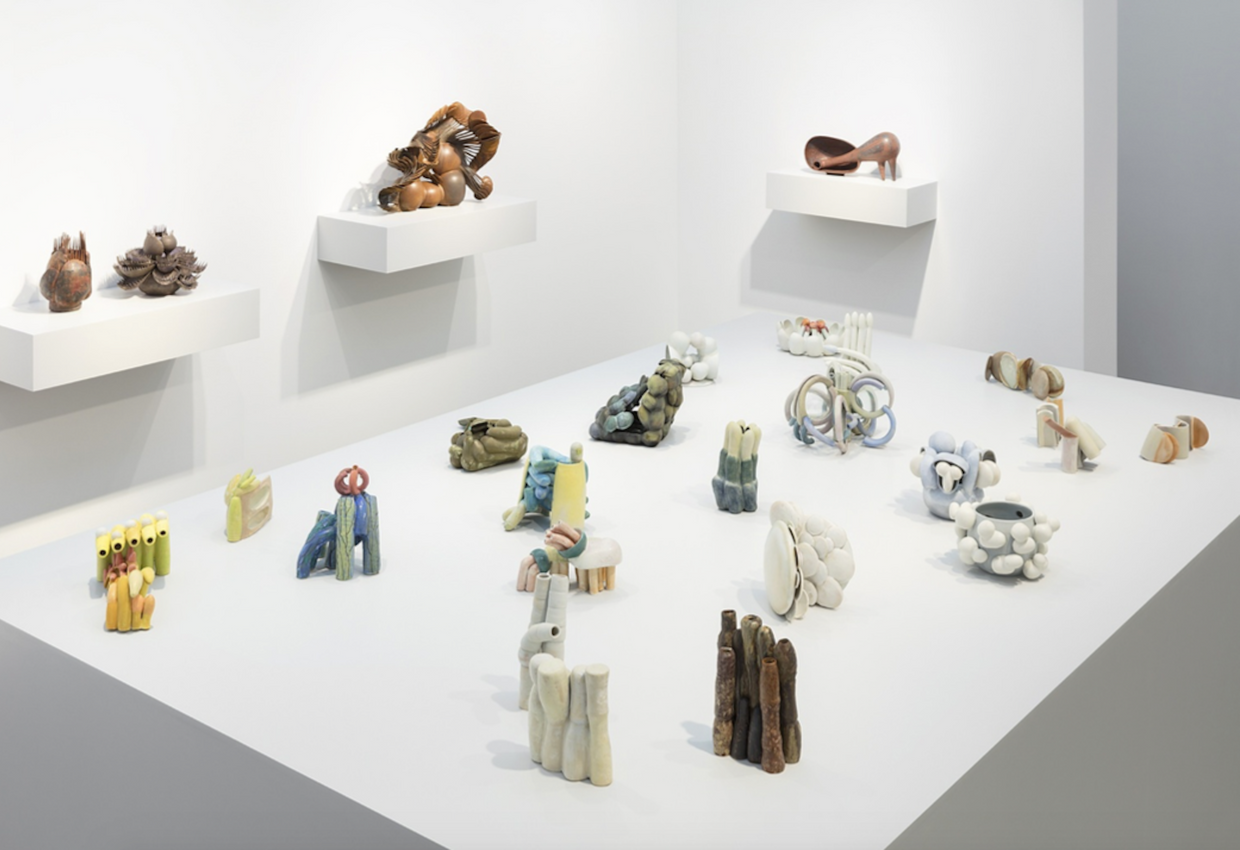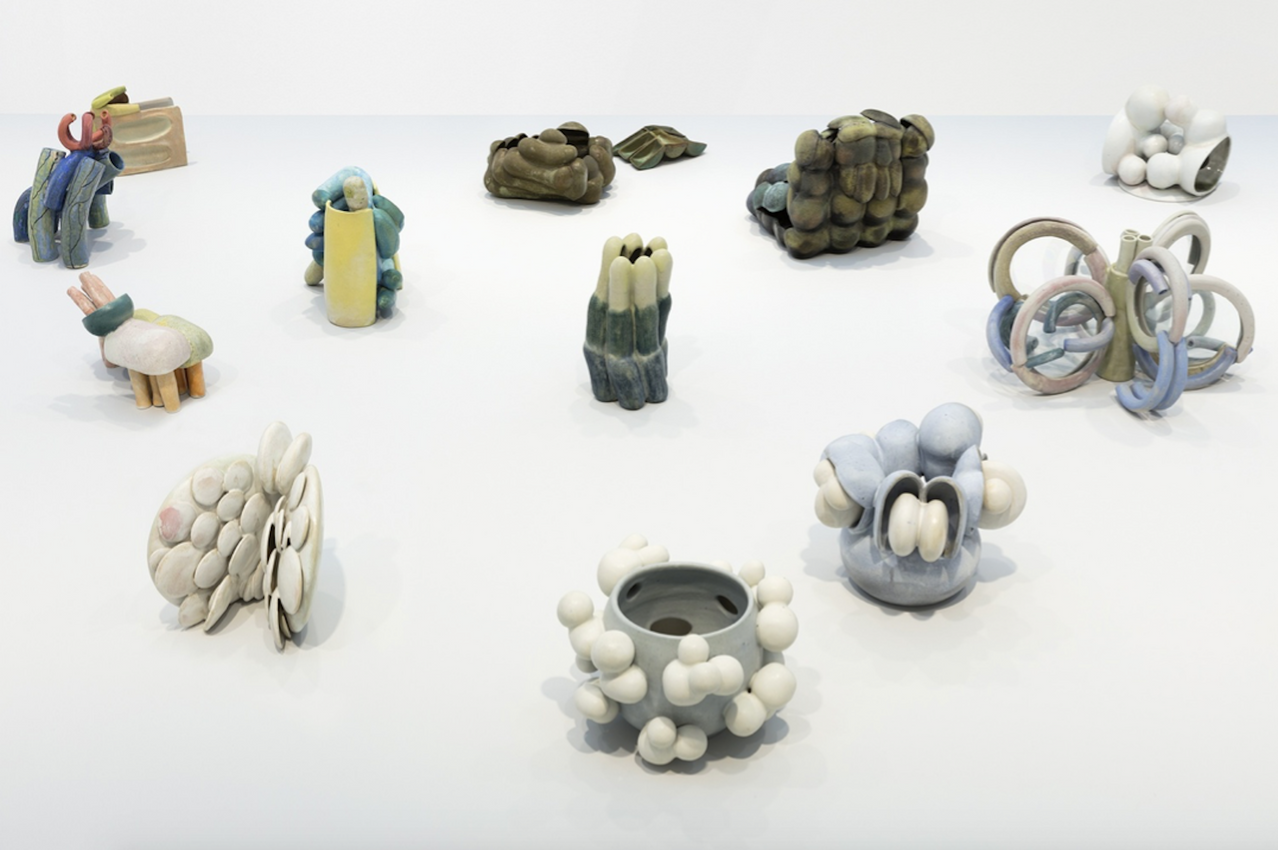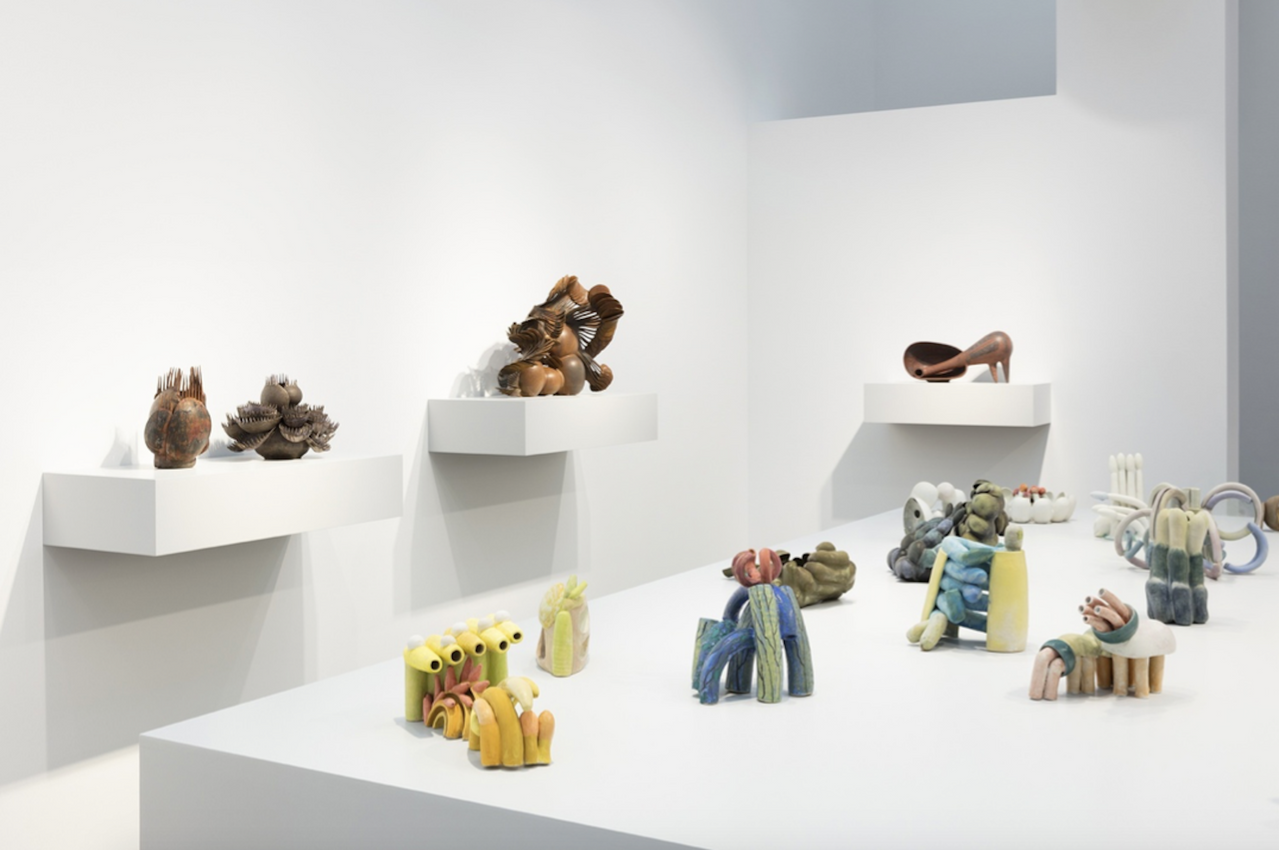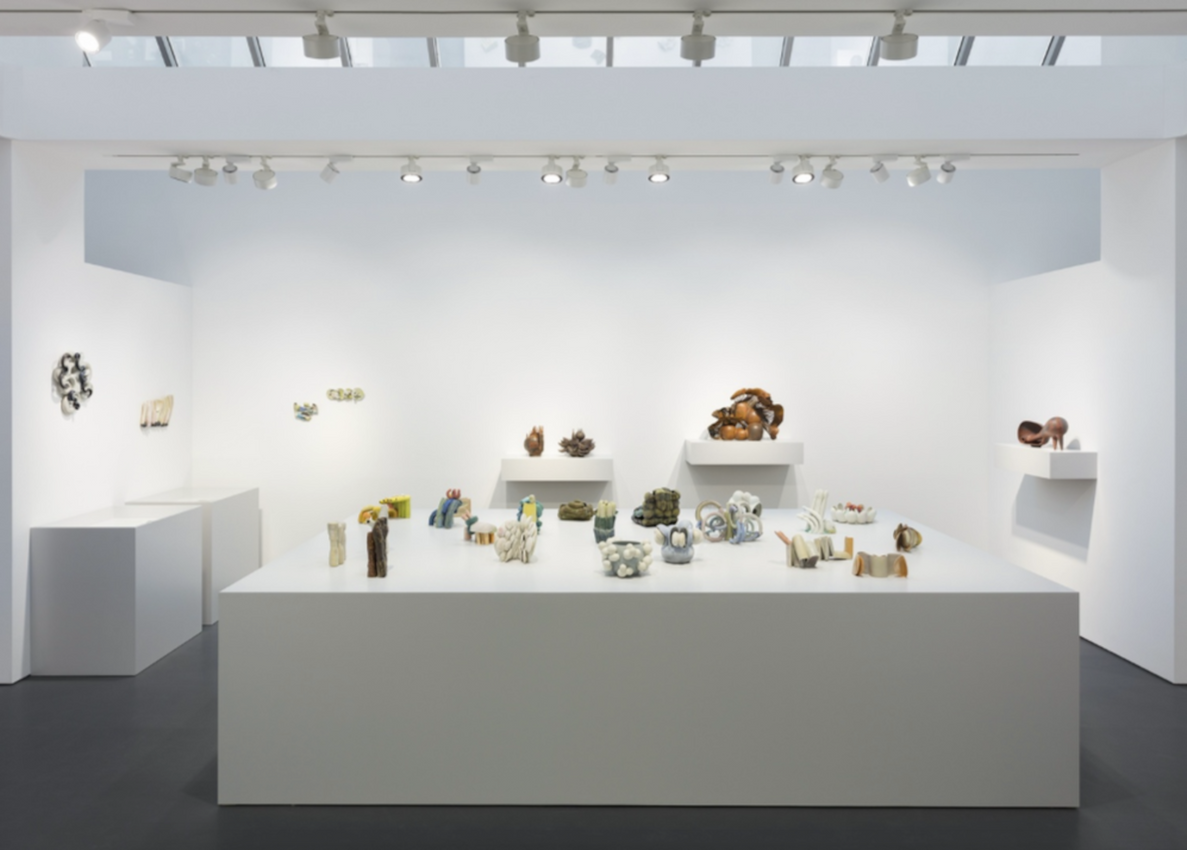
Esther Schipper is pleased to announce an exhibition of works from Beate Kuhn’s estate. On view will be works by the eminent German ceramicist from different creative periods.
Beate Kuhn was one of the most important German ceramists after 1945. Influenced not least by her intense engagement with developments in contemporaneous classical music, especially the composers associated with New Music, she developed a downright avant-garde relationship with her own profession, the boundaries of which she soon pushed beyond all conventional or functional aspects. She was one of the first to see the possibilities of structural analogies and transferred the basic compositional principles of repetition and variation into contemporary ceramics. Thus, she invented her own unique and unmistakable idiom: by assembling endlessly varied, wheel-thrown and glazed elements to creations of great complexity, she developed a special kind of ceramic sculpture that, although originating from the genuine techniques of pottery, was at the same time free, something that never existed before. Her inspirations were, in the broadest sense, creatures and structures of nature, which she transformed into plastic forms by means of sequence and montage–programmatically in the abstract interpretation of vegetation as an organic composition. Retrospectively, it doesn’t take much to see in these non-objective sequences, mounted to agglomerations and clusters, in size, chromaticism and rhythmic modulated volumes of compositions, which could be translated from their plastic three-dimensionality into acoustic temporality and be read as chordal and melodic scores.
Born in Düsseldorf on July 1, 1927, Kuhn came from an artistic family home–her father was a sculptor, her mother a pianist. A study of art history in Freiburg, which began shortly after the end of the Second World War, left a lasting impression on her. When artistic modernism returned to Germany, the heroes of the young art enthusiast were painters such as Paul Klee and Joan Miró. In a pre-war catalogue, she found vessels by the ceramicist Jan Bontjes van Beek and suddenly saw her way. From 1949 onwards, Kuhn studied at the Werkkunstschule in Wiesbaden, Germany, and after her apprentice’s examination at the Werkkunstschule Darmstadt with Friedrich Theodor Schroeder. In 1953, she and Karl Scheid, who was also educated at the Darmstadt School, took over the workshop of their teacher in the village of Lottstetten in southern Baden, where Beate Kuhn painted organic dishes and anthropomorphic vessels, transferring figurative abstraction inspired by her favorite painters to ceramics. Since 1957, Kuhn lived in Düdelsheim in Hesse, where she moved into a modernistic bungalow designed by her brother in the immediate vicinity of the new workshop of the couple Karl and Ursula Scheid and the studio of sculptor Bernhard Vogler: an unusual one-room building, which became a place of living and working. With her language of plastic assembled from wheel-thrown parts, developed towards the end of the 1950s, Kuhn became a highly respected, future developments anticipating exceptional phenomenon in German ceramics after 1945. In 1968 she became a member of the Geneva Académie Internationale de la Céramique and later became one of the founding members of Group 83; she was awarded numerous prizes and awards; she had exhibitions all over the world.
On December 10, 2015 Beate Kuhn died at the age of 88, leaving behind a life’s work that was impressive in its complexity and consistency. In 2017, the Pinakothek der Moderne in Munich dedicated a large retrospective to her work.
Selection of solo exhibitions: Beate Kuhn. Keramiken aus der Sammlung Freiberger, Die Neue Sammlung - The Design Museum, Pinakothek der Moderne, München (2017); GRASSI Museum für Angewandte Kunst, Leipzig (2016); Keramikmuseum Westerwald, Höhr-Grenzhausen (2012); Bruno11 und Schloss Büdingen, Büdingen (2010); Keramion - Museum für zeitgenössische keramische Kunst, Frechen (2007); Werkstatt Beate Kuhn, Düdesheim (2002); Museum Historisches Rathaus, Mölln (1997); Museum für Kunsthandwerk, Frankfurt am Main (1988); Keramion - Museum für zeitgenössische keramische Kunst, Frechen (1982).
Selection of group exhibitions: Cats vs. Dogs, Keramion - Museum für zeitgenössische keramische Kunst, Frechen (2016); Gefäß Skulptur. 2. Deutsche und international Keramik seit 1946, GRASSI Museum für Angewandte Kunst, Leipzig (2013); 50 Jahre Düdesheim. Jubiläumsausstellung der Werkstattgemeinschaft Kuhn und Scheid, Düdseheim (2006); Gruppe 83, Schloss der Pommerschen Herzöge, Stettin (2004); Feuerwerke, Deutsches Keramikmuseum, Düsseldorf (1999); Keramik als Leidenschaft, Museum Bellerive, Zürich (1991);The 15th Chunichi International Exhibition of Ceramic Arts, Nagoya (1987); International Ceramics 1972, Victoria and Albert Museum, London (1972); Artist-Craftsmen of Western Europe, Museum of Contemporary Crafts, New York (1961); XI Triennale di Milano, Mailand (1957); Feira internacional de São Paulo, Sao Paulo (1954).


Esther Schipper founded the gallery in 1989 in Cologne. In 1997 the gallery relocated to Berlin. Through more than three decades of continuous exhibition practice, the gallery has established itself as a major force not only in Germany but in an international context, with offices in Paris and Seoul and representatives in France, Spain, the United States, Latin America, South Korea, Taiwan and China. The gallery holds up to ten gallery exhibitions as well as multiple off-site projects each year and participates in leading art fairs across the globe.

A respected voice in contemporary art discourse.
Focusing on ambitious storytelling and insightful art-world commentary. Ocula Magazine publishes in-depth interviews, critical essays and timely analysis on the artists, exhibitions and ideas driving the global art world.
Learn more about Ocula Magazine
Showcasing the best of the art world.
Ocula partners with galleries from around the world to highlight their artists, artworks and exhibitions. Gallery membership is by application and invitation, with each member vetted by an independent panel.
Learn more about Ocula Membership

Specialises in the sale of major artworks.
Led by a team with deep ties to the world’s leading auction houses, galleries and collectors. Ocula’s advisory team offers bespoke services to high-net-worth clients from around the world who are looking to acquire the best of contemporary and modern art.
Learn more about our team and services