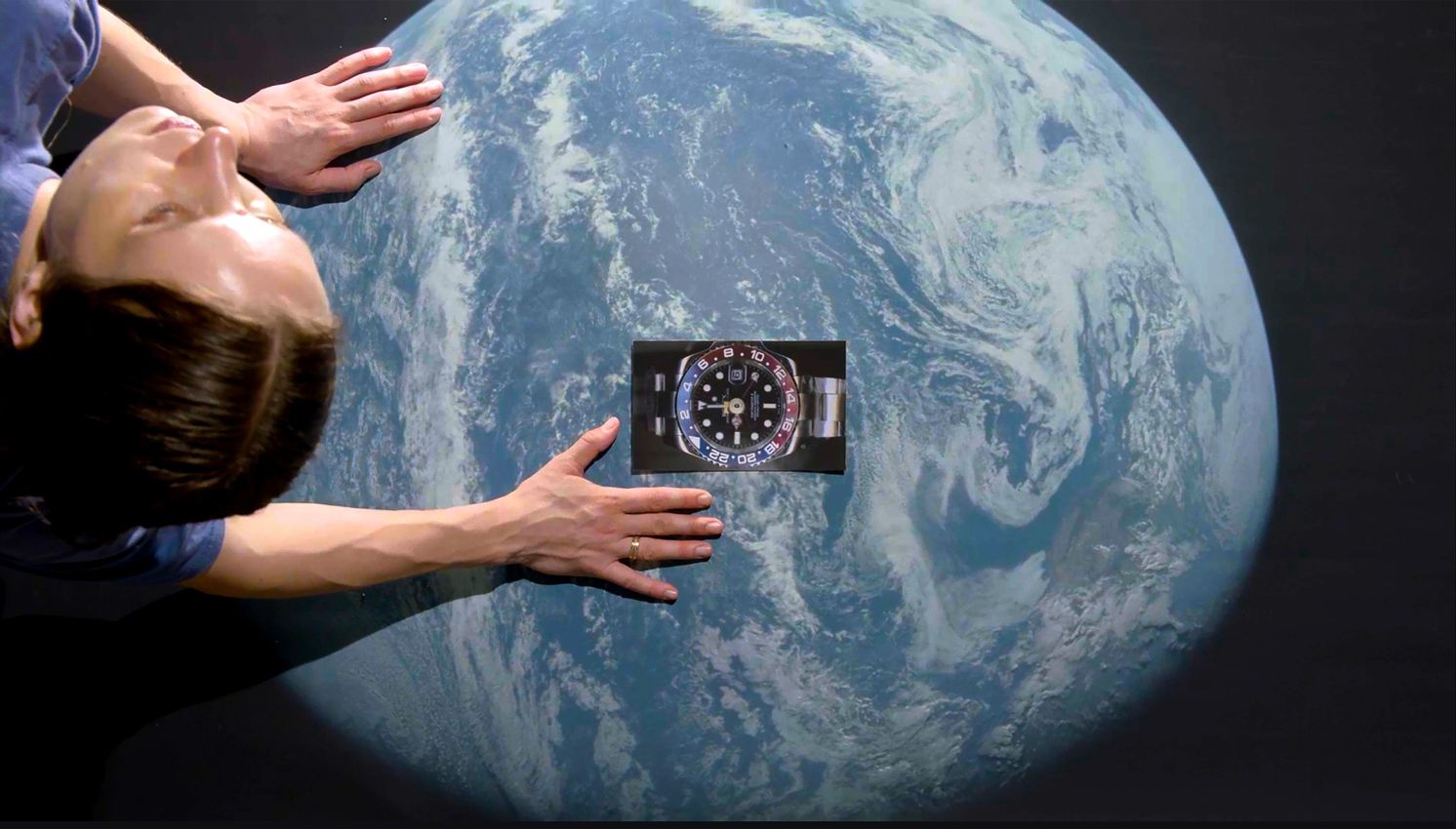
Esther Schipper is pleased to present Roman Ondak’s Out of the Blue, the artist’s second solo presentation with the gallery. On view will be sculptures as well as photographic works with various interventions.
The entanglement of past and present and of the personal and political have long been at the core of Roman Ondak’s practice. Loosely based on the color blue and its association with melancholy, the presentation includes works that evoke moments, memories and historical contiguities—and all in some way include shades of the colour. The works’ poignancy draws attention to the idea that individual sights, experiences, and decisions are what shape a life, a country and history, that past and present are in a constant dialogue across time. But Ondak is not a gloomy artist, his works, blue or not, are full of reflection but also have much affection for life and his spectators. His vision of everyday life as moments from which history is made is a humanist one.
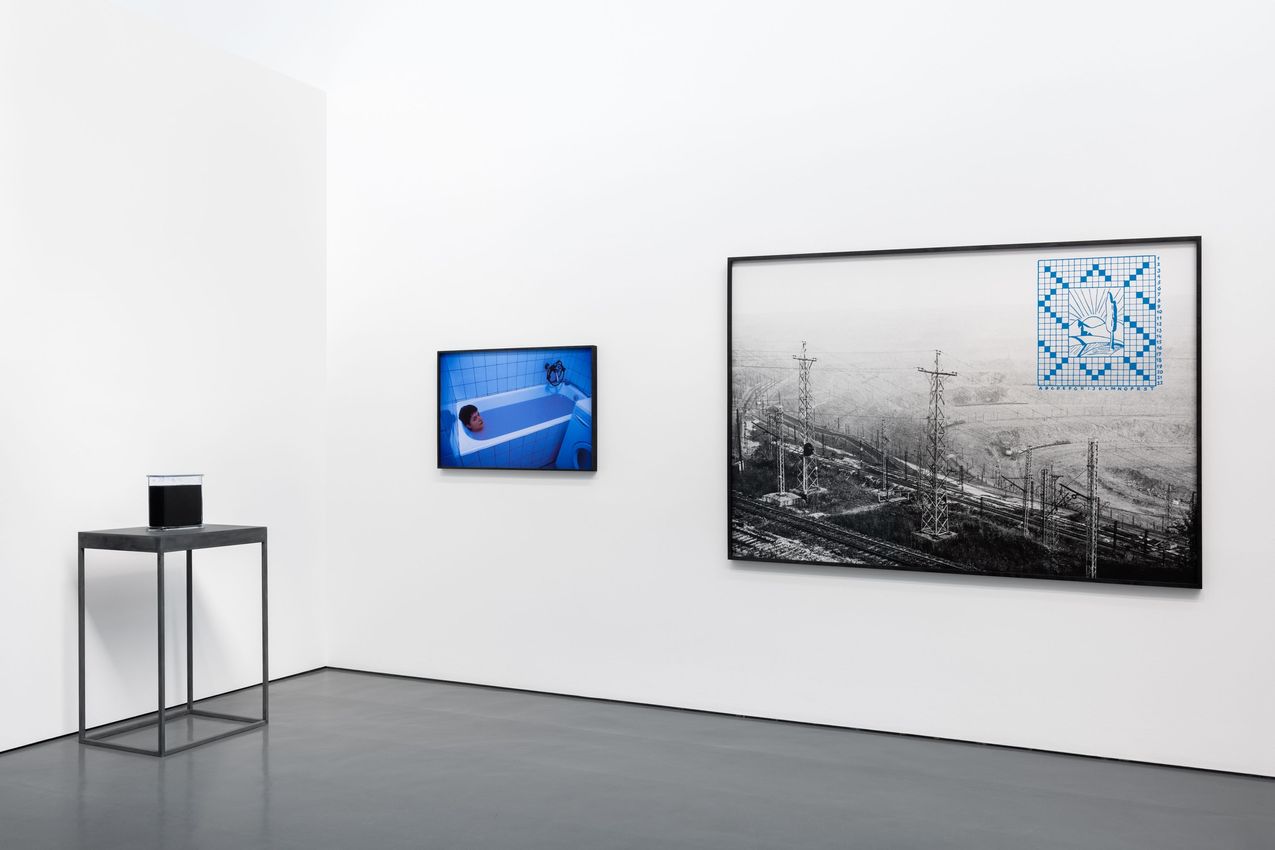
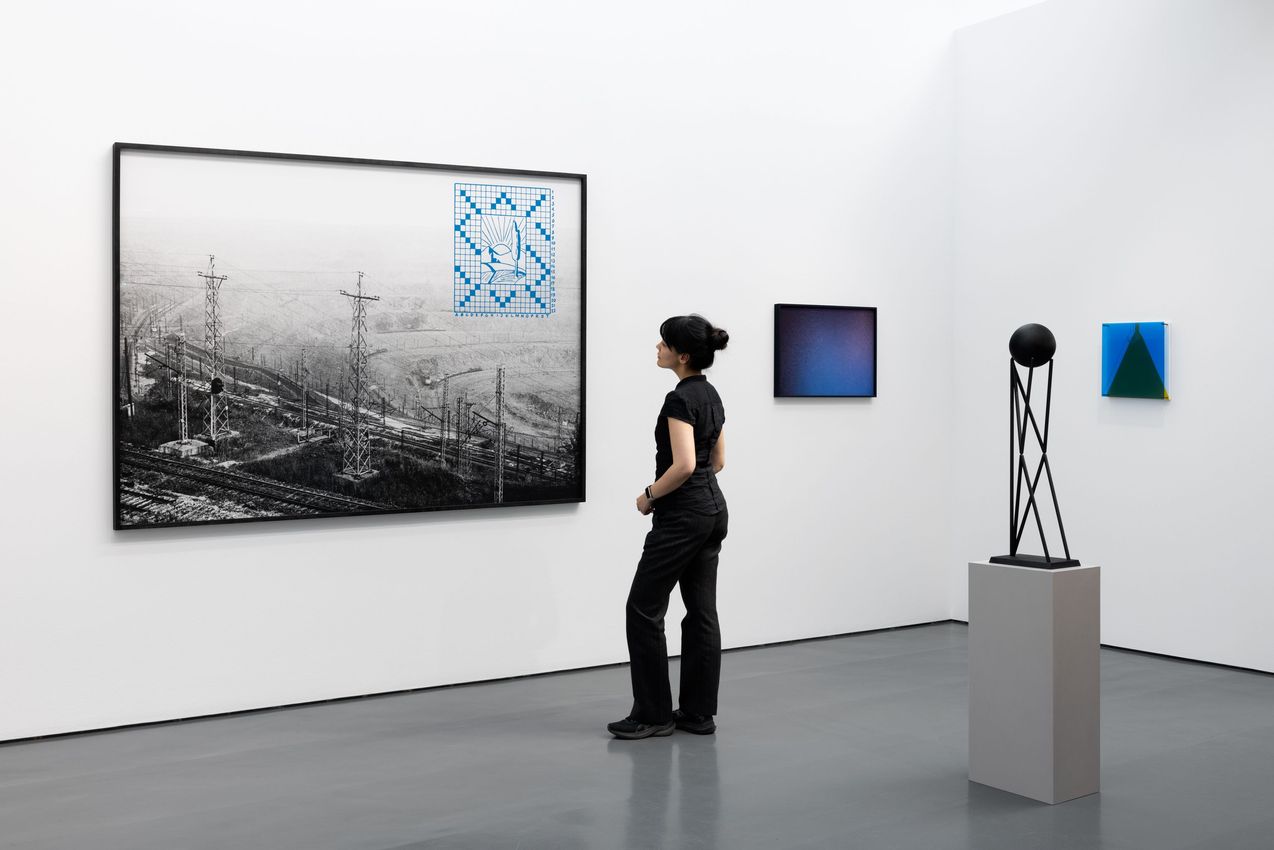
Crossword I, 2025, takes us into personal and political history. The first in a new series, it combines an archival image which Ondak reprinted and on which he then painted a crossword puzzle in light blue paint. The photo depicts a quarry. It is from the archives of a company in which the artist’s father once worked. The found crossword puzzle from the post-World War II era includes imagery of socialist propaganda. Crossword I becomes a historical palimpsest, interweaving the artist’s family’s and his home country’s life. Characteristic of Ondak’s general practice, the work has a slow burn: the enigmatic combination of the industrial site with a harmless pleasure of doing crossword puzzles invaded by propaganda affects us even before the multi-layered associations are unpacked.
Maja in Blue, 2025, another biographical work, is based on a photo taken in 1998 of the artist’s wife. It depicts a woman in a bathtub, the scene bathed in luminous blue. Her head appears large—the bathtub was very small—and disembodied, the body hidden below the surface of the water. Tightly cropped, the blue environment around her keeps her contained, perhaps even imprisoned as the dark grid of the tiles suggests. The intensity of her upward-turned gaze transports us into the past, or, it is her gaze that travels to our present.
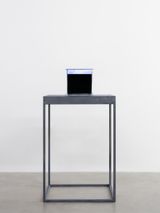
Memoirs, 2023, consists of a glass container with litres of dark blue liquid sealed inside. Identified as pen ink, the familiar colour and material evoke both writing and the ephemeral quality of memory and lived experience. What are we looking at? The tools for an account of a life yet unwritten or the accumulation of what has been written, now dissolved again; that is, something that remains to be given shape and meaning, or its dissolution?
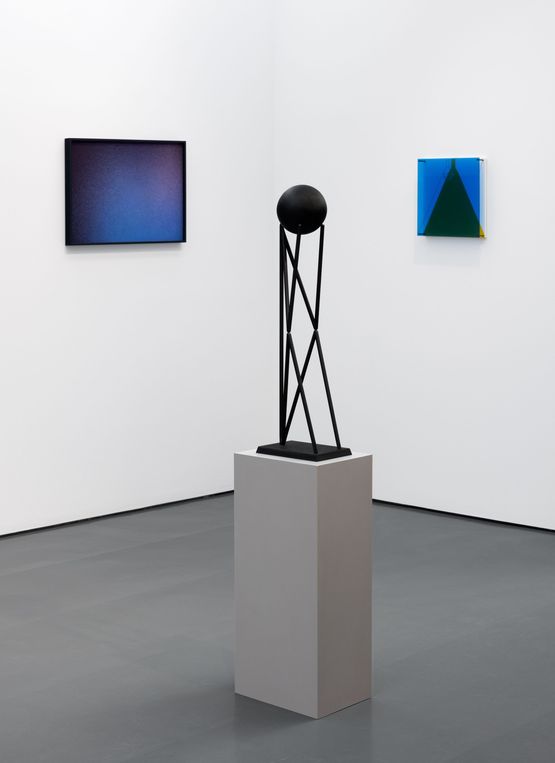
His Eyes Peer into the Gloom II, 1994, and Sea in my Room, 1997, two early works, are more literally about perception and misrecognition. The former is a wall-mounted construction of a blue sheet of Plexiglas with perforations that form a triangular shape. When seen from the front, the outline of a yellow area behind the transparent pane makes it appear as a light cone emanating from a lamp. Sea in my Room also plays with the associations everyday-life perceptions it can elicit: the picture of a dimpled glass surface is lit in such a way as to resemble a view of a shimmering expanse of water.
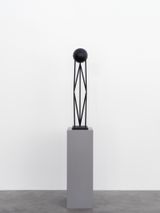
Melancholia, 2025, watching over this group of works, is a sculpture that resembles an abstracted seated figure, formed from a sphere and linear elements that read as torso and limbs. Conceptually, the new work is linked to the artist’s series of sculptures related to the first satellite Sputnik 1, assemblages from found materials that vaguely recalled the satellite’s circular shape and antennas. In another comment on past promises that have not been fulfilled, the satellite sent by man to explore space has turned into the image of a thoughtful, perhaps as the title suggests, melancholy human, similar to its namesake by Albrecht Dürer who sits and contemplates the nature of beauty and the course of history.
Roman Ondak’s work evolves from a performative conception and consists of sculpture, installation, photography, drawing and performance. The artist often uses found objects. His medium is the everyday and society’s sets of expectations, assumptions, automatisms and projections that shape our perception of reality. Although the collaborative approach is not always immediately visible, Ondak has also foregrounded the production of object-based elements by others: For his series of drawings and objects entitled Common Trip, for example, the artist asked others, among them family and friends, to make a drawing or object based on his description. Often, Roman Ondak transforms everyday rituals into poignant performative situations, obliquely addressing social and political ideas and images.


Esther Schipper founded the gallery in 1989 in Cologne. In 1997 the gallery relocated to Berlin. Through more than three decades of continuous exhibition practice, the gallery has established itself as a major force not only in Germany but in an international context, with offices in Paris and Seoul and representatives in France, Spain, the United States, Latin America, South Korea, Taiwan and China. The gallery holds up to ten gallery exhibitions as well as multiple off-site projects each year and participates in leading art fairs across the globe.

A respected voice in contemporary art discourse.
Focusing on ambitious storytelling and insightful art-world commentary. Ocula Magazine publishes in-depth interviews, critical essays and timely analysis on the artists, exhibitions and ideas driving the global art world.
Learn more about Ocula Magazine
Showcasing the best of the art world.
Ocula partners with galleries from around the world to highlight their artists, artworks and exhibitions. Gallery membership is by application and invitation, with each member vetted by an independent panel.
Learn more about Ocula Membership

Specialises in the sale of major artworks.
Led by a team with deep ties to the world’s leading auction houses, galleries and collectors. Ocula’s advisory team offers bespoke services to high-net-worth clients from around the world who are looking to acquire the best of contemporary and modern art.
Learn more about our team and services