





TOMIE OHTAKE
1913-2015, JapanTomie Ohtake was a Japanese Brazilian abstract artist whose paintings, prints, and sculptures helped define post-war abstract art in Brazil, and whose monumental public works have become enduring landmarks in São Paulo and beyond. Over a prolific career, Ohtake became one of Brazil’s most celebrated abstractionists, known for a luminous language of colour, curvature, and controlled chance.
Early life and Background
Tomie Ohtake arrived in São Paulo in 1936 to visit her brother and remained in Brazil following the outbreak of the Second World War, later becoming a central figure in the country’s modern art scene. She began painting comparatively late, around the age of 39, initially studying with Japanese painter Keisuke (also rendered Keiya) Sugano and exhibiting figurative landscapes that drew on everyday views from her home.
In the early 1950s, Ohtake joined the Seibi Group, a collective of Japanese artists in São Paulo, and rapidly shifted from post-impressionist-inflected figuration to geometric abstraction. Her first solo institutional show took place at the Museu de Arte Moderna de São Paulo in 1957, followed by participation in the São Paulo Biennial from 1961 and subsequent appearances in major international biennials, including Venice and Tokyo.
Tomie Ohtake Artworks
Tomie Ohtake’s artworks span painting, printmaking, and sculpture, uniting Japanese aesthetic sensibilities—emptiness, restraint, and calligraphic line—with the chromatic intensity and spatial scale of Brazilian modernism. Across these mediums, Ohtake used colour, curvature, and subtle depth to evoke natural phenomena and landscapes without direct representation, developing a distinctive abstract vocabulary that resists strict alignment with Concrete or Neo-concrete movements.
Blind paintings and early abstraction
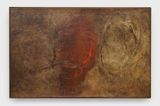
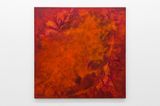
From the late 1950s, Ohtake developed her so-called ‘blind paintings’, made while blindfolded to foreground intuition and gesture. These works feature soft, gestural abstractions—arabesque lines, spots, and circular brushstrokes—that dissolve recognizable forms into fluid, atmospheric fields of colour.
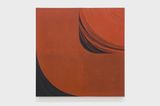
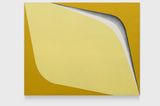
Through the 1960s, Ohtake’s paintings and prints increasingly engaged with geometric structures, often framing fields of saturated red, blue, or yellow with curved or rectangular bands that suggest portals or celestial phenomena. Her interest in the curve—both as compositional device and as a way to register movement—laid the groundwork for her later sculptural practice.
Colour, geometry, and mature painting
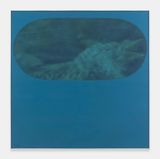
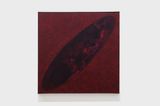
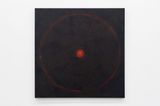
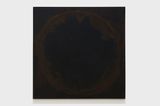
By the 1970s and 1980s, Ohtake had refined a language of bold yet balanced compositions, often juxtaposing large, floating forms against expanses of carefully modulated colour. Her canvases from this period frequently employ circles and ovals, sometimes slightly off-centre, whose edges shift from crisp to feathered, heightening a sense of vibration and spatial ambiguity.
In later decades, Ohtake’s paintings and prints sustained this focus on the curve and on chromatic nuance, while compositions became ever more distilled—single arcs, bands, or disks of colour that seem to hover against monochrome grounds, suggesting planetary bodies, eclipses, or unfolding waves.
Tomio Ohtake Sculpture and Public Works
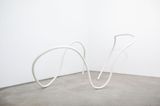
Ohtake introduced sculpture to her practice in the 1970s, initially creating smaller works before moving into monumental public commissions from the early 1980s onward. These public works, fabricated in materials such as painted steel, concrete, and glass mosaic, transpose the curves and chromatic contrasts of her paintings into large-scale forms that often read as ribbons, arcs, or waves in urban space.
Tomio Ohtake sculptures across Brazil—including iconic pieces throughout São Paulo and works such as a wave-shaped monument marking the 80th anniversary of Japanese immigration to Brazil (2008)—are characterised by a paradoxical lightness, with sweeping lines that seem to defy the actual weight of their materials. Installed at Ark Hills Sengokuyama Mori Tower in Tokyo, the monumental yellow ribbon-like sculpture Infinity extends this engagement with the city, signalling her impact on public art beyond Brazil.
Select Public Commissions
- Wave-shaped monument commemorating the 80th anniversary of Japanese immigration to Brazil, São Paulo (2008)
- Mosaic murals for Consolação metro station, São Paulo
- Infinity, monumental yellow ribbon-like outdoor sculpture, Ark Hills Sengokuyama Mori Tower, Tokyo
Select Awards and Accolades
- Artistic Personality of the Year, Brazilian Association of Art Critics (ABCA), Rio de Janeiro (1983)
- Order of Cultural Merit, Brazil (awarded in the 2000s)
- Itamaraty Award, São Paulo Biennial (1967 edition)
To be kept up to date with news relating to Tomie Ohtake follow her on Ocula.
Tomie Ohtake Exhibitions
Tomie Ohtake has been the subject of solo and group exhibitions at major museums and galleries in Brazil, Japan, and internationally, reflecting her status as a leading figure in Brazilian abstraction. Below is a selection of important exhibitions. To be kept up to date with upcoming exhibitions featuring Tomie Ohtake follow her on Ocula; you can also view her exhibitions on Ocula.
Select solo exhibitions
- 2016 – Tomie Ohtake, Tina Kim Gallery, New York
- 1988 – Tomie Ohtake: retrospective, Hara Museum of Contemporary Art, Tokyo
- 1983 – Tomie Ohtake, Museu de Arte de São Paulo (MASP), São Paulo
- 1957 – Solo exhibition, Museu de Arte Moderna de São Paulo (MAM-SP), São Paulo
Select group and biennial exhibitions
- 2024 – Abstractions, Biennale Arte 2024, Venice
- 1970s – Venice Biennale (various editions)
- 1970s – Tokyo Biennale (various editions)
- 1961 – São Paulo Biennial, São Paulo
- 1950s–1960s – Multiple Modern Art Salons, including 6th and 8th Salons at Galeria Prestes Maia, São Paulo
Sign up to Ocula to follow Tomie Ohtake, learn more about Tomie Ohtake’s art for sale, and keep up to date with upcoming exhibitions.
Tomie Ohtake FAQs
Who is Tomie Ohtake?
Tomie Ohtake was a Japanese Brazilian abstract artist, born in Kyoto in 1913 and active in São Paulo, known for paintings, prints, and sculptures that combine Japanese aesthetics with Brazilian modernism. You can follow Tomie Ohtake on Ocula to learn more about Tomie Ohtake’s work, find out about art for sale, contact Tomie Ohtake’s galleries, and keep up to date with upcoming exhibitions.
Where can I see work by Tomie Ohtake?
Tomie Ohtake’s work is held in major public collections, including The Museum of Modern Art, New York; The Metropolitan Museum of Art, New York; Dallas Museum of Art; Mori Art Museum, Tokyo; M+, Hong Kong; and leading Brazilian institutions such as MASP and Pinacoteca do Estado. You can follow Tomie Ohtake on Ocula to receive alerts on upcoming exhibitions by Tomie Ohtake.
Are there any lesser known and interesting facts about Tomie Ohtake?
Tomie Ohtake began painting only in her late thirties, after moving to Brazil, and developed her ‘blind paintings’ series by working while blindfolded to prioritise intuition. You can follow Tomie Ohtake on Ocula to receive alerts on news about Tomie Ohtake.
Where did Tomie Ohtake live?
Tomie Ohtake lived and worked in São Paulo, Brazil, for most of her life after emigrating from Kyoto in 1936. Tomie Ohtake and her family lived in neighbourhoods including Mooca and later in a home-studio environment that played a major role in Tomie Ohtake’s work.
How is Tomie Ohtake’s name pronounced?
Tomie Ohtake’s name is typically pronounced ‘TOH-mee-eh OH-tah-keh’, reflecting Japanese phonetics.
Where can I buy Tomie Ohtake’s work?
Tomie Ohtake is represented by leading contemporary art galleries, including those in Brazil, the United States, and Asia, and works are available through these galleries and on the secondary market.
You can explore Ocula to find out which Ocula galleries represent Ohtake and enquire directly about buying art by Tomie Ohtake, and follow the artist and her galleries to keep up to date. You can also get in touch with Ocula’s art advisory team to find out more about buying or selling work by Tomie Ohtake.
Ocula | 2025


View Tomie Ohtake's Artworks




















Explore and Follow Artists Shaping Contemporary Art
A respected voice in contemporary art discourse.
Focusing on ambitious storytelling and insightful art-world commentary. Ocula Magazine publishes in-depth interviews, critical essays and timely analysis on the artists, exhibitions and ideas driving the global art world.
Learn more about Ocula Magazine
Showcasing the best of the art world.
Ocula partners with galleries from around the world to highlight their artists, artworks and exhibitions. Gallery membership is by application and invitation, with each member vetted by an independent panel.
Learn more about Ocula Membership
Specialises in the sale of major artworks.
Led by a team with deep ties to the world’s leading auction houses, galleries and collectors. Ocula’s advisory team offers bespoke services to high-net-worth clients from around the world who are looking to acquire the best of contemporary and modern art.
Learn more about our team and services