Such feeling cannot be recalled again; it seemed long lost even when it was felt then.—Li Shangyin, The Sad Zither
Gagosian is pleased to announce The Sad Zither, the first solo exhibition in Europe by Chinese painter Hao Liang.
In his delicate but immersive landscape and figure paintings, and in his choice of literary references, Hao reflects on a spectrum of emotions while considering the passage of time and the ways in which we move through the world. Giving the methods and motifs of traditional Chinese ink wash painting a contemporary spin, he highlights the genre’s unique materiality while drawing on sources from cinema, modernist art, and Chinese and Western literature. Hao employs the guohua technique to make compositions on silk that are subtly toned and tinted, but indelible, accentuating his subjects’ complexity and infusing narrative and allegorical references with atmosphere and feeling.
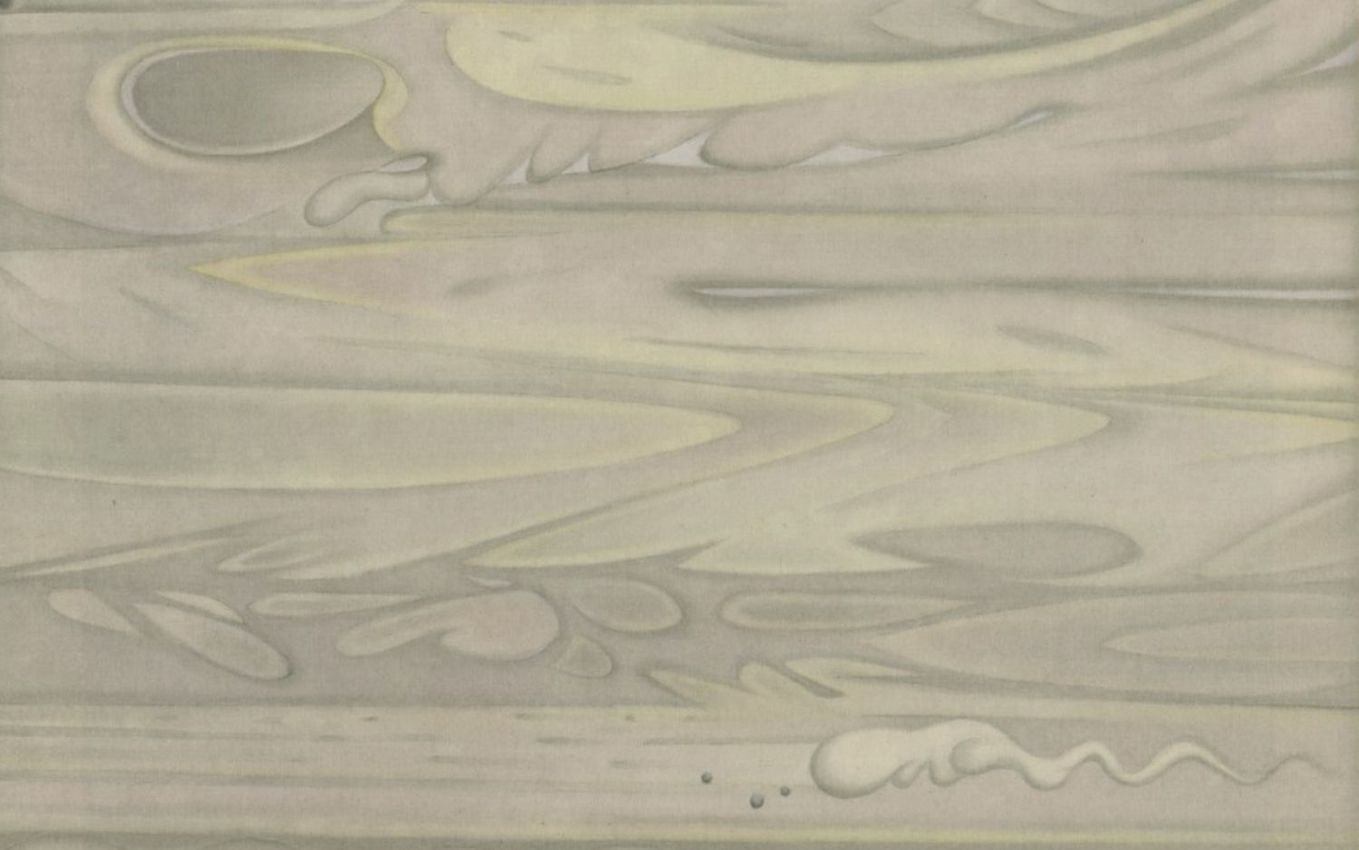
In the thirteen paintings on view at Gagosian’s Grosvenor Hill gallery, which were produced over the past two years, Hao explores themes and symbols from fiction and poetry, engaging with the works of Dante, Argentine writer Jorge Luis Borges, and Chinese poets Tao Yuanming (c. 365–427 CE), Li Shangyin (813–858 CE), and Du Mu (808–852 CE). The exhibition’s title alludes to Qian Zhongshu’s book _On the Art of Poetry _(1948), specifically the annotated text of Li Shangyin’s poem The Sad Zither, which notes various parallels between the verse and the instrument, including their translations of emotion into symbol, and their aesthetics of “rhythm and vitality.” In three paintings from 2021 named for this Tang dynasty literary and political figure, Hao presents the most impressionistic of all the exhibition’s works—shimmering, near-abstract interpretations of the writer’s texts on emotion and the natural world.
Hao’s Gatha by Ikkyū (2022) is a landscape featuring three distant figures in which a backdrop of trees adopts an ominous form suggestive of dark clouds, and a faint line of what looks like blood cuts across the skyline. The title derives from a phrase coined by Zen master Ikkyū Sōjun: ‘The blind leading the blind.’ The wistful Searching for the Peach Blossom Land to No Avail (2022), a quiet image of a tranquil landscape rendered in gentle grisaille, draws on an ancient Chinese source, Tao Yuanming’s Account of the Peach Blossom Spring (421 CE), a fable about the chance discovery of a utopian realm whose inhabitants subsist in harmony with nature.
In Divine Comedy II (2022), a disconsolate figure walks toward a group of bare trees in an otherwise barren landscape as a snake coils up from the ground. The composition is veiled by a ragged chain-link fence. Here Hao’s allusion is to Inferno—the artist has discussed his admiration for Osip Mandelstam’s reading of Dante, further remarking on the mastery of symbolism that the Russian poet shares with Li Shangyin. In Under a Tree in Britain (2022), a huge whirlpool covers the surface of a lake as a demonic figure stands beneath a tree and a second figure, in the lower right corner, walks past inconspicuously. The image refers to an incident from Borges’s story The Garden of Forking Paths, in which the narrator’s relative has penned a novel that explores every possible choice simultaneously: ‘I thought of a labyrinth of labyrinths,” the narrator relates, “of a meandering, ever-growing labyrinth that would encompass the past and future.’
A catalogue featuring texts by Travis Diehl and Zhu Zhu will be published to accompany the exhibition.
Hao Liang was born in 1983 in Chengdu, China, and lives and works in Beijing. His work is held in the collections of the Metropolitan Museum of Art, New York; Centre Pompidou, Paris; Kadist, San Francisco; and Bonnefantenmuseum, Maastricht, Netherlands, among others. Recent institutional exhibitions include Hao Liang: Aura, Bonnefantenmuseum, Maastricht, Netherlands (2016); Hao Liang: Eight Views of Xiaoxiang, Ullens Center for Contemporary Art, Beijing (2016); 57th Biennale di Venezia, Venice (2017); Streams and Mountains without End: Landscape Traditions of China, Metropolitan Museum of Art, New York (2017); and 1977–2017: Le Centre Pompidou fête ses 40 ans, Centre Pompidou, Paris (2017).


A respected voice in contemporary art discourse.
Focusing on ambitious storytelling and insightful art-world commentary. Ocula Magazine publishes in-depth interviews, critical essays and timely analysis on the artists, exhibitions and ideas driving the global art world.
Learn more about Ocula Magazine
Showcasing the best of the art world.
Ocula partners with galleries from around the world to highlight their artists, artworks and exhibitions. Gallery membership is by application and invitation, with each member vetted by an independent panel.
Learn more about Ocula Membership

Specialises in the sale of major artworks.
Led by a team with deep ties to the world’s leading auction houses, galleries and collectors. Ocula’s advisory team offers bespoke services to high-net-worth clients from around the world who are looking to acquire the best of contemporary and modern art.
Learn more about our team and services