



Press Release

The Acropolis is wonderful—more marvellous than ever I imagined. . . . it’s the greatest thrill I have ever had.—Henry Moore, 1951

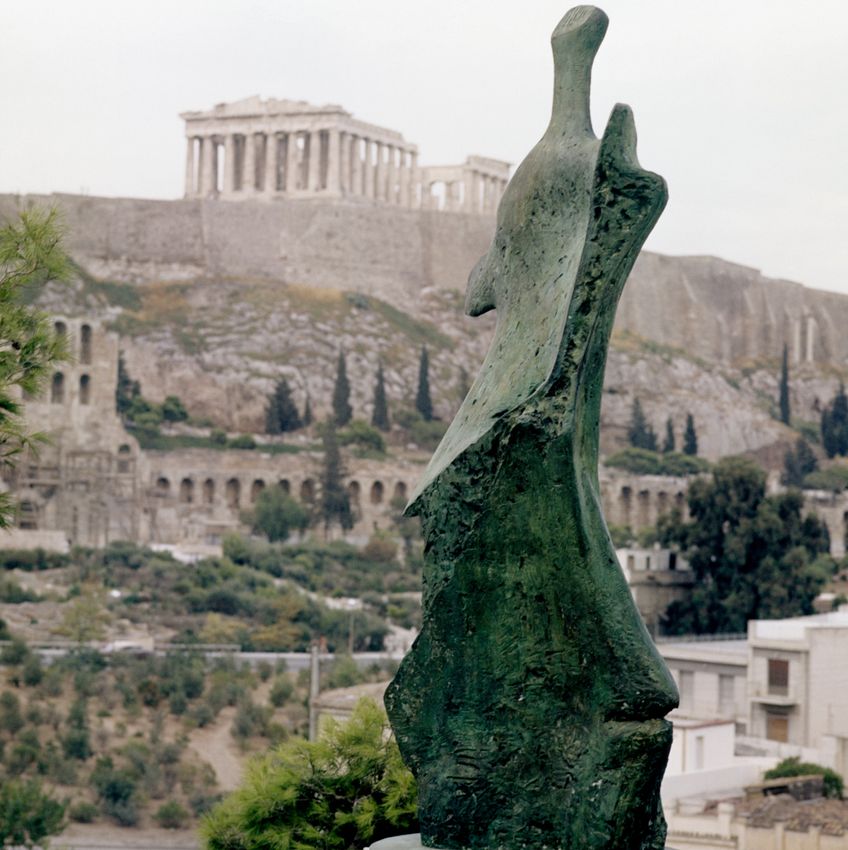
Gagosian is pleased to announce Henry Moore and Greece, organised in collaboration with the Henry Moore Foundation. Opening September 12, it is the first exhibition of the artist’s work in Greece in twenty years. Featuring a selection of work spanning Moore’s career, it illuminates the artist’s fascination with ancient Greek art, which he developed during a trip to Greece in 1951 — a few months before his first retrospective at the Tate, London.

In his early stone and wood carvings, Moore had turned away from classical tradition, deriving inspiration mostly from non-European cultures, for example, African and Mesoamerican art. It was not until the early 1950s, and especially following his 1951 visit to Greece, that his attention became increasingly drawn to Greek art. Modelling in clay or plaster and casting in bronze allowed him to work on a larger scale and to incorporate a greater sense of movement in his sculptures. Fragmentary figures—increasingly male and designed to be seen in the round—show more varied surface treatments than those of his earlier work and often incorporate clinging drapery.

Henry Moore and Greece explores links between Moore’s practice and earlier, antique Greek art, such as Cycladic sculpture. The artist made his one and only visit to mainland Greece in 1951 for an exhibition at the Zappeion Hall in Athens, also traveling to the archaeological sites of Delphi, Olympia, and Mycenae. He did not exhibit again in Athens until 1965. Large Standing Figure: Knife Edge (1961) is one of Moore’s tallest and most striking postwar bronzes, informed by his interest in Cycladic figurines but at the same time recalling The Winged Victory (or Niké ) of Samothrace (c. 200–190 BCE). The exhibition also includes casts of Draped Reclining Figure (1952–53), Falling Warrior (1956–57), and the heads of King and Queen (1952–53)—key sculptures in Moore’s dialogue with Greek art.

On the occasion of the exhibition, the Henry Moore Foundation is releasing three previously unpublished prints from a cycle of seven lithographs and etchings that were completed by the artist in 1984. Henry Moore and Greece also features thirty prints and drawings, including three colour lithographs from illustrations to Goethe’s Prometheus (Prométhée) (translated into French by André Gide and published in Paris in 1950) that demonstrate Moore’s existing interest in Greek mythological themes; photographs and archival material provide further context.

This is the third collaboration between Gagosian and the Henry Moore Foundation, following the exhibitions Late Large Forms at Britannia Street, London, and West 21st Street, New York, in 2012 and Wunderkammer—Origin of Forms at Davies Street, London, in 2015.

Read More
About the Artist

A giant of modern sculpture, Henry Moore engaged the abstract, the surreal, the primitive, and the classical in vigorous corporeal forms that are as accessible and familiar as they are avant-garde. His large-scale works celebrated the power of organic imagery at a time when traditional representation was largely eschewed by the vanguard art establishment. Their overwhelming physicality and forceful presence promotes a charged relation between sculpture, site, and viewer.

View Artist Profile

Also Exhibiting at Gagosian

About the Gallery
Gagosian is a global network of art galleries specialising in modern and contemporary art with eighteen exhibition spaces worldwide.
View Gallery Profile
Address
22 Anapiron Polemou Street Athens 11521
Opening Hours
Tues - Sat, 11am - 7pm
Except Thursday, 11am - 8pm
(1)
Athens 22 Anapiron Polemou Street
Gagosian
22 Anapiron Polemou Street, Athens, Greece
+30 210 364 0215

Opening hours
Tues - Sat, 11am - 7pm
Except Thursday, 11am - 8pm
The art world in focus