




ANTONI TÀPIES
1923-2012, SpainAntoni Tàpies was an influential Catalan artist and art theorist whose sculptures, etchings, lithographs, and paintings can be found in major collections around the world. His essays on art have been included in several international publications.
Early Years
Barcelona-born Antoni Tàpies studied law at the University of Barcelona from 1944. Aside from taking evening classes in drawing at Academia Valls during his studies, Tàpies was a self-taught artist. He first encountered contemporary art as a teenager in the Catalan magazine D’Ací i d’Allà (From here and there).
In 1946, a year after producing his first impasto works, Tàpies abandoned his studies to pursue painting. Initially drawing from Surrealist and Primitivist styles, he produced both abstract and figurative paintings, and used collage to create crosses out of scraps of newsprint and toilet paper—an echo of his Catholic education.
In 1948, Tàpies was involved in establishing the Surrealist-influenced avant-garde group Dau al Set. His works over this period were heavily influenced by Joan Miró and Paul Klee. Depicting monstrous, deformed figures and abstract linear patterns set in bizarre landscapes, Tàpies’ approach to colour, light, and shadow in these works generated mystical atmospheres.
Tàpies presented his first solo exhibition in 1950 at the Galeries Laietanes in Barcelona—a city that endured as his personal and professional home, although he travelled often throughout his life.
Antoni Tàpies Artworks
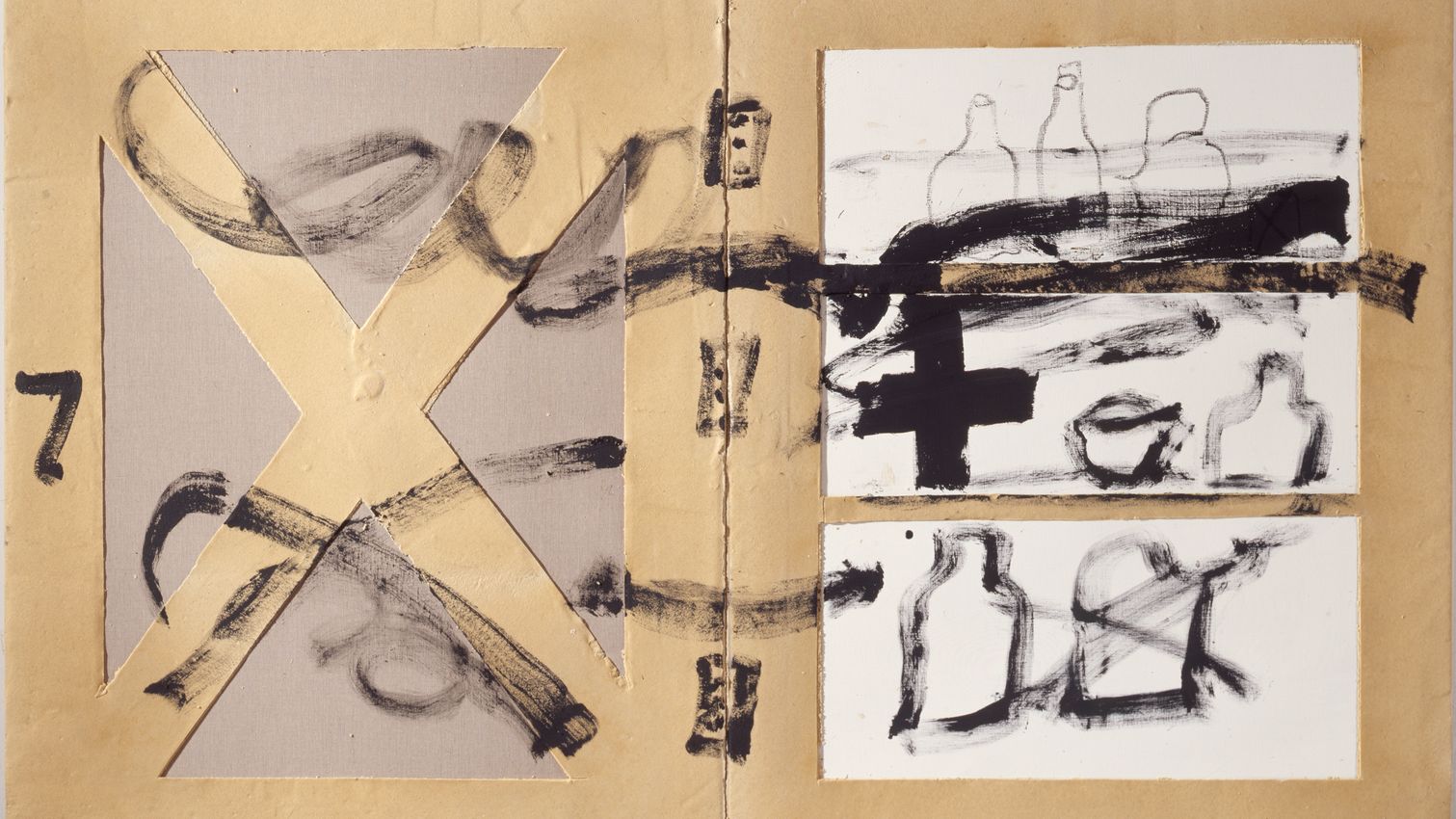
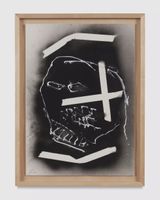
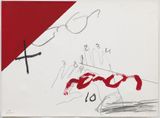
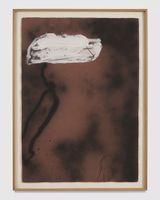
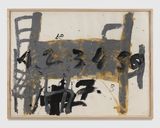
In his mixed media abstractions, Antoni Tàpies developed a complex visual language featuring materials, gestures, and symbols inspired by personal experience, history, and his native Catalonia.
Art Informel
In 1953, Tàpies turned his attention exclusively to abstraction and mixed media. He was drawn to Art Informel—one of the most prevalent art styles in post-war Europe—particularly after seeing Abstract Expressionism during his first New York solo exhibition at the Martha Jackson Gallery.
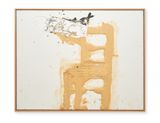
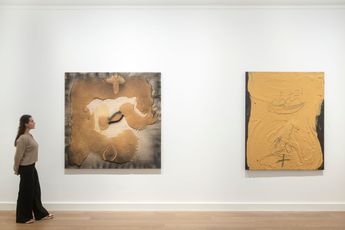
Much of Tàpies’ work sought to undermine fine art conventions by mixing non-traditional materials such as sand, soil, clay, and marble dust with paint, and including discarded materials such as paper, string, and rags. Resulting works comprised dense, monochromatic surfaces and were rich in textural patterns for which the artist became known.
Furniture in Sculpture
Influenced by Pop art in the late 1960s, Tàpies began to incorporate more substantial objects from his surroundings, crossing into the territory of Arte Povera. In his 1979 essay ‘Nothing is Mean’, Tàpies expressed his firm belief in the validity of the commonplace. This could include materials from socks to pieces of furniture. The artist often utilised doors and windows, as well as the bed for its symbolic associations with life, love, and death—as seen in the mixed media on canvas painting Díptic nocturn (1993).
A bold example of Tàpies’ incorporation of furniture in his work was the Homage to Picasso (1981) at Passeig de Picasso in Barcelona. The monumental outdoor sculpture consists of modernist furniture pierced by iron bars, tied together with ropes and draped with a sheet. The assemblage is housed within a four-metre glass cube that operates as a fountain.
Social and Political Themes
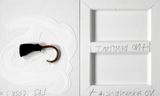
Alongside his development of abstract works that incorporated non-traditional materials, Tàpies also explored social and philosophical themes. A strong sense of his Catalan identity ran through his works in the early 1970s, such as The Catalan Spirit (1971), and the lithograph series ‘Assassins’ (1974) which also reflected the artist’s opposition of Francisco Franco’s regime. In the 1970s and 1980s, Tàpies developed an interest in Zen philosophy, existentialism, and the notion of the void. He began producing works that meditated on emptiness and the materiality of life. In Empreintes d’assiettes (1973) and Silhouette de baignoire (1982), Tàpies represents the concept of absence in everyday life—seen through imprints left by a full table setting, and the silhouette cast by a bathtub.
Tàpies’ later works from the 1990s onwards carried increasing references to pain—both physical and spiritual—and death.
Awards and Accolades
Tàpies received many accolades over his lifetime. Among these were the Praemium Imperiale awarded by the Imperial family of Japan (1990); Honorary Member, Royal Academy of Arts, London (1992); Honorary Member, American Academy of Art and Sciences, Cambridge, Massachusetts (1992); Picasso Medal of UNESCO (1993); Cross of the Order of Santiago, Portugal (1996); Velázquez Prize, Spain (2003); Commander of the Order of the French Legion of Honor (2003).
In 2010, Tàpies was bestowed the hereditary title of Marqués de Tàpies by King Juan Carlos I of Spain.
In 1984, Tàpies established the Fundació Antoni Tàpies to promote the study and understanding of modern and contemporary art. Today the foundation displays a significant collection of Tàpies’ work and publications.
Exhibitions
Antoni Tàpies has been the subject of solo and group exhibitions internationally. He appeared at the Venice Biennale in 1952, 1958, and 1977.
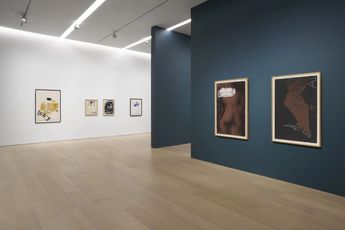
Solo exhibitions include Xhibition: Antoni Tàpies, Christie’s, London (2019); Antoni Tàpies: Retrospective, Hara Museum of Contemporary Art, Tokyo (2005); Museo Nacional Centro de Arte Reina Sofía, Madrid (2000); Tàpies, Guggenheim Museum SoHo, New York (1995); Antoni Tàpies: exposition rétrospective 1946/1973, Musée d’Art Moderne de Paris (1973).
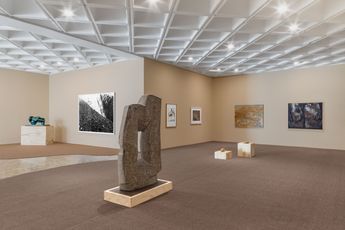
Group exhibitions include Mixed Double: The Lambrecht-Schadeberg Collection, MGKSiegen, Siegen (2022); High and Low: Modern Art and Popular Culture, Museum of Modern Art, New York (1990); Paris–Paris: Créations en France, 1937–1957, Centre Georges Pompidou, Paris (1981); European Painters Today, National Collection of Fine Arts, Smithsonian Institution, Washington, D.C. (1969); The 1952 Pittsburgh International Exhibition of Contemporary Painting, Carnegie Institute, Pittsburgh (1952).
Art Market
Tàpies’ artworks have fetched millions at auction. His highest selling work at auction was Gran ocra amb incisions (Large Ochre with Incisions) (1961) at Christie’s in 2014, which sold for USD 2,829,569, more than double the high estimate. In 2017, Arquitectura (Architecture) (1963) sold at Christie’s for close to USD 1.4 million.
Website
The website of the Fundació Antoni Tàpies can be found here.
Michael Irwin | Ocula | 2022

View Antoni Tàpies' Artworks




















Explore Antoni Tàpies' Exhibitions











Explore and Follow Artists Shaping Contemporary Art
A respected voice in contemporary art discourse.
Focusing on ambitious storytelling and insightful art-world commentary. Ocula Magazine publishes in-depth interviews, critical essays and timely analysis on the artists, exhibitions and ideas driving the global art world.
Learn more about Ocula Magazine
Showcasing the best of the art world.
Ocula partners with galleries from around the world to highlight their artists, artworks and exhibitions. Gallery membership is by application and invitation, with each member vetted by an independent panel.
Learn more about Ocula Membership
Specialises in the sale of major artworks.
Led by a team with deep ties to the world’s leading auction houses, galleries and collectors. Ocula’s advisory team offers bespoke services to high-net-worth clients from around the world who are looking to acquire the best of contemporary and modern art.
Learn more about our team and services