La Vigie
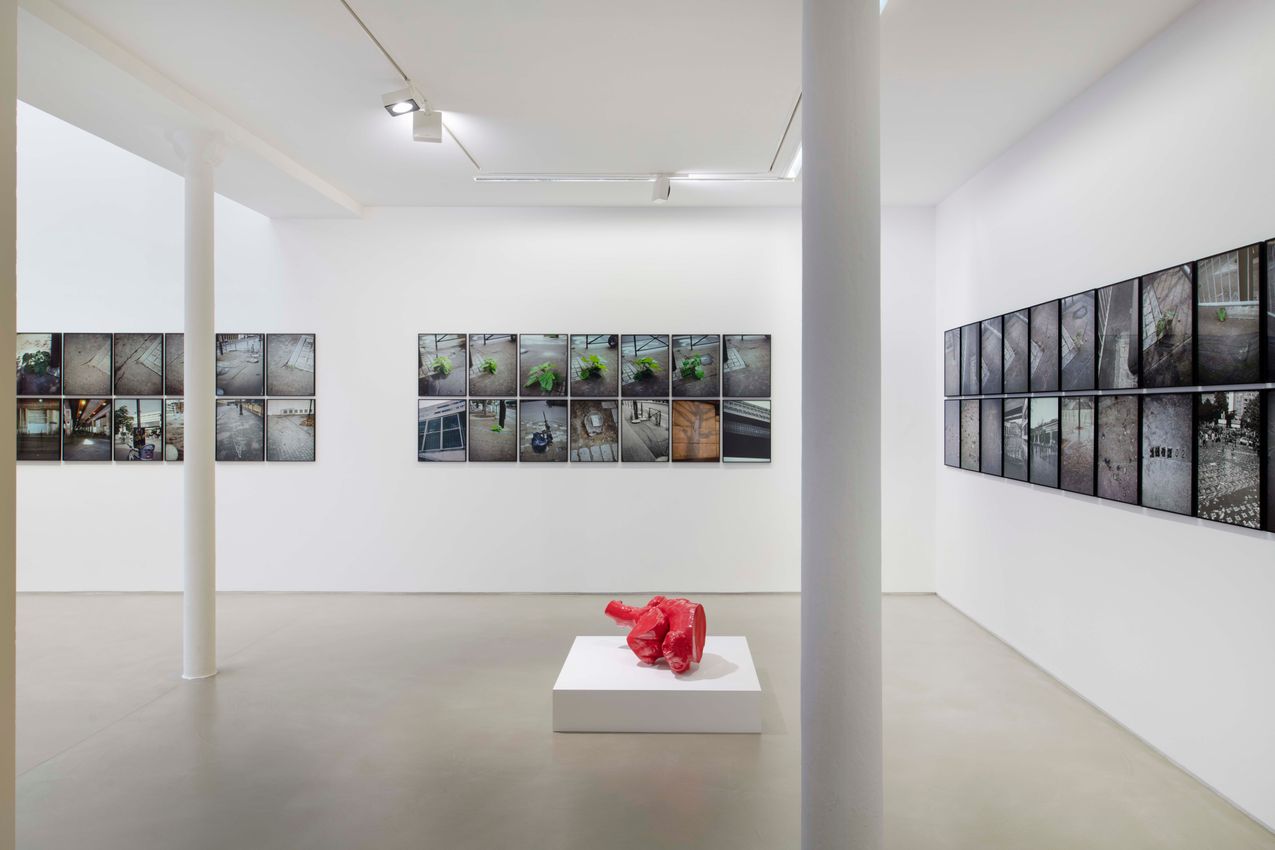
In 2004 Jean-Luc Moulène notices a stalk of Paulownia growing in the cracks of the sidewalk not far from the French Ministry of Economy, rue de Bercy. The experiment begins on 26 November 2004 and ends in December 2010.
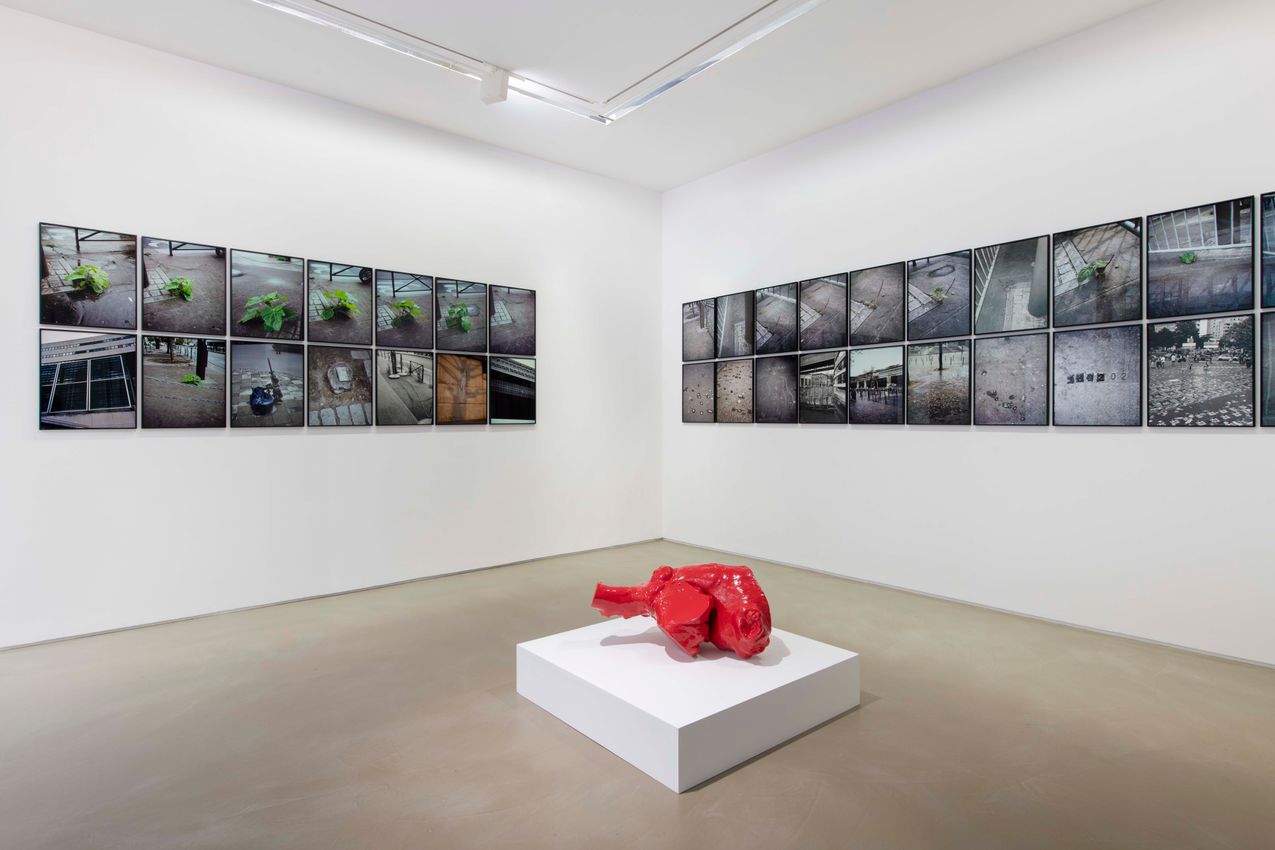
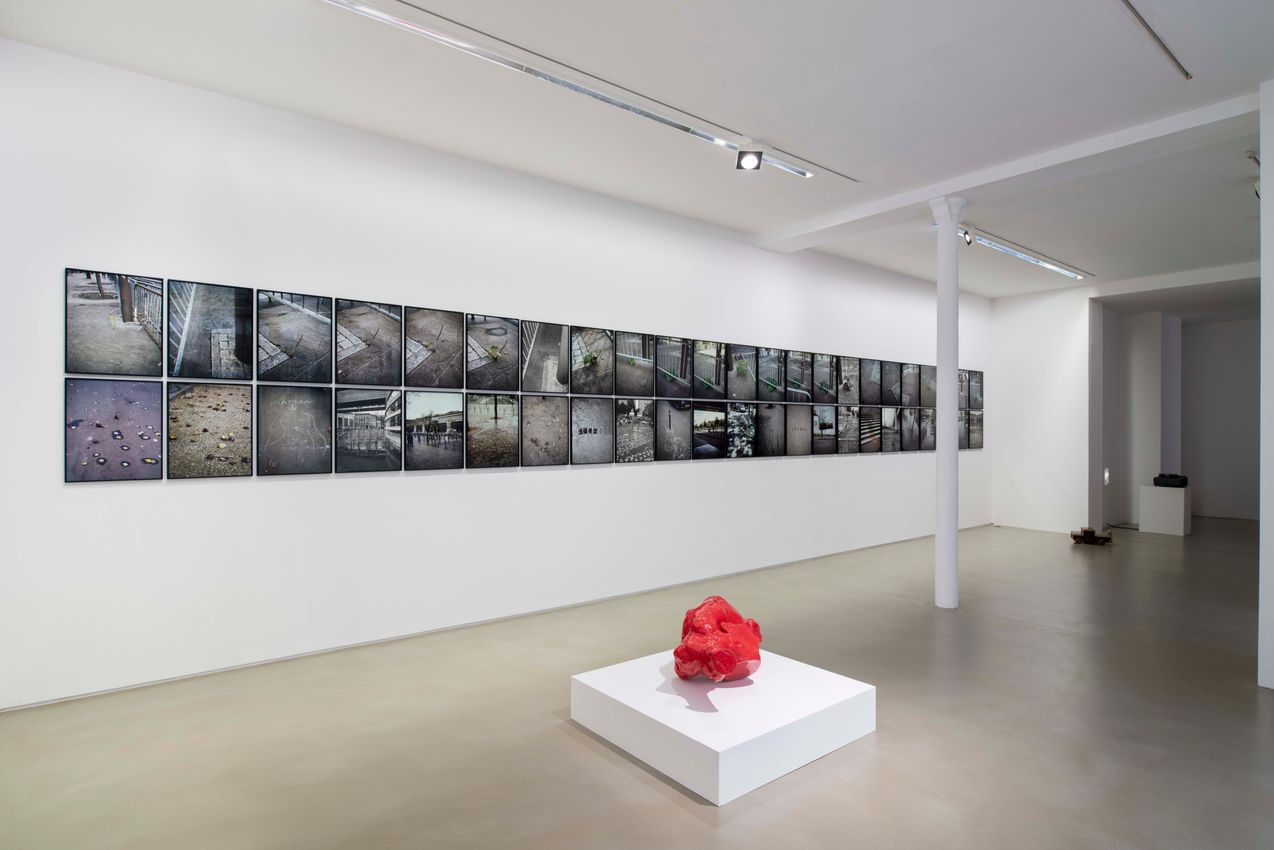
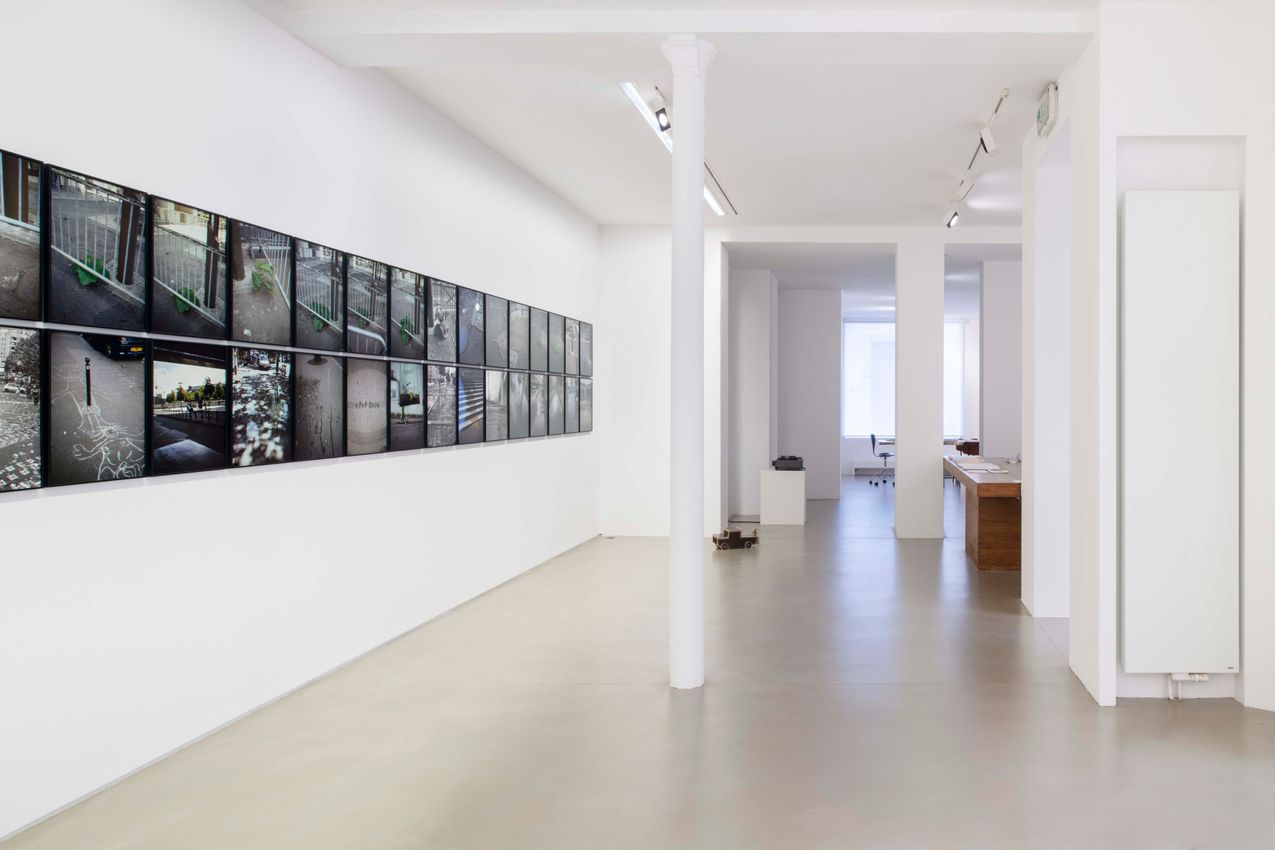
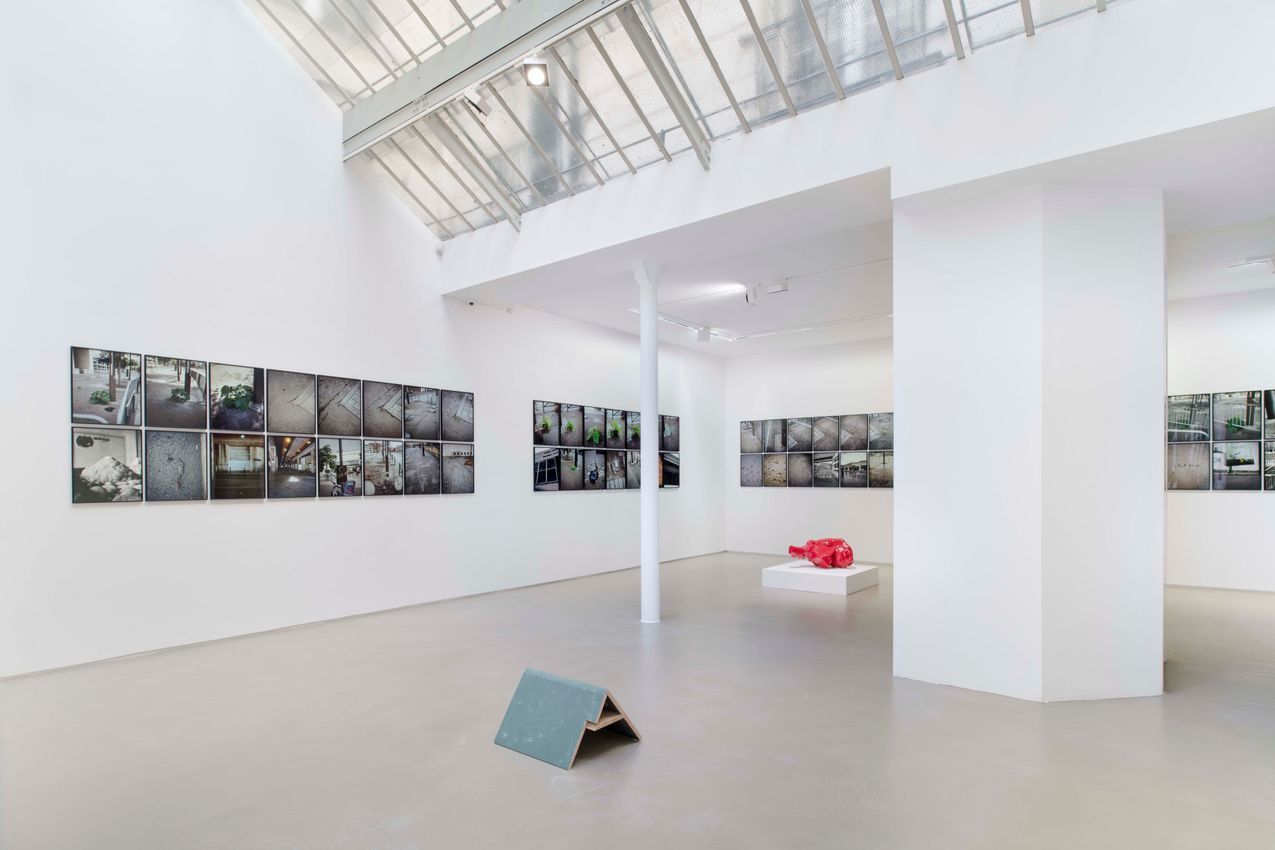
The series includes 299 photographs, printed in colour and in black and white. The top row describes chronologically the plant’s evolution throughout the seasons and different levels of the French security alert system, Vigipirate. When the alert level rises, the police barriers occupy the sidewalk and function as the plant’s protection. When the alert level lowers, the plant is no longer protected and becomes a prey of municipal sanitation services. The inferior row is a reversed angle without chronology and shows the surroundings of the Ministry of Economy where the plant is growing, providing another point of view of the plant’s environment.
La Vigie reveals an ever-shifting landscape including physical evidences of anti-terrorism vigilance and demonstrates Moulène’s interest in politics and strategies of resistance. It also reflects the impact that photography plays in the artist’s practice and extends his investigations into classification, production and circulation of images and objects.
Three sequences taken from the series are presented here.
Contre-Ciel
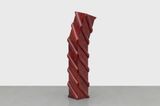
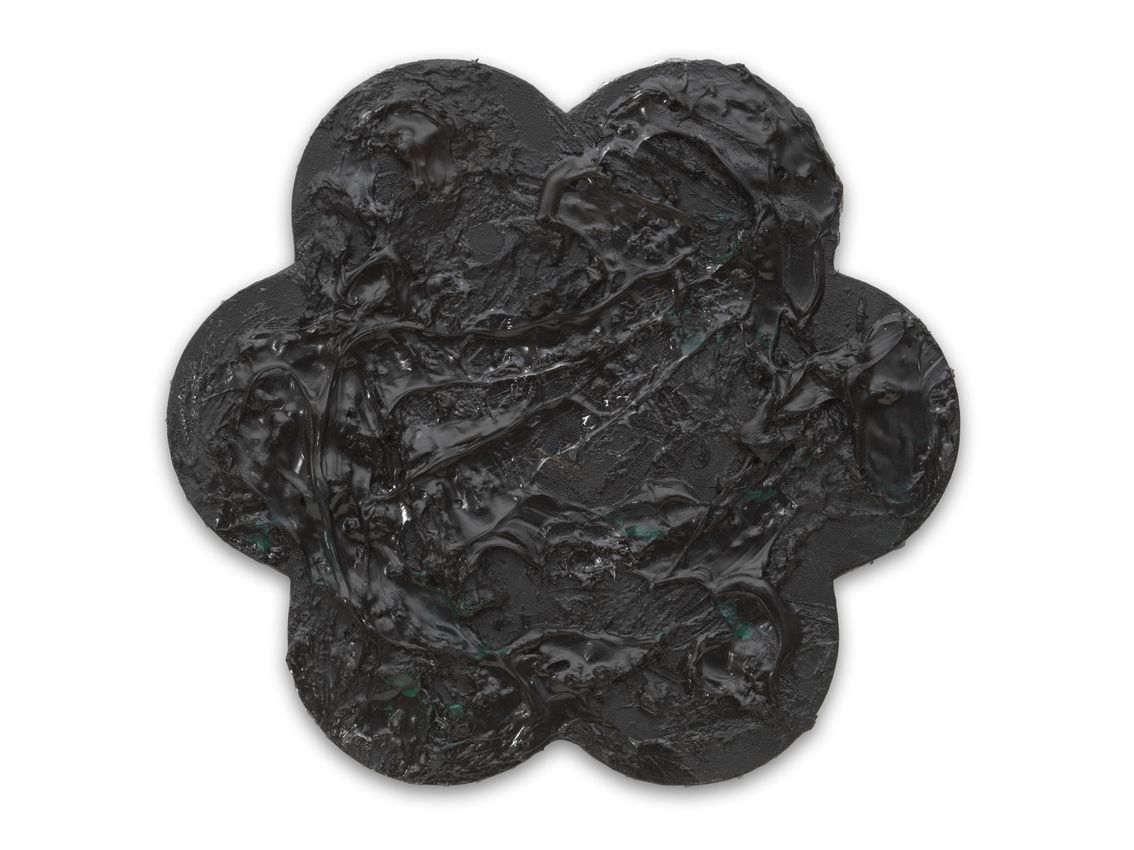
Contre-ciel is a sculpture made of reclaimed planks covered with blackboard paint. Each hole is drilled on the surface as a spiral. The artist’s changed the holes’ size, from small to large and from large to small, thus giving the spiral an oscillatory movement. In this work, Jean-Luc Moulène brings the sky down.
The work’s title, Contre-ciel, refers to René Daumal’s book Le Contre-Ciel (1936); Daumal is one of the Phrères simplistes and the founder of Le Grand Jeu* journal.
*Emerging at the same time as Surrealism, Le Grand Jeu grew out of experiments made by a group of young people from Reims including Roger Gilbert-Lecomte, René Daumal and Roger Vailland. From the journal’s first issue (1928) all members signed a foreword stating that: ’...we are not a literary group, but an union of men linked by the same research [...] art, literature are for us only means’.
Stomac
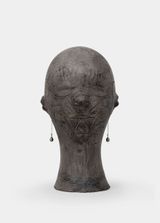
A pollard is a tree cut periodically at the same height. The pollard formation doesn’t depend on the tree variety but on its regular pruning. Bulges thus created generate folds and swellings which give the characteristic look to the pollard.
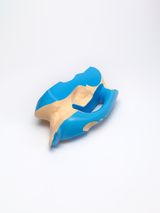
Stomac was produced in Mexico and is part of a series based on the same principle: in the Mexican countryside, the artist found and cut a tree pollard. Chosen for its anthropomorphic aspect, the pollard was then moulded and cast in ceramics at Cerámica Suro near by Guadalajara. By the use of its material this ‘hallucination’ is nonetheless bereft of any realism.
La Victoire de Bercy
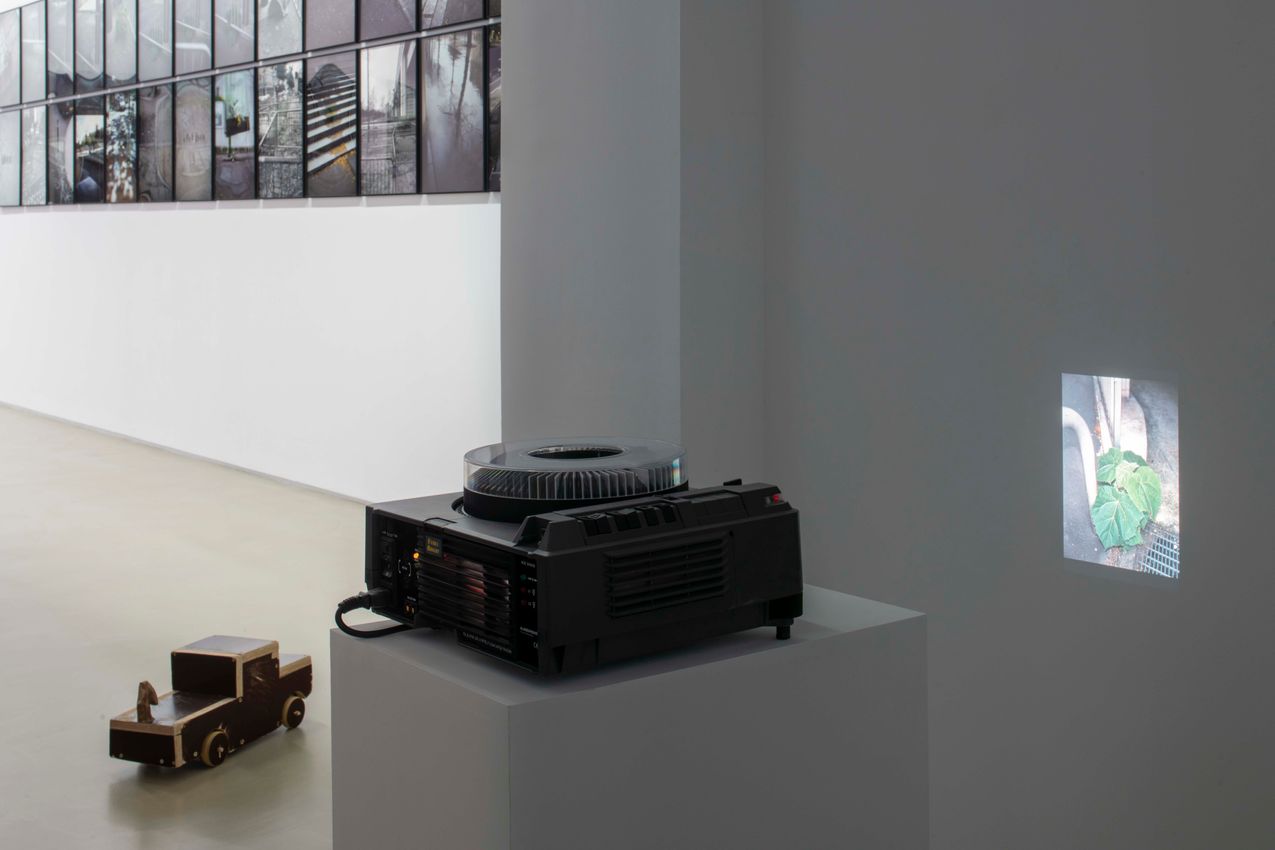
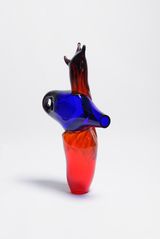
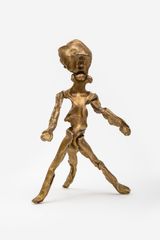
This sculpture dating from 2007, is a direct reference to handmade and ‘Do It Yourself’ children’s toys. Made from reclaimed plywood, Jean-Luc Moulène added a luxury sign which is a hood ornament like the ones adorning renowned car companies. Here, the artist’s finger made of brass is beckoning the spectator. The title refers to the artist’s Parisian neighbour: Bercy and to the Rolls-Royce’s ornament, recalling the Victory of Samothrace.
Plant
Plant is a group of 31 slides. Early stages of La Vigie, these images show the plant’s evolution over several months, growing wildly at a parking entrance near the artist’s home.
For more than twenty years, Jean-Luc Moulène has developed a complex body of work, both analytical and mysterious, of which photography has long constituted the most visible and best-known part. From the Disjunctions—a series of seemingly banal, frequently urban images that function as indeterminate topographical references at the heart of the real world—to the celebrated Objets de grève (‘Strike objects’: product shots of industrial artefacts made by striking workers, subverting the tools of their trade), Moulène’s photographs are strikingly raw, cruel and uncompromising, but always secretly metaphorical.


Located on rue Charlot in the 3rd arrondissement in Paris, Galerie Chantal Crousel presents a selection of artists highly diverse in their national and cultural origins and mediums who together contribute to a universal visual language.

A respected voice in contemporary art discourse.
Focusing on ambitious storytelling and insightful art-world commentary. Ocula Magazine publishes in-depth interviews, critical essays and timely analysis on the artists, exhibitions and ideas driving the global art world.
Learn more about Ocula Magazine
Showcasing the best of the art world.
Ocula partners with galleries from around the world to highlight their artists, artworks and exhibitions. Gallery membership is by application and invitation, with each member vetted by an independent panel.
Learn more about Ocula Membership

Specialises in the sale of major artworks.
Led by a team with deep ties to the world’s leading auction houses, galleries and collectors. Ocula’s advisory team offers bespoke services to high-net-worth clients from around the world who are looking to acquire the best of contemporary and modern art.
Learn more about our team and services