




JOSEF ALBERS
1888-1976, GermanyJosef Albers was a German-born American artist and educator who remains one of the most influential abstract painters of the 20th century. As a student and later a professor at the Bauhaus, Albers played a significant role in introducing the tenets of European Modernism to America.
Teaching
Albers’ three-decade teaching career began in 1922 when the Bauhaus hired him to work in the glass workshop. From 1923, he taught design in the institution’s Preliminary course. By 1925, he was teaching alongside Paul Klee and Wassily Kandinsky as a professor, whilst he continued to work in glass as well as furniture design and typography.
Upon his emigration to America in 1933—forced by Nazi hostility to the Bauhaus for its modernist tendencies, which they considered to be ‘un-German’—Albers was appointed as head of the art department at North Carolina’s Black Mountain College and stayed there until 1949. Although the new liberal arts college was to close prematurely in 1957, it was instrumental in exposing the minds of many young American artists, such as Ray Johnson, Kenneth Noland and Robert Rauschenberg, to the principles of Modernism and abstraction. While Albers continued the teachings of the Bauhaus at Black Mountain College, his colour theories were also influenced by his contemporaries there, including the philosopher John Dewey. From 1950 until his retirement in 1958, Albers was the chair of the Department of Design at Yale University.
Josef Albers Artworks
Josef Albers’ colour theories and paintings, which emphasise the role of colour over that of form, promote an approach to painting that is based on observation and experimentation.
Homage to the Square
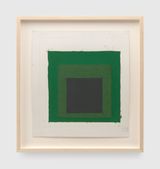
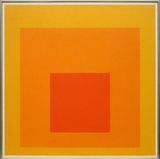
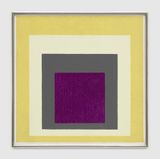
As a painter, Albers is most remembered for his ‘Homage to the Square’ series, which he began in 1950 and worked on for the following 26 years. The paintings in this series are defined by a successive superimposition of squares upon one another, sometimes in varying shades of a single colour (Departing in Yellow, 1964) and sometimes in complementary colours (a painting in red and blue, titled Homage to the Square: Against Deep Blue, from 1955). Albers painted directly from the tube with a palette knife as a way of creating a ‘pure’ painting, free of brushstrokes.
Through their abstracted forms and solid colours, Albers’ paintings contemplate human emotion and the light of different times of day and season. Albers was particularly interested in the nuanced chromatic or tonal juxtaposition of colours, once remarking that although midnight and noon cannot exist together in life, they can in a painting.
Writings and Public Works
A prolific writer and a multidisciplinary artist during his lifetime, Albers published poetry, articles and art theories and worked in painting, printmaking, murals and architecture.
He designed Two Portals (1961) at the Time and Life Building in New York, then Manhattan (1963) at the Pan Am Building in the same city. Both works reflect his exploration of the relationships between colours and adopt his signature rectangular motifs. Of his published writings, Interaction of Colour (1963) is arguably the most cited.
Sherry Paik | Ocula | 2022

Explore Josef Albers' Exhibitions On Now








Josef Albers in Ocula Magazine










Explore and Follow Artists Shaping Contemporary Art
A respected voice in contemporary art discourse.
Focusing on ambitious storytelling and insightful art-world commentary. Ocula Magazine publishes in-depth interviews, critical essays and timely analysis on the artists, exhibitions and ideas driving the global art world.
Learn more about Ocula Magazine
Showcasing the best of the art world.
Ocula partners with galleries from around the world to highlight their artists, artworks and exhibitions. Gallery membership is by application and invitation, with each member vetted by an independent panel.
Learn more about Ocula Membership
Specialises in the sale of major artworks.
Led by a team with deep ties to the world’s leading auction houses, galleries and collectors. Ocula’s advisory team offers bespoke services to high-net-worth clients from around the world who are looking to acquire the best of contemporary and modern art.
Learn more about our team and services