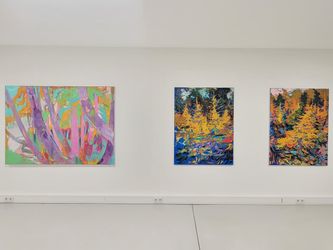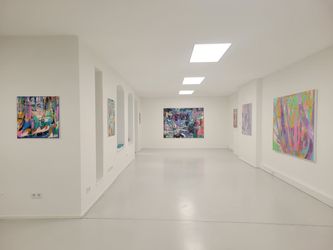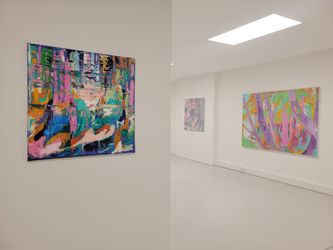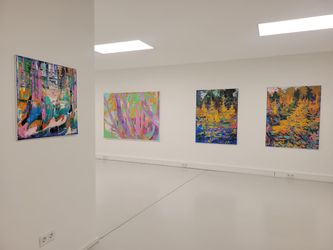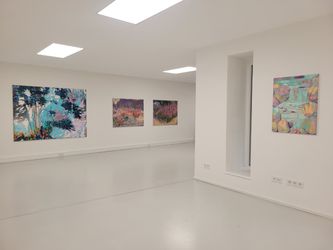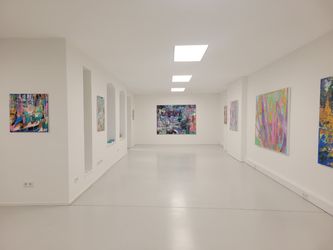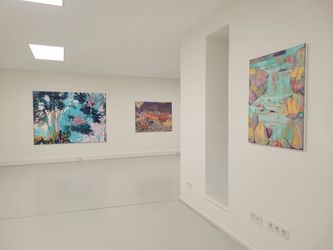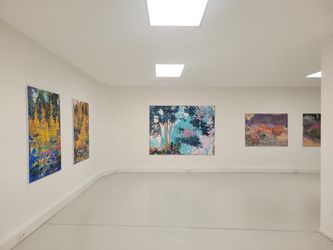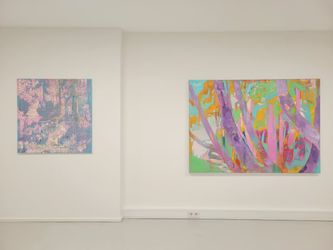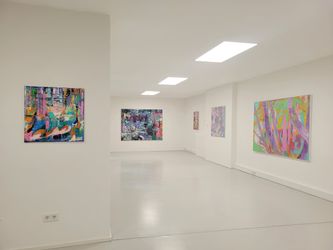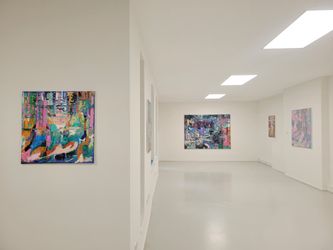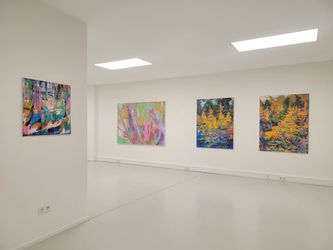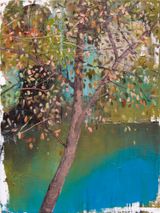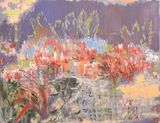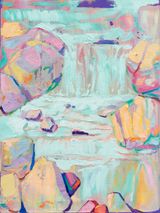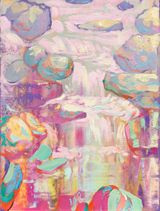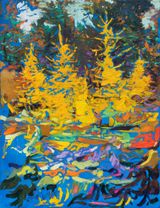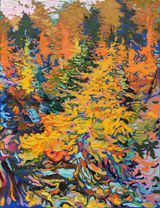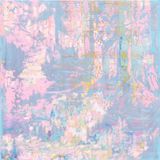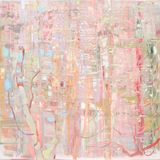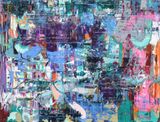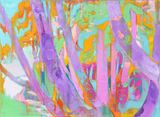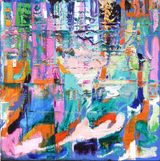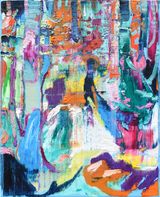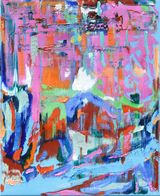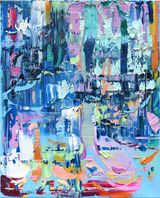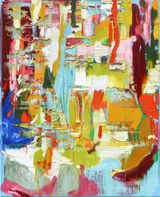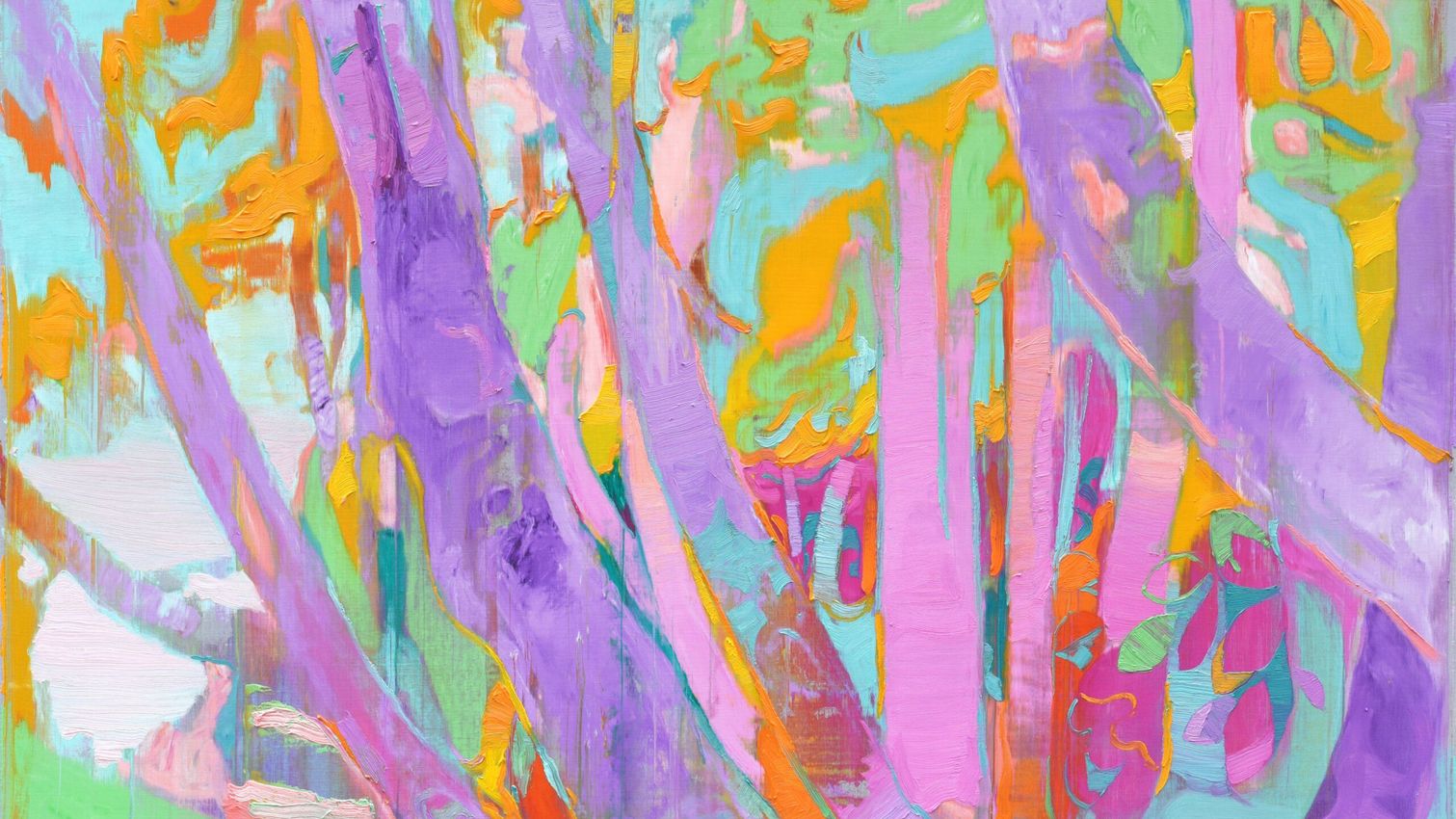
For many years, Szilard Huszank has devoted his painting exclusively to depictions of natural environments– typically forest scenes, clearings, and ponds framed by trees. Human and animal figures are entirely absent from his work. The motifs themselves recall the many nature scenes paint- ed in the 19th century in a range of styles, from Romanticism and Impressionism to Naturalism. In Huszank’s case, however, they are rendered with a color palette and painterly approach that feel distinctly contemporary–almost like a critical reflection or deconstruction of familiar landscape art.
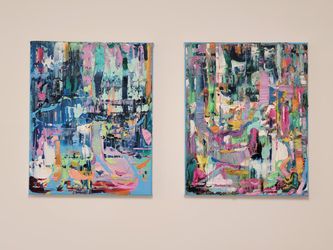
Through the years, Huszank’s painting has steadily moved away from realistic coloration. His landscapes are increasingly flowing in most bright false colors–yellow, pink, sky-blue... This shift can be seen as a move toward autonomous painting, independent of representation, but also as an implicit critique of our increasingly alienated relationship with nature.
In recent years, the distance from representational realism has intensified further, and the paintings have become progressively more abstract. In a work such as “OP # 29, pp. 118–19,” the viewer must focus intently to discern faint suggestions of leaves and branches, and mentally “reconstruct” them into a natural scene. The vivid, dynamic brushwork evokes a deliberate connection to the tradition of Expressionist painting. Wolfgang Rihm’s already quoted statement that “in our time, when surrounding nature is endangered and retreating, the principles of the creaturely and the vegetative must find their realization in art” seems especially relevant here.Considering Huszank’s paintings, one gets the impression that color, form, and expressive gesture themselves take on a natural quality–and that painting, in a sense, replaces the natural landscape. His works become artificial natures, or reservoirs of energy in Rihm’s sense–while also offering a kind of sanctuary for our perception, which is worn down by the relentless visual overload of everyday life.
Press release courtesy Galerie Tanit, Munich/Beyrouth. Text: Peter Lodermeyer, Bonn.


Named after a Phoenician goddess, Galerie Tanit is a long running contemporary art gallery based in Munich and Beirut that has dynamically adjusted its focus with the times.

A respected voice in contemporary art discourse.
Focusing on ambitious storytelling and insightful art-world commentary. Ocula Magazine publishes in-depth interviews, critical essays and timely analysis on the artists, exhibitions and ideas driving the global art world.
Learn more about Ocula Magazine
Showcasing the best of the art world.
Ocula partners with galleries from around the world to highlight their artists, artworks and exhibitions. Gallery membership is by application and invitation, with each member vetted by an independent panel.
Learn more about Ocula Membership
Specialises in the sale of major artworks.
Led by a team with deep ties to the world’s leading auction houses, galleries and collectors. Ocula’s advisory team offers bespoke services to high-net-worth clients from around the world who are looking to acquire the best of contemporary and modern art.
Learn more about our team and services