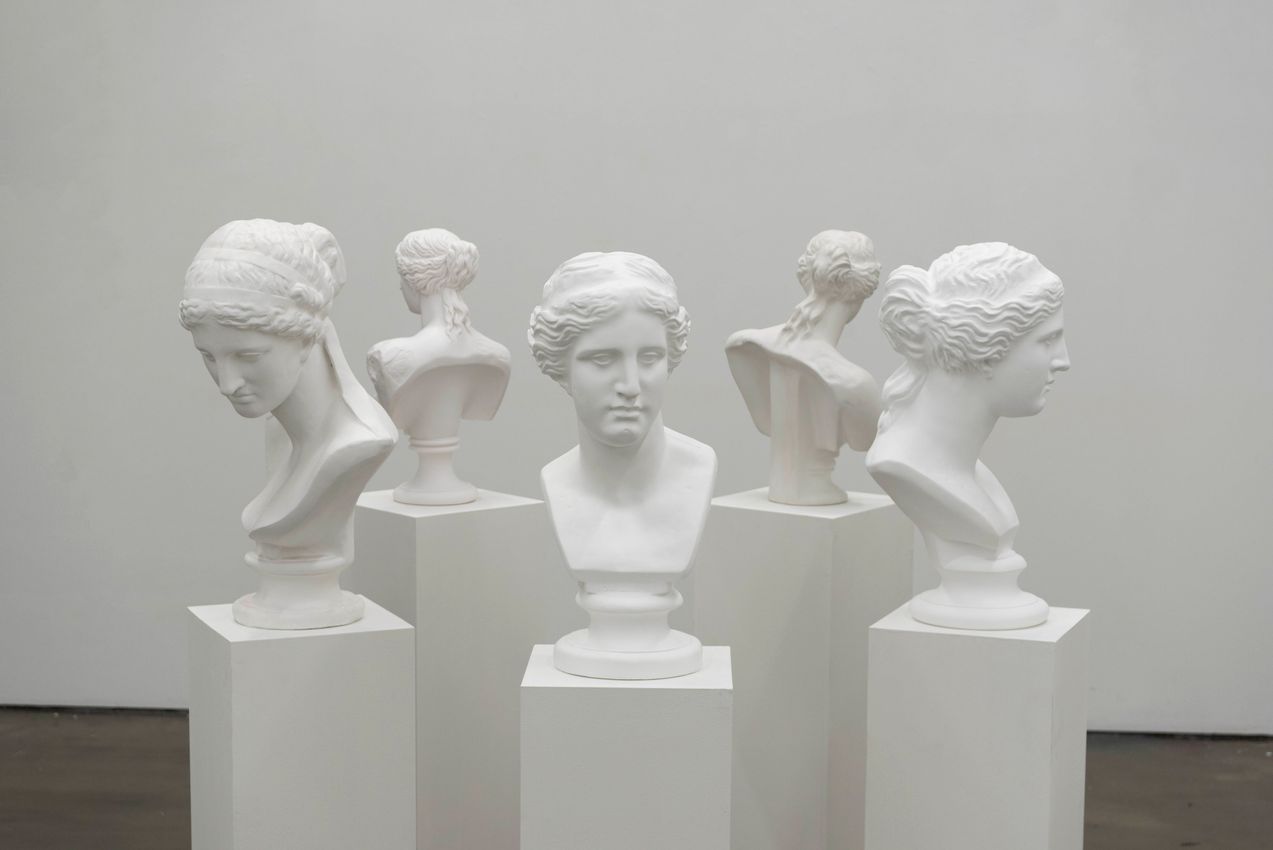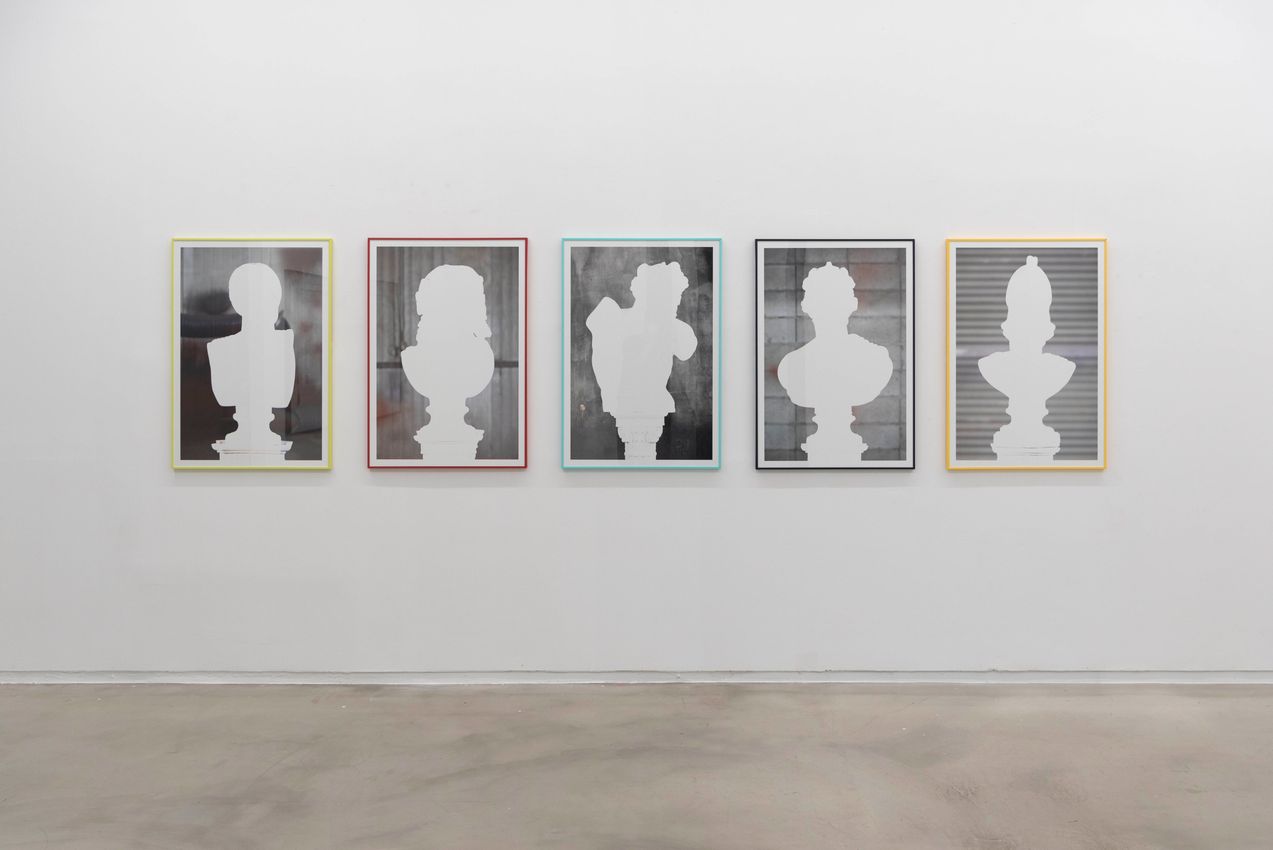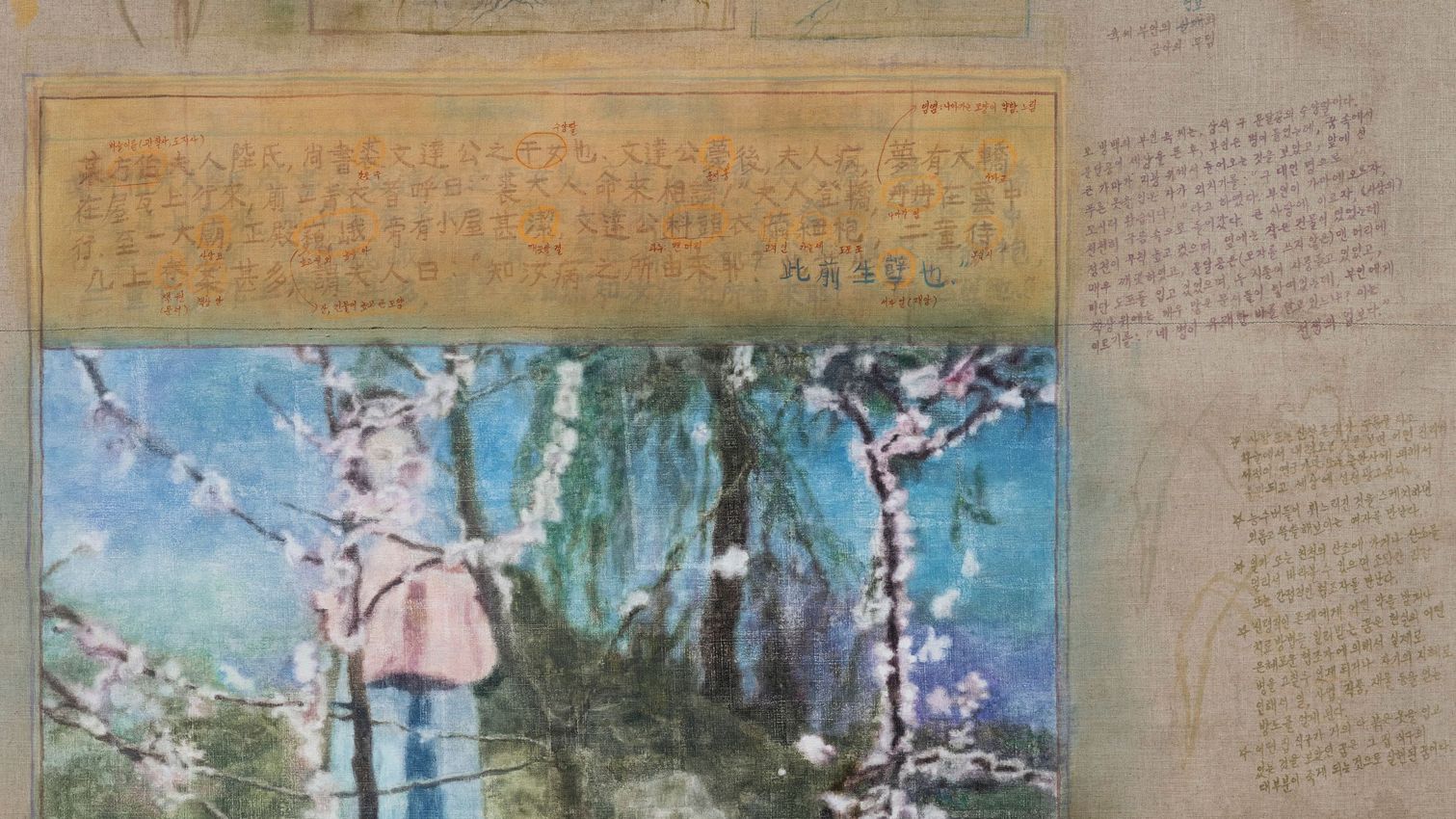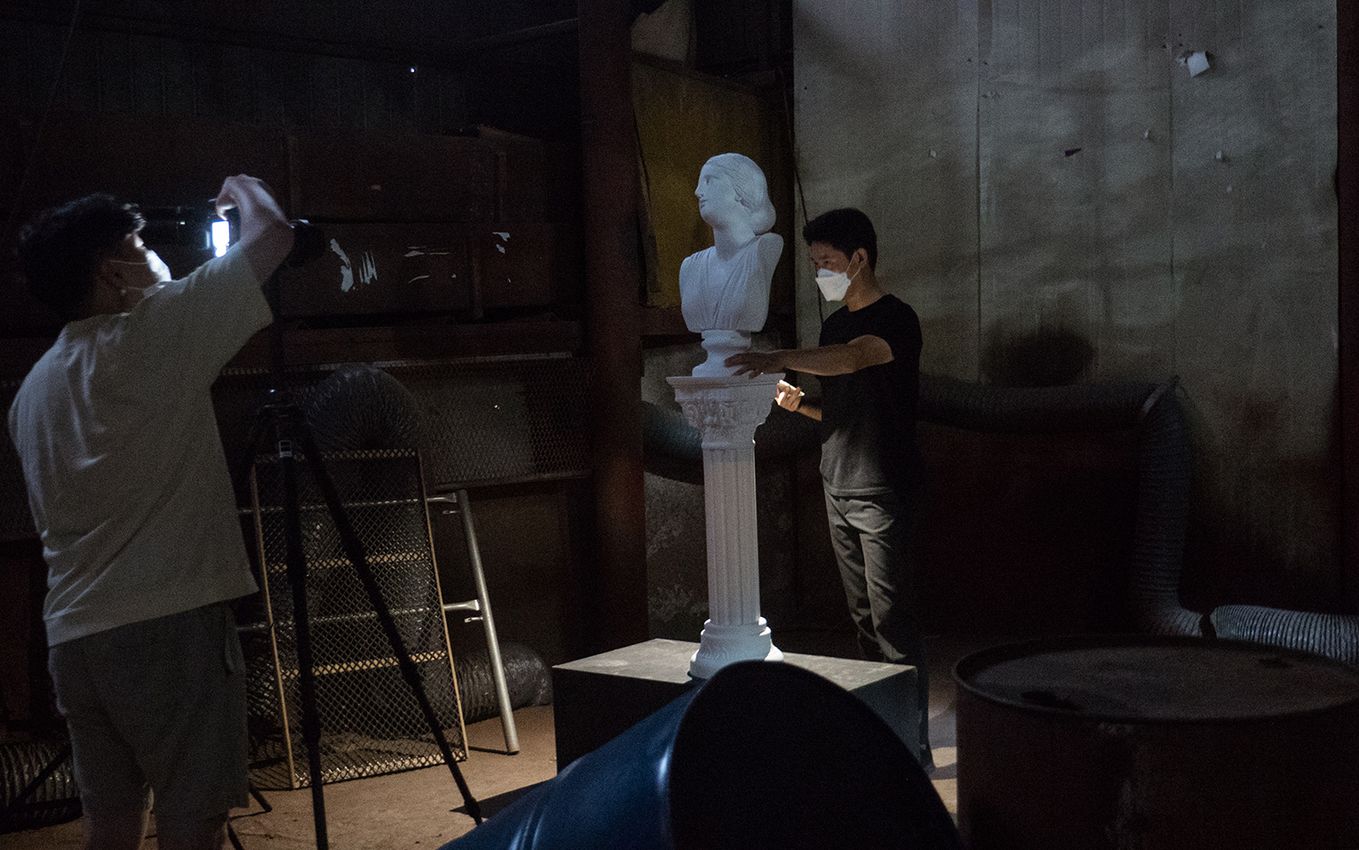
The photographs in Seoyeoung Won’s installation all face toward the viewer, reflecting the artist’s core objective of honestly representing the viewer’s perspective by capturing full frontal scenes through his camera lens. Won’s Compressed Reality (2011) series comprises photos of various objects—chairs, candle sticks, wheels, and lightbulbs—each of which bears the name of its respective subject as its title. The objects in these photos are positioned in front of a large colorless canvas, which combines the surrounding photographic frame, the light directed toward the subject, and the camera’s perspective. Ultimately, these photographic images deliberately omit any overlap in their composition of physical elements. In truth, such a flat perspective dictated by the uniform, frontal placement of Won’s camera lens essentially annihilates any sense of mass or dimensional depth of the photographed subject. The only perceptible sense of space is implied by the vague, scattered markers of the subject’s location that facilitate recognition of the image. Such a structural approach to composition was apparent in Won’s previous exhibitions in London and Seoul, in which he established three-dimensional structures by means of cleverly installed windows set against the white walls of each exhibition space. This arrangement encouraged viewers to adopt a frontal perspective, thus allowing Won to translate two-dimensional compositions into a frontally-oriented spatial relationship. This concern with a head-on orientation, as well as his subsequent formulation of compositions that appeal to this sensibility by using both flat and three-dimensional elements, appears again in his current exhibition. It is worth noting, however, that his Invisible (2018) series ironically twists Won’s signature frontal perspective to a certain extent. In both Invisible and Compressed Reality, he employs identical photography techniques, yet the former incorporates white plaster models of mythological figures that are often used as subjects for art class drawing practice. Additionally, each photo in the Invisible series uses the name of its corresponding mythological subject—Apollo, Venus, Hermes, etc.—as its title. However, Won neutralizes the facial characteristics of these sculptures by exposing them to harsh rays of concentrated light, thereby eliminating the unique individuality of each mythological figure. With their facial features thus erased, these sculptures lay in waiting for a voice to call them to the fore. The images in Won’s Invisible series are positioned in linear fashion to yield a uniform frontal perspective. As such, these photos aim to obfuscate and hide their subjects rather than reveal and clarify them, in contrast to the artist’s Compressed Reality series. Ironically, the residual outlines of each white plaster bust resemble hollowed-out constructs instead of actual objects with mass. In beholding the absolute frontality of the Invisibility series, such limited perceptible imagery stimulates the viewer’s desire to examine the underside, the rear and the folding lines of each composition. Won’s current exhibition, face, asserts a similar creative dynamic as its foundation. Around Us, Behind Us, and Below Us The traditional belief that photographs function as a testament to the existence of their subjects is somewhat true. Producing a photo necessitates minimal physical contact between a subject and the camera lens (through light); on the other hand, the essential components of any photo include elements that refute the connection between the image and its physical reality. Even without any additional retouching of the original photo, using a camera lens involves the imposition of a visual frame that crops its image. Moreover, a photo may enlarge, distort, or gloss over the original shape of its subject, and in certain photos dramatic lighting seems to either completely erase the visual existence of their subjects or imbue them with fantastic illusions. Such tensions between the photographic image and its original subject partially liberate the photo from its conventional purpose of validating the actual existence of its subject. Won’s decision to use plaster casts for the Invisible series as well as his recent Unknown Portrait (2021) series belies an awareness of the above conceptual context. He seems to consider the image as a device used for visualizing a certain presence or identity. For example, Won remains curious about the fundamental principle that informs the representation of fictional or mythological figures through tangible and unique anthropomorphic images. Invisible and Unknown Portrait thus experiment with the ways in which a fabricated image can inspire actual belief, how a seemingly realistic photo can refute the existence of its subject, and how images can internalize fictional elements. In other words, Won’s photos undermine the photo’s function as an arbiter of reality, presenting a physically present entity as the footprint of a fiction. The collection of images in Unknown Portrait appropriates the stylistic formula of personal portraits through a focused presentation of anthropomorphic faces set against abstract backgrounds within a defunct factory. These faces, however, are unrecognizable because of the harsh lighting that whitewashes their features, transforming their individual facial characteristics into vague shadows of mass atop clearly delineated white surfaces. Furthermore, Unknown Portrait refuses to conform to a traditional portrait format, selecting truncated torsos or classical seated postures as subjects. Won abandons the fundamental, symbolic spatiality of his previous works, instead presenting images that hardly reveal any visual information. Their absence of faces results in images that are flat yet three-dimensional, concealing yet illuminating, and encourages viewers to imagine what is not there; it is even possible to speculate how the artist’s intentional truncation and obfuscation may have altered the original scene. Two other bodies of work included in this exhibition, Lost Stars and Liar, present the actual plaster casts that appear in Won’s photos. When juxtaposed with these objects, the photos operate as a psychological taunt, suggesting the actual existence of the photographed subject despite the lack of any identifiable representation in the photos. In other words, the juxtaposition of the subject alongside its photographic image creates an undeniable compulsion to equate the image to the object—to confirm the photo’s testimonial function in verifying the existence of the subject. Won’s structuring of flat perspective, however, suggests a two-dimensional frontal perspective for viewers, even when beholding these three-dimensional plaster casts, thereby minimizing the materiality of the original subject itself. In addition, viewing the plaster casts head-on generates a perspective that excludes their facial features. In order for viewers to actually confirm the existence of the facial features suggested in the photos, they must circle the plaster casts to empirically observe their physical presence by examining them from the front, rear, side, and bottom. Face is an exhibition that utilizes both the gallery’s underground and ground level exhibition spaces, compartmentalizing photographs and installations. This arrangement presents fabricated anthropomorphic faces in a full frontal perspective, an installation scheme that erases the expected presence of faces and encourages one to look beyond their visible outlines, residual shadows, harsh lights, and smudged traces. Although structurally organized, the frontal composition of each image confirms the derivative paradoxes of Won’s frontality. As such, the images thus through this suggested presentation of faces—or the spaces on the periphery of imagined faces—oscillate between existence and annihilation while attempting a simultaneous manifestation of both dynamics.
Korean-English Translation of this text is supported by Ministry of Culture, Sports and Tourism and Korea Arts
Gallery Chosun was established in 2004 in Bukchon, an area in Seoul known for its vibrant art scene comprising prominent art galleries and the National Museum of Modern and Contemporary Art. With a reputation for providing a versatile environment for its forward-thinking exhibitions, Gallery Chosun is committed to becoming an ultimate paradigm for Korean contemporary art.

A respected voice in contemporary art discourse.
Focusing on ambitious storytelling and insightful art-world commentary. Ocula Magazine publishes in-depth interviews, critical essays and timely analysis on the artists, exhibitions and ideas driving the global art world.
Learn more about Ocula Magazine
Showcasing the best of the art world.
Ocula partners with galleries from around the world to highlight their artists, artworks and exhibitions. Gallery membership is by application and invitation, with each member vetted by an independent panel.
Learn more about Ocula Membership

Specialises in the sale of major artworks.
Led by a team with deep ties to the world’s leading auction houses, galleries and collectors. Ocula’s advisory team offers bespoke services to high-net-worth clients from around the world who are looking to acquire the best of contemporary and modern art.
Learn more about our team and services