




HOWARDENA PINDELL
b. 1943, United StatesHowardena Pindell is an American artist, curator, writer, and educator whose work fuses rigorous abstraction with urgent reflections on race, gender, trauma, and memory. Over more than five decades, she has developed a materially inventive, conceptually rich practice spanning painting, drawing, collage, printmaking, photography, and video, while simultaneously challenging structural exclusion within major art institutions.
Biography and practice
Born in Philadelphia in 1943, Pindell grew up in a middle-class African American family and decided to become an artist as a child, taking Saturday art classes and visiting local museums. She studied painting at Boston University (BFA, 1965) and Yale University (MFA, 1967), initially working figuratively before embracing abstraction in the late 1960s and early 1970s.
After graduating, Pindell moved to New York and began a 12-year tenure at the Museum of Modern Art, first in the Department of Prints and Illustrated Books and later as an associate curator, becoming the museum’s first African American curator. In 1972 she co-founded A.I.R. Gallery, the first women’s cooperative, artist-run gallery in New York, and later joined collectives and committees addressing racial exclusion, censorship, and violence in the art world.
Pindell’s visual language emerges from meticulous, often repetitive processes—punching and saving paper dots, spraying paint through templates, stencilling numbers, cutting and reassembling photographs, and building densely layered surfaces. These material strategies anchor an inquiry into racism, segregation, state violence, the AIDS crisis, feminist histories, global travel, and the fragility and reconstruction of memory, while also serving as a diaristic record of her own life.
Circles, dots, and early abstraction
One of Pindell’s most recognisable signatures is the circle, which operates both as motif and physical material. The form links to a childhood experience of segregation during a road trip, when she noticed red circles marking the utensils reserved for Black customers at a restaurant in northern Kentucky; this memory of coded discrimination underpins her later transformation of circles into fields of colour, texture, and light.
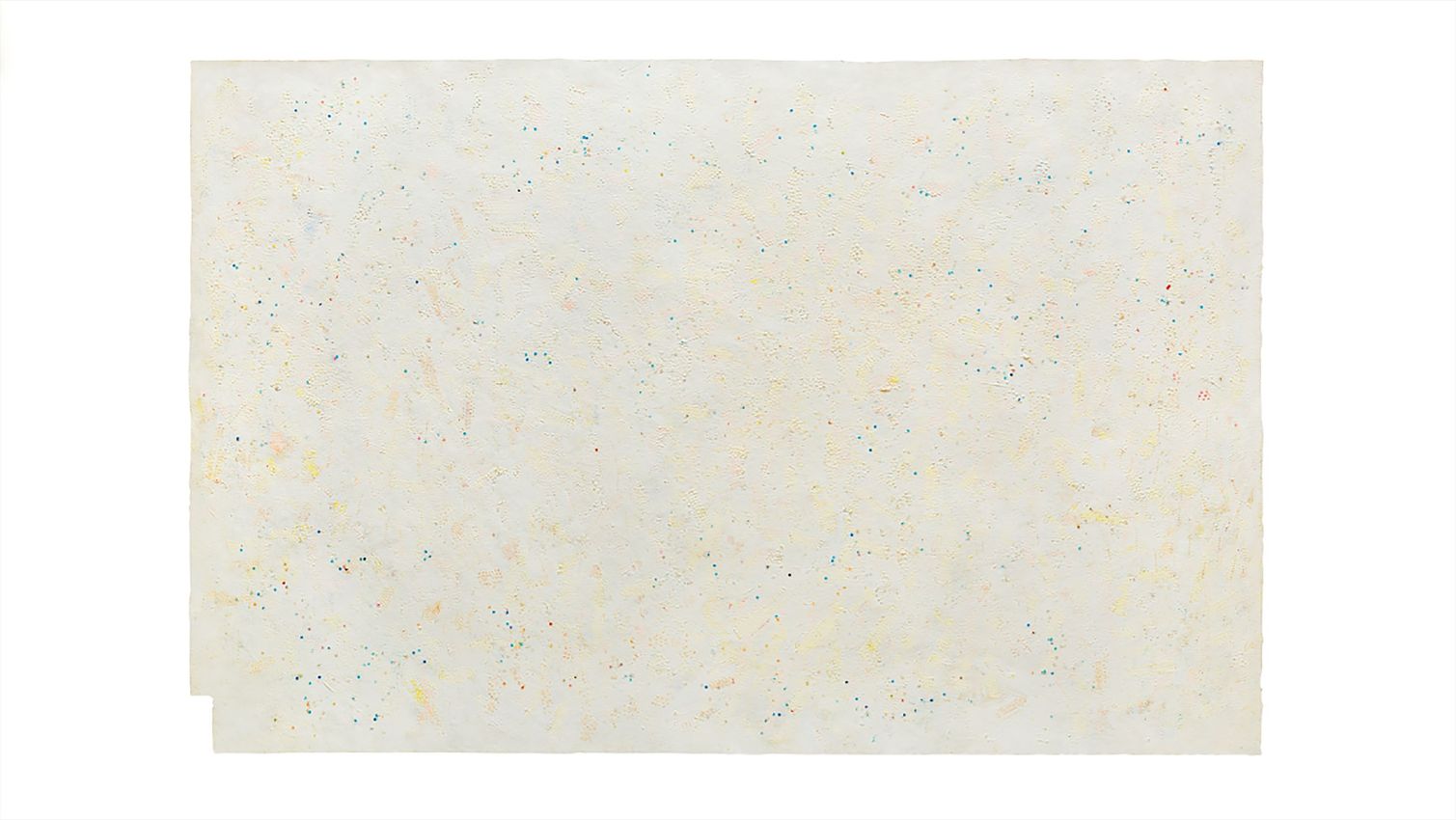
In the early 1970s she began producing ‘Spray Dot’ paintings by spraying paint through hole-punched cardstock templates, building ethereal colourfields from accumulations of dots. At the same time she started saving the tiny punched-out paper circles, later incorporating them into works such as Untitled #7 (1973), where hand-numbered cream discs are painstakingly adhered to a canvas of the same tone to create a continuous, almost topographic surface that reads as both minimal and intensely personal.
These works explored seriality, systems, and the limits of perception, aligning with but also challenging Minimalism and Op art. Even when ostensibly non-figurative, their labour and density hint at the bodily and social stakes that would become increasingly explicit after 1979.
Accident, memory, and the Autobiography series
A near-fatal car accident in 1979, which left Pindell with a serious concussion and long-term memory impairment, marked a turning point in both her life and art. Resigning from MoMA that same year, she began teaching at the State University of New York at Stony Brook, eventually becoming a full professor and later a distinguished professor, while using the studio to work through the disorientation and trauma of her injuries.
This period catalysed the ‘Autobiography’ series (1980–2005), a body of mixed-media paintings and works on paper composed from photographs, postcards, travel mementos, and personal ephemera cut into strips or fragments and recomposed with acrylic paint, drawing, and collage. Moving away from square, gridded canvases, she developed ovoid and irregular supports that trace the silhouette of her body, as in Autobiography: Earth (Eyes/Injuries) (1987), which layers images of eyes, cars, and wounds, and Autobiography: Water / Ancestors / Middle Passage / Family Ghosts (1988), which braids personal and ancestral histories into turbulent, watery fields.
The Autobiography works register the effort to reconstruct self and memory after trauma, and they widen the scope of her practice to encompass family narratives, global travel, spirituality, and the legacies of slavery and displacement. Their dense iconography and physically complex surfaces demonstrate how abstraction can hold narrative and political content without becoming illustrative.
Video, politics, and AIDS
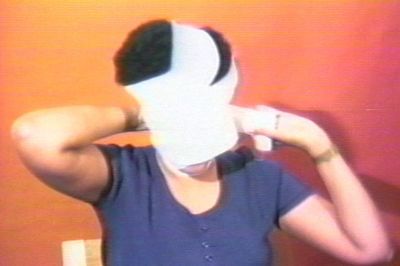
From the early 1980s, Pindell’s practice took on an increasingly explicit socio-political dimension, especially through video and collage. Her most widely discussed video, Free, White and 21 (1980), stages a stark confrontation with racism and denial: Pindell appears as herself, calmly recounting incidents of discrimination experienced by her and her mother, and as a white character who dismisses or belittles these accounts, while she wraps her face in gauze and tape.
The work exposes the violence of disbelief and gaslighting directed at Black women, and remains a touchstone in discussions of race, feminism, and performance in late 20th-century art. It also solidifies Pindell’s insistence that personal testimony and structural critique belong alongside material experimentation in contemporary practice.
Her engagement with the AIDS crisis is crystallised in Separate but Equal Genocide: AIDS (1991–92), a diptych of black and white American flags dedicated to a cousin who died of AIDS, and to children infected via contaminated blood transfusions. The flags incorporate names and text, linking epidemic, nationalism, and systemic neglect; the title underscores how racism and inequality worsened the impact of the disease.
Across these and other works, Pindell continually returns to themes of segregation, violence, erasure, and survival, while also exploring the possibilities of repair, remembrance, and collective accountability.
Teaching, writing, and advocacy
Parallel to her studio work, Pindell has maintained a significant career as an educator and writer. After joining Stony Brook University in 1979, she taught there for decades, becoming a full professor, directing the MFA program, and mentoring generations of artists; she has also served as a visiting professor at Yale University.
Her essays and surveys on representation in museums and galleries documented the underrepresentation and exclusion of women and artists of colour, helping to shape debates around diversity and accountability in the arts. The anthology The Heart of the Question (1997) brought together much of this writing, positioning her as a critical voice as well as an artist.
Howard Pindell Exhibitions
Pindell has exhibited widely in the United States and internationally, with solo and survey presentations that highlight both the breadth and depth of her practice.
Recent and selected solo exhibitions:
- Howardena Pindell, White Cube Bermondsey, London (2025).
- Deep Sea, Deep Space, White Cube Hong Kong (2024–25).
- Howardena Pindell: A New Language, Fruitmarket, Edinburgh, touring to Kettle’s Yard, Cambridge; Spike Island, Bristol; and Irish Museum of Modern Art, Dublin (2020–23).
- Howardena Pindell: What Remains to be Seen, Museum of Contemporary Art Chicago and Virginia Museum of Fine Arts, first major US survey (2018).
- Howardena Pindell: A Retrospective, travelling exhibition (early 1990s), bringing together art and writing.
- Solo shows at the Cleveland Institute of Art; Museum of Contemporary Art Chicago; the Studio Museum in Harlem; and other institutions in the US and abroad.
Selected group and thematic exhibitions:
- WACK! Art and the Feminist Revolution, Museum of Contemporary Art, Los Angeles (2007).
- Soul of a Nation: Art in the Age of Black Power, Tate and international tour (from 2017).
- Exhibitions at Turner Contemporary (Margate), the Museum of Modern Art and New Museum (New York), Museum of Contemporary Art Kiasma (Helsinki), Tate Modern (London), Guggenheim Bilbao, and other major venues.
Collections and Recognition
Pindell’s work is held by many leading museums, reflecting her central place in postwar and contemporary art.
Selected public collections:
- Museum of Modern Art, New York.
- The Metropolitan Museum of Art, New York.
- Whitney Museum of American Art, New York.
- Guggenheim Abu Dhabi.
- Institute of Contemporary Art, Boston.
- Other major US and international institutions across Europe and the Middle East.
Her contributions have been recognised through awards, fellowships, and honorary doctorates, including honorary degrees from Massachusetts College of Art and Parsons School of Design, and distinctions for both artistic and cultural leadership. She continues to live and work in New York, maintaining an active practice that links material innovation with sustained activism and historical consciousness.
Howardena Pindell FAQs
Who is Howardena Pindell?
Howardena Pindell is an American artist, curator, writer, and educator born in Philadelphia in 1943, whose practice spans painting, collage, drawing, printmaking, photography, and video. She is known for merging meticulous, process-driven abstraction with explicit engagement with racism, feminism, trauma, and the politics of visibility in institutional contexts.
Where did Howardena Pindell study and how did her career begin?
Howardena Pindell studied painting at Boston University (BFA, 1965) and Yale University (MFA, 1967), beginning her career as a figurative painter before shifting toward abstraction during and after graduate school. After moving to New York in 1967, she joined the Museum of Modern Art, eventually becoming the first African American curator in the Department of Prints and Illustrated Books, while pursuing her own work at night.
What roles has Howardena Pindell held as an educator?
In 1979, Pindell left MoMA to join the faculty at the State University of New York at Stony Brook, where she taught for many years, became a full professor, and later directed the MFA program. She has also served as a visiting professor at Yale University and has lectured widely, shaping conversations around art, race, gender, and institutional responsibility.
What mediums and approaches does Howardena Pindell work with?
Howardena Pindell works across painting, collage, drawing, relief, photography, and film/video, often combining them in layered, labour-intensive constructions. Her methods include spraying paint through templates, punching and applying thousands of paper dots, stenciling numbers, cutting and reconfiguring photographs, and using irregular, body-referencing canvases, creating surfaces that read as both systematic and personal.
Why are circles and dots so important in Howardena Pindell’s work?
Circles are rooted in a childhood memory of segregated dining, where red circles marked the utensils that Black customers were allowed to use, leaving a lasting impression of how racism is encoded in everyday objects. In her art, she transforms circles into repeated motifs and physical elements—fields of dots, punched disks, and circular cut-outs—turning an emblem of exclusion into a language of resilience and abstraction.
How does Howardena Pindell use these circles materially?
Howardena Pindell’s early ‘Spray Dot’ paintings involved spraying pigment through hole-punched cards onto large canvases, creating shimmering, atmospheric fields built from overlapping dots. Later works such as Untitled #7 (1973) incorporate thousands of hand-punched, sometimes hand-numbered paper circles adhered to the canvas, producing dense, tactile surfaces that hover between painting, drawing, and low relief.
What is the significance of Howardena Pindell’s 1979 car accident?
Howardena Pindell’s 1979 car accident caused a concussion and long-term memory issues, disrupting Pindell’s sense of continuity and prompting a profound reassessment of her life and work. It led her to resign from MoMA, focus more intensely on teaching and making art, and generate a body of work that directly addressed trauma, healing, and the reconstruction of memory.
What characterises Howardena Pindell’s ‘Autobiography’ series?
Howardena Pindell’s ‘Autobiography’ series (1980–2005) is composed of mixed-media works that weave together cut-up postcards, snapshots, travel images, and personal documents with acrylic paint, drawing, and collage, often on ovoid or irregular supports that reference the artist’s body. Works like Autobiography: Earth (Eyes/Injuries) and Autobiography: Water / Ancestors / Middle Passage / Family Ghosts layer imagery of eyes, vehicles, water, and historical references to address injury, ancestral memory, and the legacies of the Middle Passage, moving beyond earlier, more restrained abstractions into dense, narrative-inflected compositions.
How does Howardena Pindell address socio-political issues in her work?
From the 1980s onward, Pindell created works that explicitly confronted racism, sexism, police and state violence, the AIDS epidemic, war, and censorship. She often uses collage, text, photography, and performance alongside abstraction to foreground stories that are ignored or suppressed, presenting them through structures and surfaces that demand sustained attention.
What is Howardena Pindell’s ‘Free, White and 21’ work about, and why is it important?
Free, White and 21 (1980) by Howardena Pindell is a landmark video in which Pindell recounts episodes of racism experienced by her and her mother, appearing alternately as herself and as a white character who dismisses these experiences. As she speaks, she wraps her head in gauze and tape, producing an image of physical and psychological constraint that exposes the violence of disbelief and denial; the work remains a key reference point in discourses on race, feminism, and performance.
How has Howardena Pindell responded to the AIDS crisis?
Howardena Pindell’s Separate but Equal Genocide: AIDS (1991–92) responds to the AIDS epidemic through a pair of black and white American flags created in memory of a cousin who died of AIDS. The work includes embroidered or inscribed names of people affected, including children infected through blood transfusions, drawing attention to how prejudice, indifference, and structural inequality shaped the course of the crisis.
What themes run through Howardena Pindell’s practice overall?
Across her oeuvre, Howardena Pindell returns to themes of racism, segregation, trauma, memory, healing, and the politics of representation, often infusing abstract languages with specific historical and personal references. She consistently ties intimate experience—injury, family history, travel, and daily encounters with discrimination—to broader narratives of slavery, colonialism, and systemic injustice, insisting on their visibility within contemporary art.
Where has Howardena Pindell exhibited?
Pindell has had solo exhibitions at the Cleveland Institute of Art; Museum of Contemporary Art Chicago; Irish Museum of Modern Art; Spike Island, Bristol; Fruitmarket, Edinburgh; the Studio Museum in Harlem; and numerous other venues in the US and abroad. She has participated in major group shows including WACK! Art and the Feminist Revolution (MOCA, Los Angeles), Soul of a Nation: Art in the Age of Black Power (Tate and tour), and exhibitions at MoMA, the New Museum, Tate Modern, Turner Contemporary, Kiasma, and Guggenheim Bilbao.
Which collections hold Howardena Pindell’s work?
Howardena Pindell’s work is represented in major public collections including the Museum of Modern Art, the Metropolitan Museum of Art, the Whitney Museum of American Art, Guggenheim Abu Dhabi, and the Institute of Contemporary Art, Boston, among others. These and other holdings across Europe and North America underscore her status as a pivotal figure in late 20th- and early 21st-century art.
How does Howardena Pindell work relate to abstraction today?
Howardena Pindell expands abstraction by tying repetitive, system-based processes—punching, numbering, gridding—to intensely autobiographical and political content, demonstrating that abstract languages can carry testimony and critique. Her practice challenges the idea of abstraction as neutral or detached, positioning it instead as a means to register and resist social and historical violence.
Why is Howardena Pindell considered important for younger artists?
Howardena Pindell is an artist who has worked simultaneously as a curator, educator, writer, and activist, Pindell offers a model of how to navigate and challenge institutions while maintaining a rigorous studio practice. Her long-standing commitment to addressing racism, sexism, and exclusion—through both art and data-driven studies—continues to influence younger generations seeking to align formal experimentation with social responsibility.
Ocula | 2025








Explore and Follow Artists Shaping Contemporary Art
A respected voice in contemporary art discourse.
Focusing on ambitious storytelling and insightful art-world commentary. Ocula Magazine publishes in-depth interviews, critical essays and timely analysis on the artists, exhibitions and ideas driving the global art world.
Learn more about Ocula Magazine
Showcasing the best of the art world.
Ocula partners with galleries from around the world to highlight their artists, artworks and exhibitions. Gallery membership is by application and invitation, with each member vetted by an independent panel.
Learn more about Ocula Membership
Specialises in the sale of major artworks.
Led by a team with deep ties to the world’s leading auction houses, galleries and collectors. Ocula’s advisory team offers bespoke services to high-net-worth clients from around the world who are looking to acquire the best of contemporary and modern art.
Learn more about our team and services