




ELLSWORTH KELLY
1923-2015, United StatesKnown for his use of colour, form and line, Ellsworth Kelly’s immediately recognisable style and consistent artistic vision shines through his works, which span paintings, sculptures, prints, drawings, photographs and even a building.
Early Years
Ellsworth Kelly was born in Newburgh, New York, on 31 May 1923. His interest in art began at a young age: he created the covers for Oradell Junior High School’s magazines. His fascination with colour, and the relationship between colour and space, came from his love of birdwatching (a lifelong hobby). He studied at the Pratt Institute in New York City but volunteered for the army in 1942 and served in England, France, Germany, Luxembourg and Belgium. He made watercolours during this period and also explored historic towns and churches, beginning an interest in Byzantine and Romanesque art and architecture. After the war he moved to Paris, where he came into contact with Constantin Brancusi, Jean Arp and Alexander Calder. Back in New York City, he set up a studio in the Financial District, away from the Abstract Expressionist scene and in a community that included Agnes Martin, Robert Indiana and Jack Youngerman.
Ellsworth Kelly: Artworks
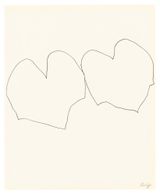
Chance, colour, line, architecture and form characterise Ellsworth Kelly’s artworks. Although working in New York City at the same time as the Abstract Expressionist movement, his approach to abstract art was different, without expressive gestures and taking inspiration from found sources, from folded card to the outline of a grape leaf to the way the light played on the Seine in Paris. He also produced panel paintings and experimented with irregularly shaped canvases.
- 1966’s Yellow Piece saw Kelly move away from traditional rectangular or square canvases, pairing two curved corners with a single colour.
- Kelly began The Chatham Series in 1970 when he and his husband moved out of New York City to Spencertown and Kelly rented a theatre in the town of Chatham as a studio space. Each piece comprises two joined canvases, and vary in proportion and colour.
- Graphite-on-paper drawings of flowers and plants were a mainstay of Kelly’s practice—notable examples are 1949’s Hyacinth and Wild Grape (1980)
- Kelly took up printmaking during the 1960s, making lithographs of all scales including Purple/Red/Grey/Orange (1988), one of the largest single-sheet lithographs ever made measuring more than five metres.
Ellsworth Kelly: Select Public Commissions
- Sculpture for a Large Wall, Penn Centre, Philadelphia (1957) (now dismantled)
- Wright Curve, Peter B Lewis Theatre, Solomon R Guggenheim Museum, New York City (1966)
- Blue Green, Unesco, Paris (1969)
- Curve XXII (I Will), Lincoln Park, Chicago (1981)
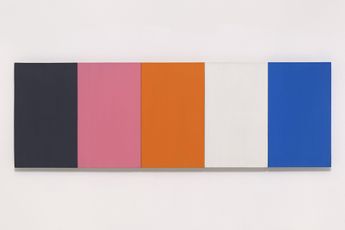
- Dallas Panels (Blue Green Black Red), Morton H Meyerson Symphony Centre, Dallas (1989)
- Memorial, United States Holocaust Memorial Museum, Washington DC (1993)
- Berlin Panels 2000, Bundestag, Berlin (1998)
- Blue Black, Pulitzer Arts Foundation, St Louis (2001)
- White Curve, Art Institute of Chicago (2009)
- Spectrum VIII, Fondation Louis Vuitton, Paris (2014)
- Austin, Blanton Museum of Art, University of Texas, Austin (2018)
Elsworth Kelly: Select Awards
- Member of the National Institute of Arts and Letters (1974)
- Chevalier de l’Ordre des Arts et des Lettres (1987)
- Edward MacDowell Medal (1999)
- Praemium Imperiale (2000)
- National Medal of Arts (2013)
Elsworth Kelly: Exhibitions
Select Solo Exhibitions
- Ellsworth Kelly, Taro Nasu Gallery, Tokyo (2025)
- Ellsworth Kelly: Spectrum Colours Arranged by Chance, Art Institute of Chicago (2024)
- Ellsworth Kelly: Line Form Colour, La Fondazione Nicola del Roscio, Rome (2023)
- Blue Green Black Red, Matthew Marks Gallery, New York City (2022)
- Silent Vision, Fondation Beyeler, Basel (2020)
- Ellsworth Kelly: Chatham Series, MoMA, New York City (2013)
- Ellsworth Kelly: Paris/New York 1994–1959, Philadelphia Museum of Art (2006)
- Ellsworth Kelly, The Years in France 1948–1954, Galerie Nationale du Jeu de Paume, Paris (1992)
- Ellsworth Kelly, Paintings and Sculptures 1963–1979, Stedelijk Museum, Amsterdam (1979)
- Ellsworth Kelly, MoMA, New York City (1973)
- New Work by Ellsworth Kelly, Ferus Gallery, Los Angeles (1966)
- Ellsworth Kelly, Paintings 1951–1956, Betty Parsons Gallery, New York City (1956)
- Kelly, peintures et reliefs, Galerie Arnaud, Paris (1951)
Select Group Exhibitions
- Twenty Five, Ingleby, Edinburgh (2023)
- Abstract Dissonance, Gagosian, Paris (2022)
- Postwar Abstraction: Variations, Oklahoma City Museum of Art (2020)
- Rosebud, Matthew Marks Gallery, Los Angeles (2019)
- Willem de Kooning, Peter Fischli, David Weiss, Lucian Freud, Katharina Fritsch, Roni Horn, Ellsworth Kelly, Brice Marden, Matthew Marks Gallery, New York City (1999)
Further Reading
- Ellsworth Kelly’s obituary in The New York Times
- Ellsworth Kelly Studio Instagram
- Ellsworth Kelly official website and Ellsworth Kelly Foundation
- 2004 interview from Guggenheim magazine
- Gwyneth Paltrow interviews Ellsworth Kelly (2011)
- Interview in the Guardian from 2015
Ellsworth Kelly FAQs
Did Ellsworth Kelly plan his artworks?
Not always—sometimes he left the composition of his artworks entirely up to chance. An example of this is Spectrum Colours Arranged by Chance (1951–1953), on display at the San Francisco Museum of Modern Art. He assigned a number to each colour and then randomly selected the arrangement. This set him against the abstract expressionism movement, because he didn’t include any gestures or hints of the artist’s hand. He said in 2004: “I also made drawings with my eyes closed or without looking at the paper. Most drawing and most painting is an invention, and I learned very early that I wanted chance more and invention less.”
Did Ellsworth Kelly live in Paris?
Yes, the six years Ellsworth Kelly spent in Paris after the Second World War had a profound influence on his artistic practice. Speaking to The New York Times in 1996, he said: “Paris was grey after the war. I liked being alone. I liked being a stranger. I didn’t speak French very well, and I liked the silence.” He was inspired by the city in the creation of his first abstract pictures, using patterns he saw in the light on the River Seine or on pavements. He had a one-person show in Paris in 1951, but returned to New York City when his GI Bill support ran out.
Was Ellsworth Kelly in the “Ghost Army”?
Yes, Ellsworth Kelly was a member of the 23rd Headquarters Special Troops, otherwise known as the “Ghost Army”, which used visual deception (notably including inflatable tanks) to confuse Germany about the size and location of the Allied forces. This classified unit was made up of specialised battalions, including the 603rd Engineer Camouflage Battalion, which Kelly joined because he had taken a camouflage course at Pratt. In the army he experimented with camouflage techniques and produced educational material about the principles of camouflage.
Ocula




Explore Ellsworth Kelly's Exhibitions










Explore and Follow Artists Shaping Contemporary Art
A respected voice in contemporary art discourse.
Focusing on ambitious storytelling and insightful art-world commentary. Ocula Magazine publishes in-depth interviews, critical essays and timely analysis on the artists, exhibitions and ideas driving the global art world.
Learn more about Ocula Magazine
Showcasing the best of the art world.
Ocula partners with galleries from around the world to highlight their artists, artworks and exhibitions. Gallery membership is by application and invitation, with each member vetted by an independent panel.
Learn more about Ocula Membership
Specialises in the sale of major artworks.
Led by a team with deep ties to the world’s leading auction houses, galleries and collectors. Ocula’s advisory team offers bespoke services to high-net-worth clients from around the world who are looking to acquire the best of contemporary and modern art.
Learn more about our team and services