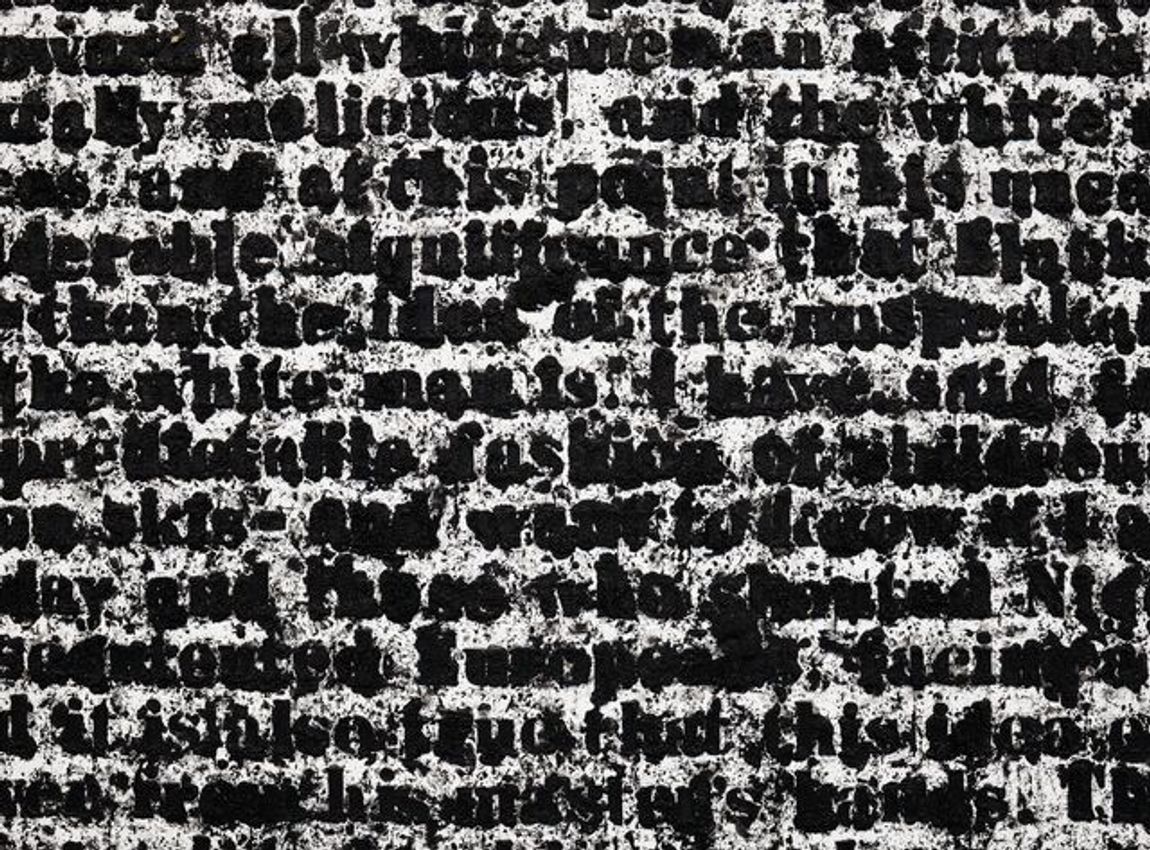
This September, the celebrated American artist Glenn Ligon will debut a major new work in his first exhibition with Hauser & Wirth titled First Contact. Coinciding with Zurich Art Weekend, Ligon will present a large-scale diptych from his Stranger series, which first began in 1997 and renders excerpts from James Baldwin’s 1953 essay, ‘Stranger in the Village’. This is the first time in the series that Ligon uses the entire text in a painting and marks the inaugural presentation of this body of work in Switzerland. The exhibition in Zurich precedes Ligon’s major solo presentation spanning three floors at Hauser & Wirth New York, 22nd Street, opening on 10 November, and a new publication from Hauser & Wirth Publishers forthcoming this autumn.
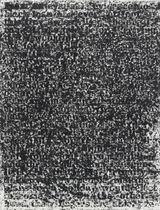
This monumental diptych, Stranger (Full Text) #1 (2020–2021) measures 45 feet long and 10 feet high (13.7 x 3 m) and is the sole artwork in the Zurich presentation. The location and scale reflect both the Swiss setting of James Baldwin’s autobiographical essay and the magnitude of racial alienation it describes. In the text, Baldwin recounts his experience of visiting the small mountain village of Leukerbad, Switzerland where he encounters villagers who have never met a Black man before him. He describes his interactions with the villagers, over multiple visits to the town, as they react to his Blackness, sometimes with curiosity and enthusiasm, and sometimes with fear and suspicion. He connects these experiences to global structures of racism, colonialism, and white supremacy and analyses how they manifest in both the United States and Europe. Baldwin compares the alienation he feels in this small village with the racism he experienced in America, but concludes that the foundations of American racism, in fact, originated in Europe.
In appropriating Baldwin’s essay in Stranger (Full Text) #1 (2020–2021), Ligon draws connections between the cultural context of the United States and Europe in the 1950s to the present, underscoring the ongoing presence of systemic racism and the effects of colonialism within it. As the inaugural presentation of this body of work in Switzerland, Ligon felt this was ‘an opportunity to show this work for the first time there, but also to recognise that these are [both] American issues and global issues’. First Contact refers both to Baldwin’s presence in Leukerbad and Ligon’s Zurich presentation of the Stranger series.
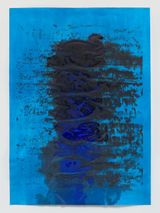
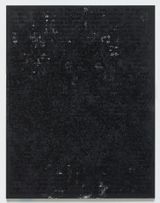
This work is a part of a larger body of text-based paintings in which Ligon stencils text onto canvas with oil stick creating a relief of sentences. As the stencil is moved across the canvas, oil stick residue and smudges from previous words mark the canvas, obscuring some of the text. Through the work’s varying degrees of legibility, Ligon uses the representational form of language to depict varying states of hypervisibility and invisibility in the Black experience. Ligon concludes his ‘Stranger’ series, which he has worked on for over two decades, with these new monumental paintings using Baldwin’s entire essay. A new triptych from the same series, also measuring 45 feet long, will be on view at Hauser & Wirth New York this November.
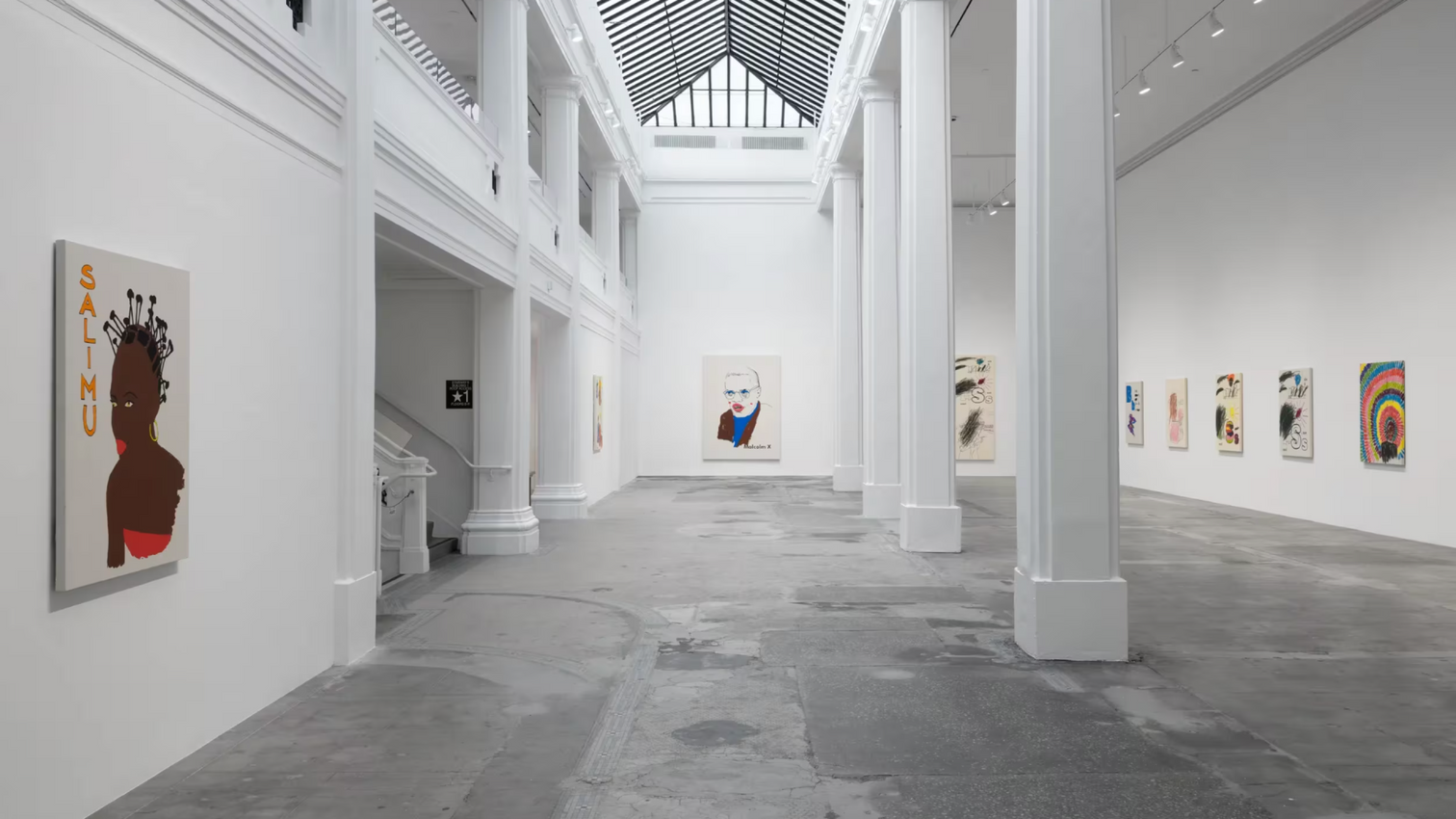
Born in the Bronx, New York, in 1960, Glenn Ligon received a BA from Wesleyan University in 1982. His early practice was grounded in painting, and his canvases of this period built upon the legacies of such Abstract Expressionist artists as Philip Guston, Cy Twombly, Robert Rauschenberg, and Jasper Johns. In 1984–1985, Ligon spent an academic year in the Whitney Museum of American Art’s Independent Study Program, developing a series of representational drawings of iconic sculptures by European artists such as Alberto Giacometti and Constantin Brâncuși, juxtaposed against images of African American hair products rendered in acrylic and ink.
Hauser & Wirth was founded in 1992 in Zurich by Iwan Wirth, Manuela Wirth and Ursula Hauser, who were joined in 2000 by Partner and Vice President Marc Payot. A family business with a global outlook, Hauser & Wirth has expanded over the past 26 years to include outposts in Hong Kong, London, New York, Los Angeles, Somerset and Gstaad. The gallery represents over 70 artists and estates who have been instrumental in shaping its identity over the past quarter century, and who are the inspiration for Hauser & Wirth’s diverse range of activities that engage with art, education, conservation and sustainability.

A respected voice in contemporary art discourse.
Focusing on ambitious storytelling and insightful art-world commentary. Ocula Magazine publishes in-depth interviews, critical essays and timely analysis on the artists, exhibitions and ideas driving the global art world.
Learn more about Ocula Magazine
Showcasing the best of the art world.
Ocula partners with galleries from around the world to highlight their artists, artworks and exhibitions. Gallery membership is by application and invitation, with each member vetted by an independent panel.
Learn more about Ocula Membership

Specialises in the sale of major artworks.
Led by a team with deep ties to the world’s leading auction houses, galleries and collectors. Ocula’s advisory team offers bespoke services to high-net-worth clients from around the world who are looking to acquire the best of contemporary and modern art.
Learn more about our team and services