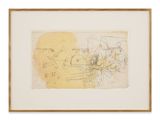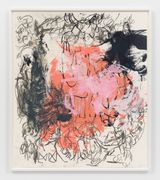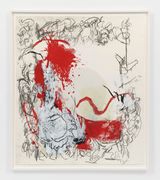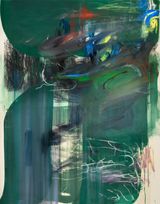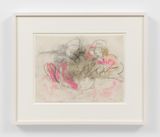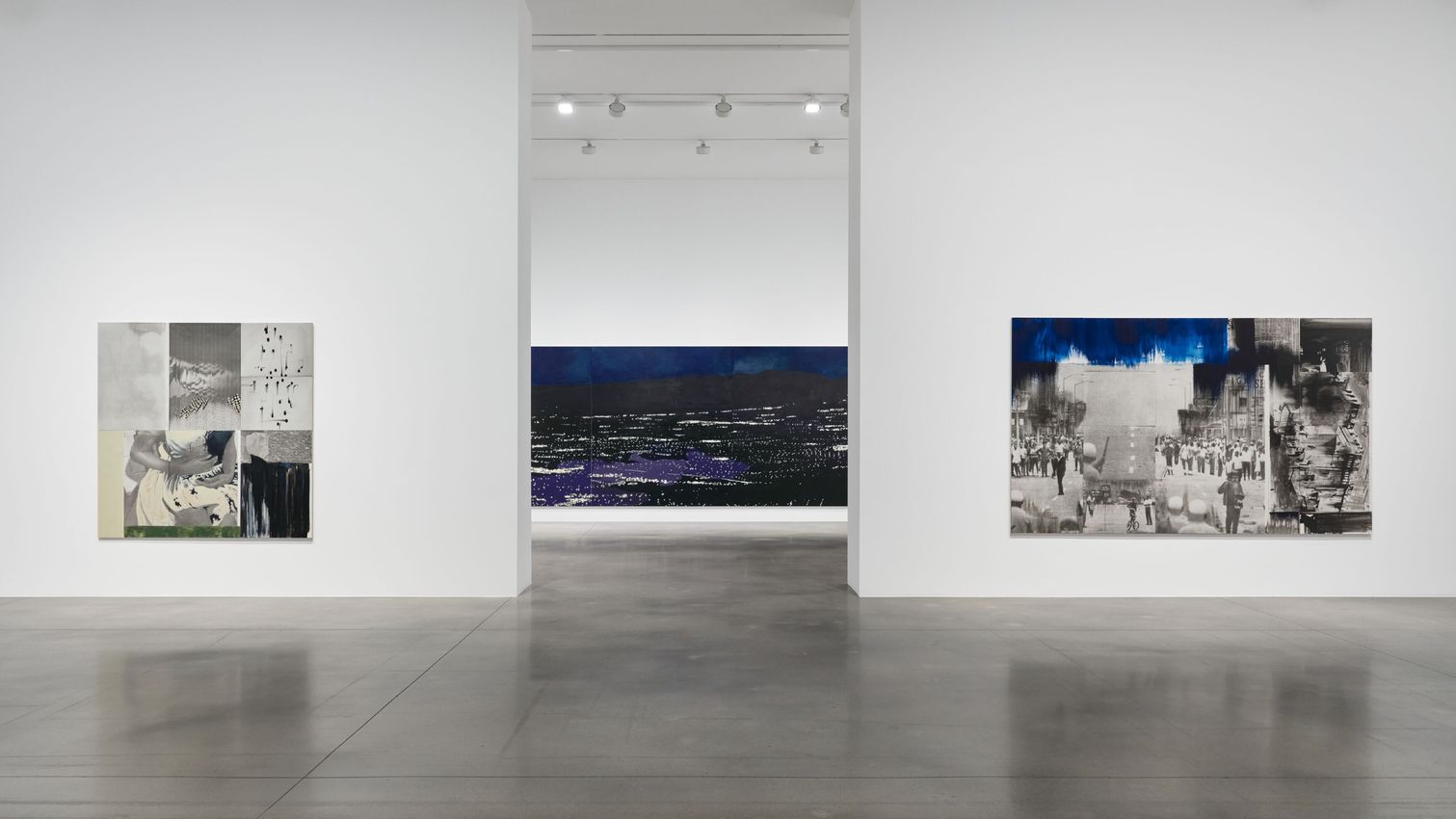




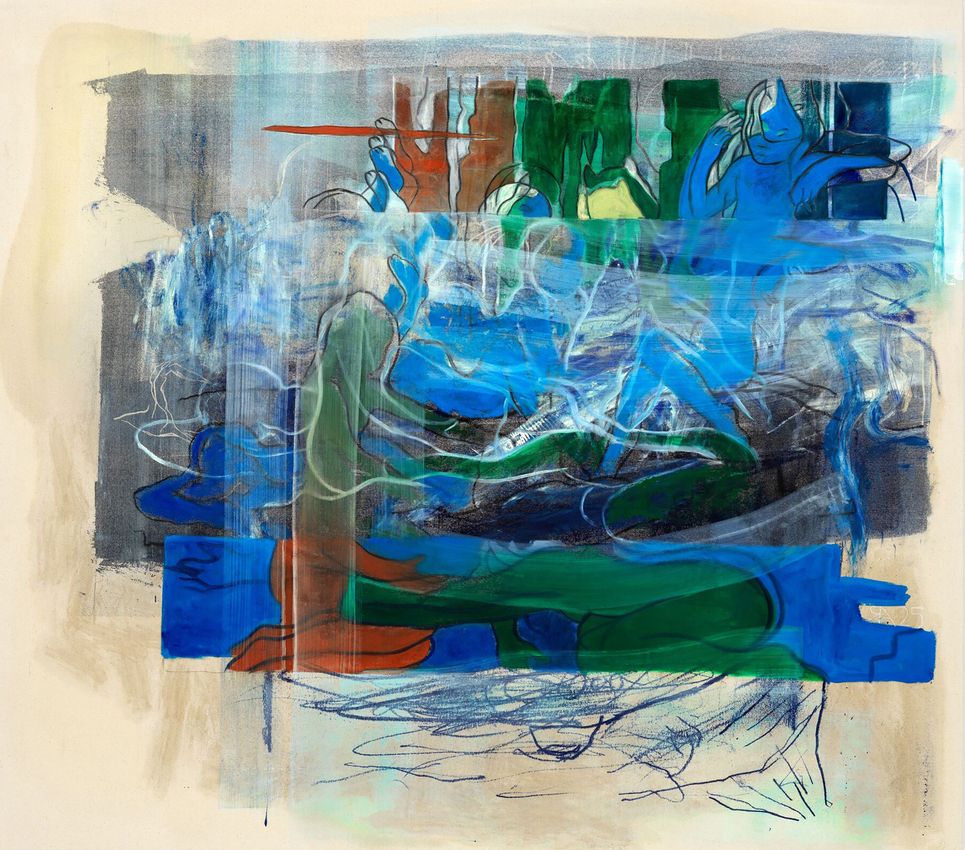
In her first exhibition at Hauser & Wirth’s Paris gallery, Rita Ackermann presents a new series of paintings and large, related works on paper that take up the theme of the double. In the works on view, Ackermann does not just evoke the presence of a dual entity but unveils its structure. Innovative in their unexpected combinations of materials and defined by a sharp conceptual tension, these works draw inspiration from two giants of French culture—Jean-Luc Godard and Paul Virilio. The results are as unsettling as they are exacting.
Ackermann’s Doubles (2024 – 2025) bespeak things that bedevil one another: a present the artist can never be at one with; a past that disallows any full disencumbering—images so well-known that they might be better forgotten. What force drives such image-making, if not a desire to capture the nuances of an ever-shifting reality dominated by a sense of absences and displacements? In these new works, shapes invert, colors reverse, images can be read as positives or negatives. In some of them, contour lines entrance, forming figures both elastic and weightless, always on the verge of vanishing. In others, pigment reduces bodies to a few restless, contorted shapes. Everything about these Doubles not only turns the tables on their beholders, but also subverts established ways of interpreting works of art. Even their title misleads, for these Doubles have as little to do with mirrors as with alter egos. Instead, these images of images fluctuate between remaining a nascent spectre and the moment when that mental projection gains substance, doubling into a recognisable thing, as in cinema.
The artist’s concern with such visual phenomena is not merely conceptual. Its origins reach back to impulses that began to structure her life, when she relocated from Budapest to New York City. From then on, she began to exist in a median state, defined by a double set of experiences: the one, anchored in a soft-Communist upbringing; the other, a coming of age as an artist in the dream factory of the Big Apple, where she chose to remain. The dialectic between those two beginning points also left a deep mark on her first body of work (1993-1995): the adolescent girls who would become the springboard for much that followed, for example, ‘Doubles 8’ (2025). Its flattened, almost transhuman forms appear as though enlargements on a screen that slides in and out of view. Overlapping and instable, like their predecessors these girls are nothing if not clones.
Ackermann’s Doubles also nod to debates around the original and the copy, and to the aesthetics of appropriation. But her concern with doubling has its roots elsewhere – in a growing preoccupation with projected images. A Hungarian translation of Paul Virilio’s ‘The Aesthetics of Disappearance’ (1991), helped focus that inclination. Ackermann not only read it once but returned time and again to this series of meditations on the interrelatedness of consciousness, perception, speed, and film. For the French author, technological advances during the 20th Century had not only effectuated the development of a cinematic self, but a being given to constructing ‘his double, his intelligent specter, and entrust[ing] the keeping of his knowledge to a reflection.’ Ackermann also looked repeatedly at Jean-Luc Godard’s ‘My Life to Live’ (1962)—a film saturated with doubles in the form of characters, images and narrative allusions. Several works of art subsequently emerged. Godard’s reflexive film practice, however, lodged deeper, taking hold in ways that took time to surface. It would only be much later that Ackermann felt ready to launch her own recursive aesthetic. Filled with images that loop back onto themselves, these new Doubles are the most recent manifestations of the provocative form such visual language can take.
—Pamela Kort
Rita Ackermann is featured in ‘Copyists’ at Centre Pompidou-Metz in collaboration with Musée du Louvre, on view from 14 June 2025 – 2 February 2026.
Rita Ackermann is a Hungarian-born, New York-based artist known for her dynamic paintings that merge figuration and abstraction, exploring themes of transformation, erasure, and the tension between chaos and control. Her works have been widely exhibited internationally and are held in major museum collections, cementing her status as a significant figure in contemporary art.


A respected voice in contemporary art discourse.
Focusing on ambitious storytelling and insightful art-world commentary. Ocula Magazine publishes in-depth interviews, critical essays and timely analysis on the artists, exhibitions and ideas driving the global art world.
Learn more about Ocula Magazine
Showcasing the best of the art world.
Ocula partners with galleries from around the world to highlight their artists, artworks and exhibitions. Gallery membership is by application and invitation, with each member vetted by an independent panel.
Learn more about Ocula Membership

Specialises in the sale of major artworks.
Led by a team with deep ties to the world’s leading auction houses, galleries and collectors. Ocula’s advisory team offers bespoke services to high-net-worth clients from around the world who are looking to acquire the best of contemporary and modern art.
Learn more about our team and services