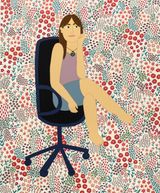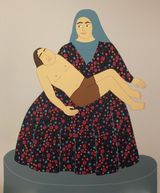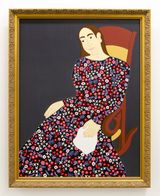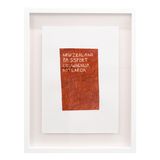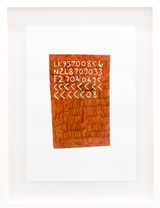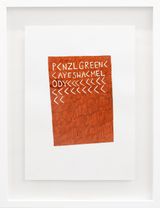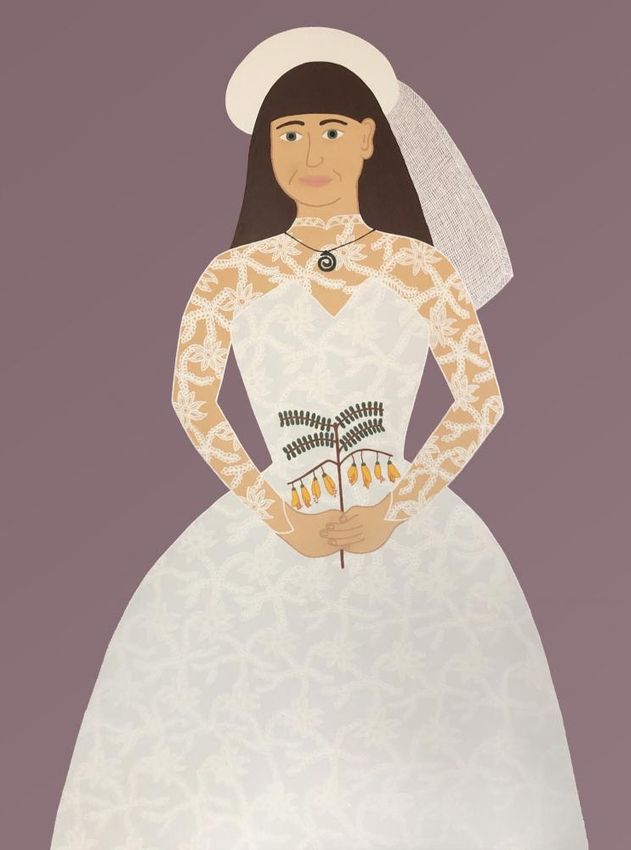
Ayesha Green’s solo exhibition Good Citizen operates at the intersections of culture, religion, whakapapa and nationality. In this new suite of portraits and works on paper, Ayesha asks, what might good citizenship be? Who gets to define what is good and who gets to define what it might mean to be a citizen? Within a nation-building framework, Māori are forced to perform their citizenship through acts of assimilation. In this exhibition, Green specifically explores the interracial family unit and how this process has resulted in her own identity as a citizen of Aotearoa New Zealand.
Good Citizen is grounded in the religious allegory of Mary mourning over the body of her dead son, Jesus. This iconic image provides a critical entry-point with Mary’s role as a cipher, deployed as the perfect feminine image of deference, sacrifice and ultimately, unattainability.
Botanical patterning is used to echo the unending nature of whakapapa and its connection to Papatūānuku, travelling through images of Green’s grandmother, mother, and herself. These portraits of an artist and her whānau wāhine draw parallels between the self, intermarriage and ‘successful’ assimilation.
Ayesha Green (Kai Tahu, Ngāti Kahungunu) is an artist based in Tāmaki Makaurau. She graduated with a Bachelor of Media Arts from Wintec in 2009 and went on to complete a Master of Fine Arts from Elam in 2013. In 2016 she completed a Graduate Diploma in Arts specalising in Museums and Cultural Heritage. In 2020 she was a Springboard Arts Foundation Recipient and in 2019 she won the National Contemporary Art Awards. Recent exhibitions include: Toi Tū Toi Ora, Auckland Art Gallery 2020/21, Wrapped up in Clouds, Dunedin Public Art Gallery, 2020, Strands, The Dowse Art Museum (2019); Tuia — Southern Encounters, The Hocken Gallery (2019); Elizabeth the First, Jhana Millers. Her work is in the collection of Te Papa Tongarewa, Dunedin Public Art Gallery, The Dowse Art Museum, The Govett-Brewster, The MTG Hawkes Bay and more.
“In her studio-based practice, Ayesha Green sustains a provocative engagement with processes of reproduction. By her own admission, Green utilises mimicry and copying to undermine the authority of symbolic objects, questioning the authenticity of their claims to power. While giving precedence to source material from the era of first contact between Māori and Pakēha, Green continues to draw on a wide range of references. Attempting to transmute the power of inherited objects and images by establishing new reading’s, Green thus pushes back at European-centric practices of anthropology and classification, and the demonstrable military and cultural domination of our shared colonial history.”

Jhana Millers Art Gallery was established in 2018 in Te Whanganui-a-Tara, Wellington to showcase compelling and innovative contemporary art and promote emerging local talents. Housed in the listed Mibar Building, fitted with large windows and a concrete ceiling, the gallery provides space for solo and curated group exhibitions.

A respected voice in contemporary art discourse.
Focusing on ambitious storytelling and insightful art-world commentary. Ocula Magazine publishes in-depth interviews, critical essays and timely analysis on the artists, exhibitions and ideas driving the global art world.
Learn more about Ocula Magazine
Showcasing the best of the art world.
Ocula partners with galleries from around the world to highlight their artists, artworks and exhibitions. Gallery membership is by application and invitation, with each member vetted by an independent panel.
Learn more about Ocula Membership

Specialises in the sale of major artworks.
Led by a team with deep ties to the world’s leading auction houses, galleries and collectors. Ocula’s advisory team offers bespoke services to high-net-worth clients from around the world who are looking to acquire the best of contemporary and modern art.
Learn more about our team and services