A line is the most elemental of marks. Straight or sinuous, it bounds space into form, creating a primordial rupture that is both an opening and a wound. The violence of coming into being, and the beauty of its completion, can be imagined in the drawing of a line. This boundary engenders an awareness of states of alterity, of the frisson where I end and you begin.
With an abiding interest in the edges of encounters, Manisha Parekh creates affective and associate forms through instinctual processes. These range from the immediate gesture to the slow layering of material, each with a different rhythm and effect. While figure and narrative are latent on the surfaces of Parekh’s works, the suggestion of assemblies of bodies and vessels, both minuscule and cosmic, propel meaning. The ensuing sensation of vertigo, of moving between scales and distances, and of contemplating the tension between the self and the other, are hallmarks of Parekh’s practice.
In A River Inside, Parekh uses liquid and its shimmering movements as metaphors for apprehending experience and describing desire. The sensuousness of water, its tendency to yield, and its forceful ability to overcome, serve to highlight acts of creation and living. Parekh’s distillation of shared ideas into visual form is not a search for universals but takes personal and peculiar trajectories that are attentive to the formal balance between intricacy and restraint.This engagement with duality, and the throbbing ambiguous fissure between, much like the line or the river, is at this exhibition’s core.
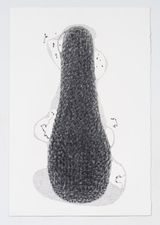
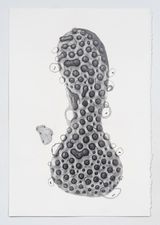
The series ‘The Sound of Water’ is the outcome of fluid layering of graphite on paper. Parekh begins by pouring glue on board and waiting for the drops and dribbles to harden. She then places a paper on this undulating surface in order to transfer the edges and densities of the shapes through rubbing. The process of recording the results of chance and accident provides a structure, which is later detailed through intense and gentle marking with graphite. Each of the works in this series offers a different morphological suggestion and a shifting position to the viewer. Are we looking above from a great height or peering into microscopic depths? In both cases, we are witness to hectic activity, to gatherings that dissolve outwards, and to bodies that let in others.
Parekh’s use of graphite in The Sound of Water creates an echo that can be traced back to the artist’s foundational experiences as a student of painting at the Maharaja Sayajirao University of Baroda during the mid-1980s. Training under Nasreen Mohamedi, Parekh learnt to observe the concrete presence of line and space and developed a sensitivity to its mutable qualities.At the time, the narrative-figurative idiom was ascendant in Baroda, and Mohamedi’s work was an anomaly within the context. For Parekh to walk through the opening created by Mohamedi was a turn away from the dominant ideology. When Parekh left for London to attend a master’s programme in painting at the Royal College of Art in 1991, her identity acquired a sharper edge, and instead of making it visible, she pared down her images such that the body disappeared and came to be indicated only by containers like bathtubs, hats and shoes, allbanal objects that stood in for the elusive traces of presence. In Following You, a series of wall-mounted metal sculptures, these vessels are further reduced to their bare bones, leaking light and shadow.
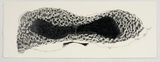
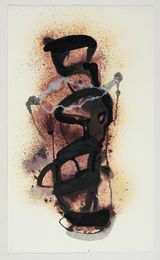
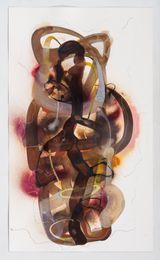
Parekh’s figuration, if one can call it that, tends towards opacity. Relic and Totem, both contain references to flesh in their titles, evoking bodies that have been preserved and fabricated for remembrance and devotion. These are not solid, stable forms, as one might expect them to be, but washes of colour that swirl with movement, and are infused with urgency. On many of the works in these two series, tiny lifeforms grow on the larger wholes, drawing energy and maintaining vitality. Parekh’s continued reverence for the parasitic—for its desire for life and its enactment of change—is also apparent in Ripple, with its punched and perforated holes that bring to mind the trails left behind by insects boring through paper. The works in Ripple appear like cartographic records in which line becomes void. Violence appears as a necessary condition of life, as does loss and disappearance, from which the possibility of beauty and transformation arises.
In this exhibition, and across her practice, Parekh raises fundamental questions about the way in which marks act upon a surface and on a viewer, how they might be perceived, and how they may disappear. These questions are rooted as much in introspection as in engagement with exterior forms. Parekh’s labour demands the courage to return to beginnings and to have faith in not knowing where she may arrive.
Zeenat Nagree
Manisha Parekh (b.1964, Uttarsanda. Lives and works in New Delhi) is notable for her abstract style. Both biomorphic and gestural, she has developed a distinct aesthetic that subtly references the work of Nasreen Mohamedi, her teacher at Baroda. Often making pieces in series and using a linear plane or grid as her organising principle, Parekh dices with Minimalism and localizes it. Her materials – paper, cord, rope – draw on the craft traditions of India. Parekh explores their properties and works predominantly by hand to conjure organic, vegetal forms indebted to the natural world.

Jhaveri Contemporary was formed in 2010 by sisters Amrita and Priya with an eye towards representing artists, across generations and nationalities, whose work is informed by South Asian connections and traditions. The gallery’s dedication to original scholarship, engendered through its carefully crafted shows, is one of the many ways it distinguishes itself. Entwined with this philosophy is another guiding principle: showcasing the heterogeneous practices of long-celebrated luminaries as well as emerging talents, often in generously interrogative conversations. With a focus on mining lesser-known art histories, Jhaveri Contemporary facilitates dialogue between artists, curators and historians to add to the wider field of art. Estates served by the gallery include Mrinalini Mukherjee and Anwar Jalal Shemza.

A respected voice in contemporary art discourse.
Focusing on ambitious storytelling and insightful art-world commentary. Ocula Magazine publishes in-depth interviews, critical essays and timely analysis on the artists, exhibitions and ideas driving the global art world.
Learn more about Ocula Magazine
Showcasing the best of the art world.
Ocula partners with galleries from around the world to highlight their artists, artworks and exhibitions. Gallery membership is by application and invitation, with each member vetted by an independent panel.
Learn more about Ocula Membership

Specialises in the sale of major artworks.
Led by a team with deep ties to the world’s leading auction houses, galleries and collectors. Ocula’s advisory team offers bespoke services to high-net-worth clients from around the world who are looking to acquire the best of contemporary and modern art.
Learn more about our team and services