



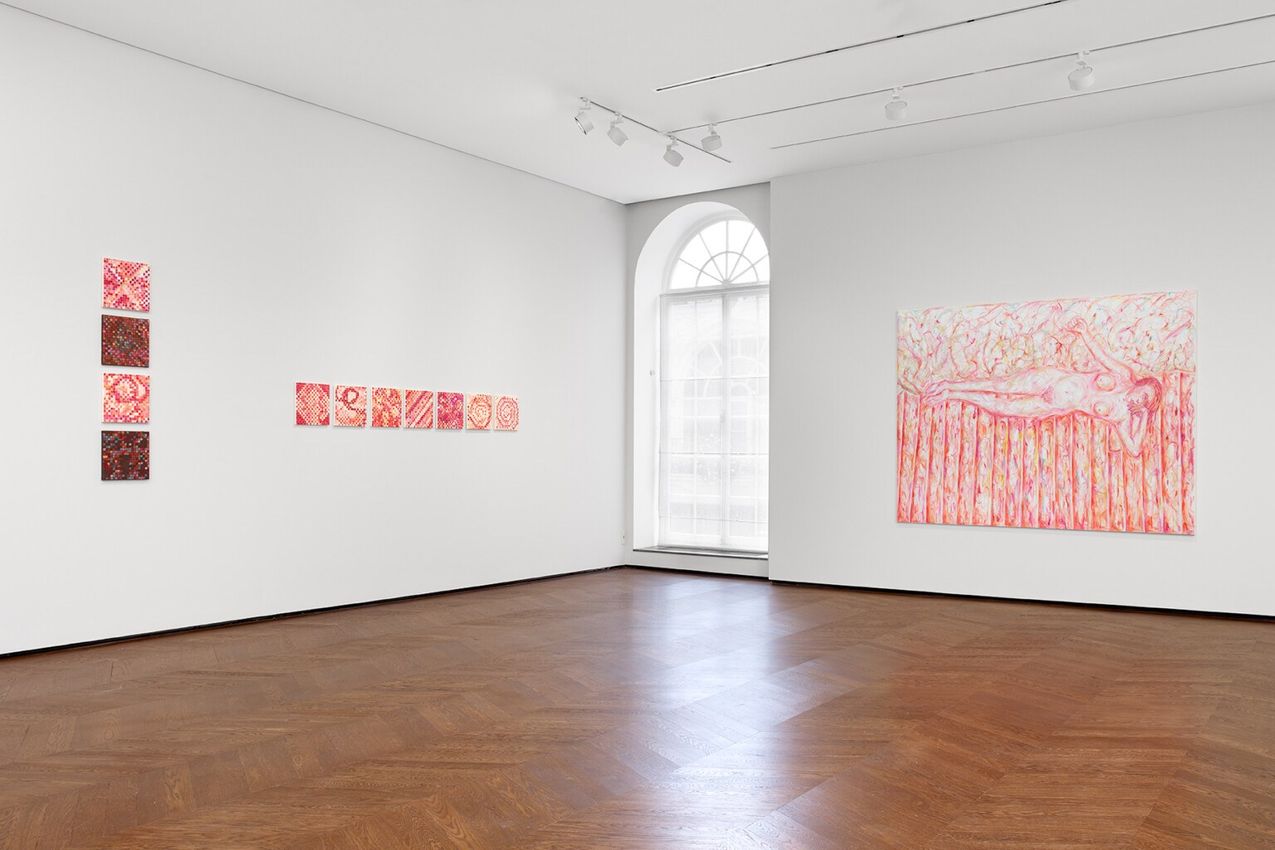
We are pleased to announce the second exhibition with Jutta Koether. On view at 22 Old Bond Street and 40 Albemarle Street, Jutta Koether: Femme Colonne features seven new, large-scale paintings. Since the 1980s, Koether has utilised appropriation to situate herself within an eclectic artistic genealogy that references idioms from French baroque painting to Symbolism, Post-Impressionism, and Surrealism. In a recurring repertoire of pixelated or ‘bruised’ grids, vibrant red paint, and unfurling ribbons and curtains, Koether layers her own figuration with art historical motifs, recasting these symbols to provoke generative new meanings. This recursion of representational devices invites each viewer to engage deeply with Koether’s canvases, exploring the many valences of signification each opens up—individually and in juxtaposition with other works, across the landscape of art history.
Jutta Koether: Femme Colonne elaborates on the artist’s tradition of canonical reference. The exhibition borrows its title from a term coined by art historian T. J. Clark in an essay on the French classicist Nicolas Poussin (1594–1665). In his reading of Poussin’s The Sacrament of Marriage (1647–1648), Clark refers to the figure at the painting’s far left as the ‘femme-colonne,’ which literally translates to ‘woman column’—the folds of her clothes and veil are all that remain visible beyond the looming architectural form at her right. Koether’s paintings in Femme Colonne reckon with and reimagine this mysterious figure, simultaneously encompassing the human and the architectural, the upright and the horizontal, the marginal and the pivotal.
The paintings on view extend representational motifs and schemas Koether has developed throughout her artistic career; her signature red hue and reconceptualised female nudes respond to Clark’s academic proposition of uprightness, femininity, and light. Like the ‘woman column’ herself, Koether’s Femme Colonne is what Clark might call ‘an invitation to reading.’ Portraying a vibrant dialogue with art history, the seven distinctive works also encourage contemporary discourse, their iterative structure functioning as a unified body which interweaves verticality, gender, materiality, and paint. In her project of revisiting, remaking, and (re)presenting the femme-colonne, Koether paints new, evocative formations that rely upon and engage the participation of the viewer—the presence of the being standing always nearly out of frame.
Born in Cologne in 1958, Jutta Koether studied art and philosophy at the University of Cologne and the Independent Study Program of the Whitney Museum of American Art in New York. In 1980, she joined the editorial staff of the music and art journal Spex. She has also written for such publications as Eau de Cologne, Artforum, _Texte zur Kuns_t, and Flash Art. She is the author of several books, including f. (1987), which was translated into English and republished by Sternberg Press in 2015. Her work is marked by multiple collaborations, including her participation in the collective Reena Spaulings, and her musical performances with Rita Ackerman, Tony Conrad, Kim Gordon, John Miller, Steven Parrino, and Tom Verlaine.


Helmed by Dominique Lévy, Brett Gorvy, and Amalia Dayan, Lévy Gorvy Dayan collaborates with artists, estates, non-profit organizations, foundations, museums, and private collections to increase the visibility of twentieth- and twenty-first century works and artists—realizing seminal projects and furthering legacies. In forming Lévy Gorvy Dayan, the partners merge their respective specialties across twentieth- and twenty-first century art, their reputations as leaders and tastemakers, and their respective backgrounds in the primary and secondary markets. Lévy Gorvy Dayan provides opportunities for education, exposure, and access to acquiring exceptional art through its museum-quality exhibition program and thoughtful participation in international art fairs. Expanding, refining, and enhancing world-class modern and contemporary art collections, the gallery emphasizes connoisseurship and curation in its collection development, estate planning, and art appraisal services. Both international and local in practice and perspective, Lévy Gorvy Dayan has unique spaces and unmatched market knowledge in New York, London, and Hong Kong, in addition to representation in Geneva, Milan, Paris, Shanghai, Singapore, and Taiwan.

A respected voice in contemporary art discourse.
Focusing on ambitious storytelling and insightful art-world commentary. Ocula Magazine publishes in-depth interviews, critical essays and timely analysis on the artists, exhibitions and ideas driving the global art world.
Learn more about Ocula Magazine
Showcasing the best of the art world.
Ocula partners with galleries from around the world to highlight their artists, artworks and exhibitions. Gallery membership is by application and invitation, with each member vetted by an independent panel.
Learn more about Ocula Membership

Specialises in the sale of major artworks.
Led by a team with deep ties to the world’s leading auction houses, galleries and collectors. Ocula’s advisory team offers bespoke services to high-net-worth clients from around the world who are looking to acquire the best of contemporary and modern art.
Learn more about our team and services