



My artistic trajectory had previously followed the Duchamp path, really, so Picasso was a late discovery. I started looking at him seriously and became a little bit obsessed, specifically with the classic period of Cubism, 1911–1914
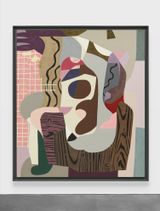
Rodney Graham returns to London for his thirteenth show with Lisson Gallery, exhibiting a new suite of paintings developed from a series begun with an online exhibition, Painting Problems two years ago. While an inveterate and self-confessed appropriator in the Duchampian mode, Graham has now entered a self-reflexive mode of painting, drawing from his own past projects, rather than wholly from art historical precedent.
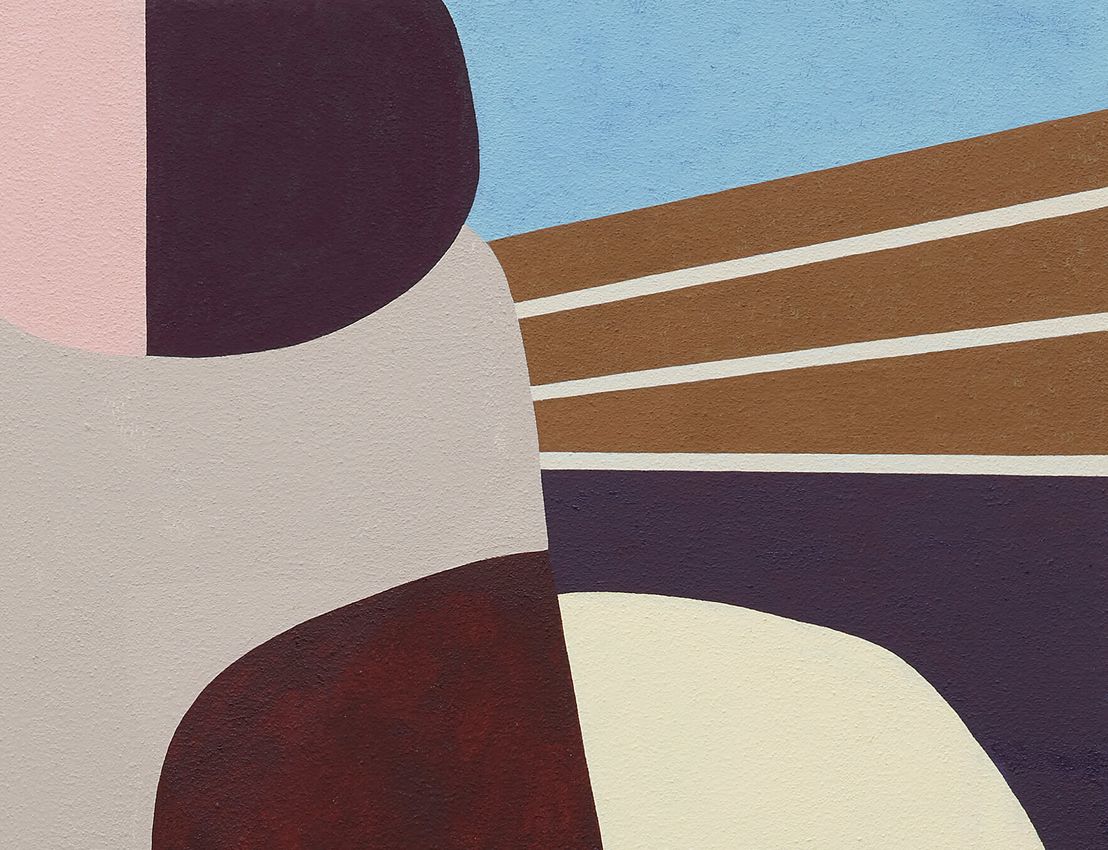
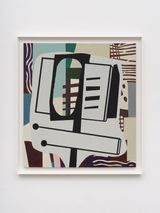
Through layering and superimposition, Graham achieves the painterly equivalent of an all-over Cubism in the largest of these new paintings, with the introduction of quasi-recognisable objects or symbols – a button, a keyboard, a zebra stripe–simultaneously flattening and adding realistic depth to the compositions. His technique of re-incorporating or stitching together motifs from previous bodies of painting perhaps adds to the familiarity of form, through which Graham finds his own harmonic, graphic outcome.
‘The system we developed to achieve this depth, through airbrushing and spray painting, was to take a fragment of a larger template that I created – if you look from one to the other you might see a simple shape recurring. This was then overlaid and spray painted over with a kind of a shadow effect that evokes, I guess, in a graphic way, the techniques of Analytic Cubism.’
Although best known for his conceptual practice as a photographer and installation artist, Graham, has often turned to painting, in the first instance for his 2007 exhibition, ‘Wet on Wet: My Late Early Styles’. Then generated from examples of abstract artists including Francis Picabia or Jean Arp, he moved on to Morris Louis-style drip painting, then shaped canvases and multipartite painting, before embarking on impastoed, midcentury modernist works in the manner of Lucio Fontana.
More recent works started with an example of Alexander Rodchenko, which was endlessly cut-and-pasted, rotated and transformed in Photoshop before becoming unrecognisable as source material. The current body of works owe as much to Matisse as they do Picasso, with windows, openings and guitar shapes all coalescing into view. While his ‘late early styles’ could have been considered ironic experimentation with a post-medium condition, Graham has now developed his own ‘mature’ expression as a painter from a position of experience and prolonged studio practice.
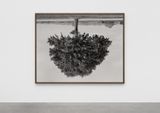
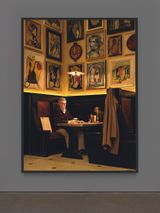
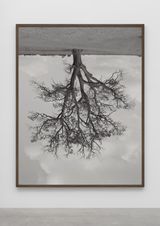
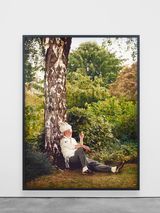
Rodney Graham pulls at the threads of cultural and intellectual history through photography, film, music, performance and painting. He presents cyclical narratives that pop with puns and references to literature and philosophy, from Lewis Carroll to Sigmund Freud to Kurt Cobain, with a sense of humour that betrays Graham’s footing in the post-punk scene of late 1970s Vancouver. The nine-minute loop Vexation Island, 1997, presents the artist as a 17th-century sailor, lying unconscious under a coconut tree with a bruise on his head; after eight and a half minutes he gets up and shakes the tree inducing a coconut to fall and knock him out, and for the sequence to start again. Graham returns as a cowboy in How I Became a Ramblin’ Man, 1999, and as both city dandy and country bumpkin in City Self/Country Self, 2001 – fictional characters all engaged in an endless loop of activity. Such dream states and the ramblings of the unconscious are rooted in Graham’s earlier upside-down photographs of oak trees. Inversion, Graham explains, has a logic: ‘You don’t have to delve very deeply into modern physics to realise that the scientific view holds that the world is really not as it appears. Before the brain rights it, the eye sees a tree upside down in the same way it appears on the glass back of the large format field camera I use,’ 2005.


Established in 1967 in London, Lisson Gallery is one of the most well-known galleries operating globally. Boasting an influential and continuing legacy, including playing a pivotal role in the careers of many pioneers of historically important art movements, the gallery works with some of the most significant contemporary artists today.

A respected voice in contemporary art discourse.
Focusing on ambitious storytelling and insightful art-world commentary. Ocula Magazine publishes in-depth interviews, critical essays and timely analysis on the artists, exhibitions and ideas driving the global art world.
Learn more about Ocula Magazine
Showcasing the best of the art world.
Ocula partners with galleries from around the world to highlight their artists, artworks and exhibitions. Gallery membership is by application and invitation, with each member vetted by an independent panel.
Learn more about Ocula Membership

Specialises in the sale of major artworks.
Led by a team with deep ties to the world’s leading auction houses, galleries and collectors. Ocula’s advisory team offers bespoke services to high-net-worth clients from around the world who are looking to acquire the best of contemporary and modern art.
Learn more about our team and services