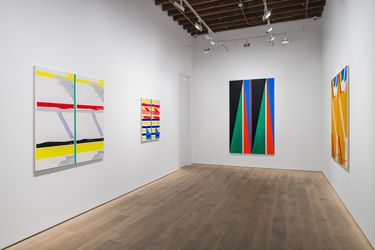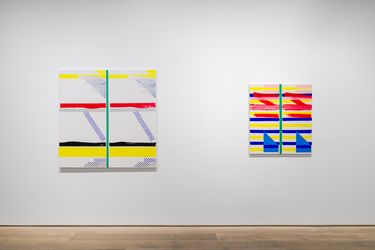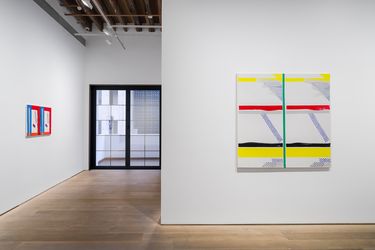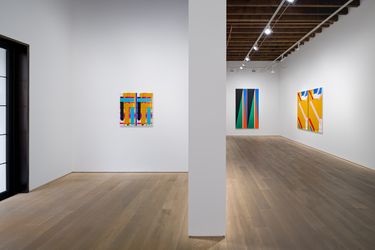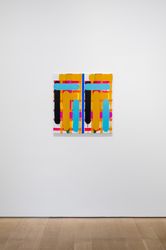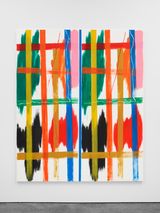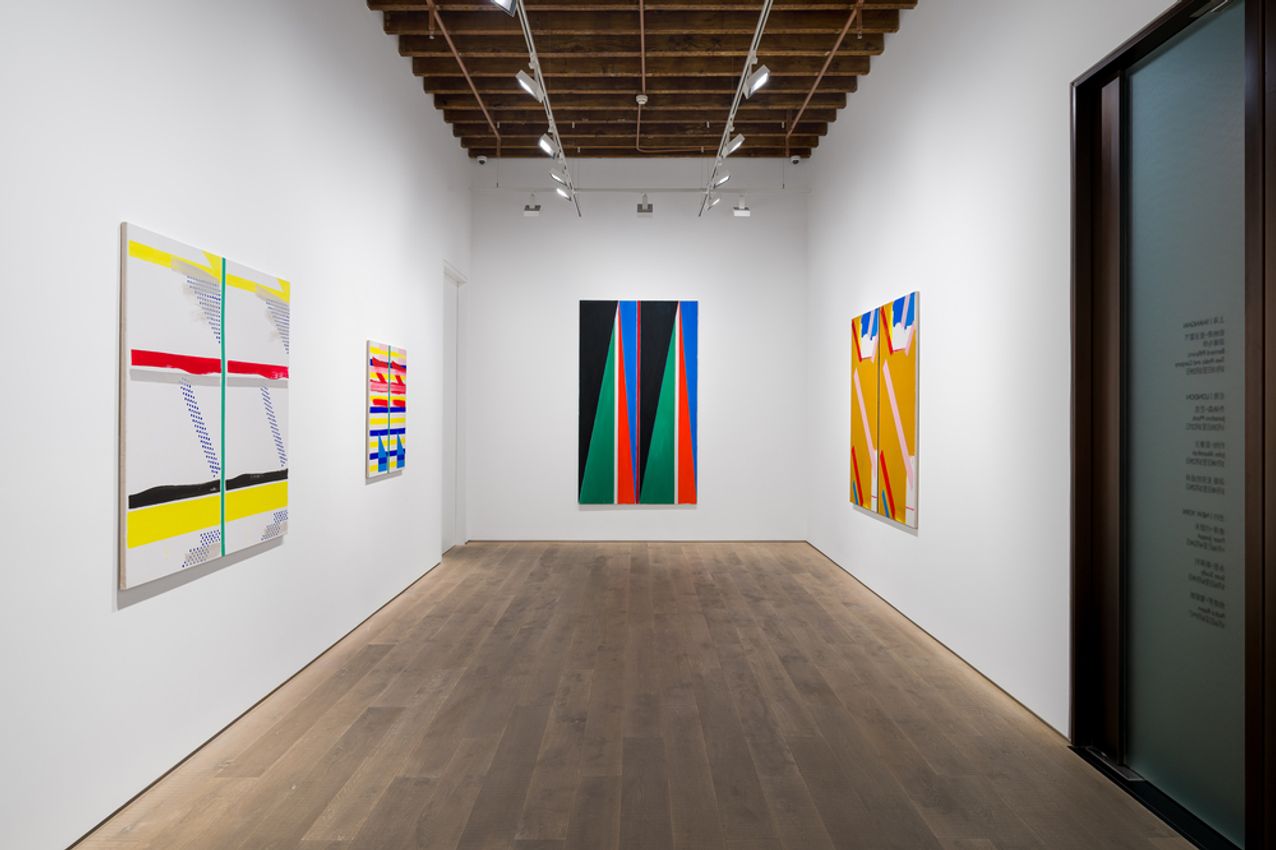
Lisson Gallery is delighted to open its first exhibition of work by the French artist, Bernard Piffaretti, in Shanghai. The exhibition features a selection of colourful, dynamic new works, all created by the artist in his Paris studio over the past year. The presentation highlights the role of cinema, in particular, the visionary filmmakers David Lynch and Orson Welles, in the creation of Piffaretti’s ‘moving image’ style of painting, and the connections between their bodies of work.
Named one of the greatest painters of his generation, Piffaretti has refined his ‘Piffaretti system’ for many decades. These new acrylic on canvas paintings on show in Shanghai, all Untitled (2020) like the majority of Piffaretti’s oeuvre, illustrate this method. Each painting begins with the artist establishing a clear separation between left and right, by painting ‘the central mark’—the vertical line that divides the canvas into two equal sides. The artist then creates an abstract composition of gestural marks on one side, and follows to re-create the image opposite, on the other side of the vertical line. However, while Piffaretti is interested in the process of mirroring, he is not concerned with producing an ideal, symmetrical image. Instead, he purposely paints an inexact, doubled image that instantly challenges our perception and forces us to question what we are seeing. Because we do not know which side the artist painted first (left or right), we cannot identify which side is ‘right’ or ‘wrong’, and instead each becomes an equally imperfect double. Our minds actively try to decode the puzzle of Piffaretti’s chosen variations, highlighting our inherent psychological and emotional response to this technique.
The title of the show, Twin Peaks and Company, was selected by Piffaretti as a tribute to two filmmakers: David Lynch and Orson Welles as, he says, ‘a kind of twin legacy’. Twin Peaks, directed by David Lynch, was the famed American horror drama which originally aired in 1990 before returning as a limited series in 2017. Piffaretti, like Lynch, came to prominence in the 1980s, alongside the development of the ‘high concept’ era in cinematic style and the continuation of the filmmaker-driven format. The latter part of the title, and Company, refers to Lynch’s forerunner, Orson Welles, who greatly influenced Lynch in his formal approach to directing and its psychological effects. In particular, Piffaretti notes the film, The Lady from Shanghai (1947) which Lynch has discussed as a major influence on his work. The finale of this film features a unique climactic shoot-out in the Magic Mirror Maze, a hall of mirrors comprising a multitude of real and false images, where each face is repeated and mirrored numerous times.
Piffaretti’s own exploration of visual language is mirrored in the work of Lynch and Welles, and indeed Piffaretti has noted ‘I practice painting like one would a “moving picture”, I see it as a “moving situation”’, as is often seen in the artist’s work. The artists all adopt distortion in their work, mystery, reflections, and a deconstruction of images to push the boundaries of their medium and illustrate the psychological effects of their methods. Piffaretti’s work is also influenced by the stylistic negation of filmmakers such as Lynch and Welles, who refuse to be categorized by one artistic vocabulary, as well as the performance of the process. The ‘peak’ is a recurrent motif in Piffaretti’s paintings—one of these, depicting a pair of peaks against a black backdrop, is included in the exhibition. The artist adds: ‘I noticed in Shanghai there is a shipping line named “The Twin Peaks Express”. This construction, at different levels, is always in action in my work: the questions involved in the figure of the double, of the twin.’


French artist Bernard Piffaretti bases his practice on repetition while analysing the components of painting. After art studies at the school of Fine Arts in Saint-Etienne from 1973 to 1979, he began to elaborate his ‘Piffaretti system’, fixed in 1986. This protocol is at the origin of every work he produces: each is composed of two panels apparently identical, separated by a vertical strip; one of the two parts is an attempt to duplicate the other, made beforehand. Once both panels are finished, the distinction between the copy and the original tends to fade. As the artist admits himself, ‘the repetition, act by act, on the second half of the canvas, can only produce an imperfect image’: Piffaretti’s system aims at showing us this impossible reproduction of the artistic gesture. In some works, the second part is even left irremediably blank, because of the complexity of the shapes painted. Piffaretti also realises drawings after paintings, reversing the concept of preparatory sketches and using them to seize his own work.


Established in 1967 in London, Lisson Gallery is one of the most well-known galleries operating globally. Boasting an influential and continuing legacy, including playing a pivotal role in the careers of many pioneers of historically important art movements, the gallery works with some of the most significant contemporary artists today.

A respected voice in contemporary art discourse.
Focusing on ambitious storytelling and insightful art-world commentary. Ocula Magazine publishes in-depth interviews, critical essays and timely analysis on the artists, exhibitions and ideas driving the global art world.
Learn more about Ocula Magazine
Showcasing the best of the art world.
Ocula partners with galleries from around the world to highlight their artists, artworks and exhibitions. Gallery membership is by application and invitation, with each member vetted by an independent panel.
Learn more about Ocula Membership

Specialises in the sale of major artworks.
Led by a team with deep ties to the world’s leading auction houses, galleries and collectors. Ocula’s advisory team offers bespoke services to high-net-worth clients from around the world who are looking to acquire the best of contemporary and modern art.
Learn more about our team and services