


HELEN FRANKENTHALER
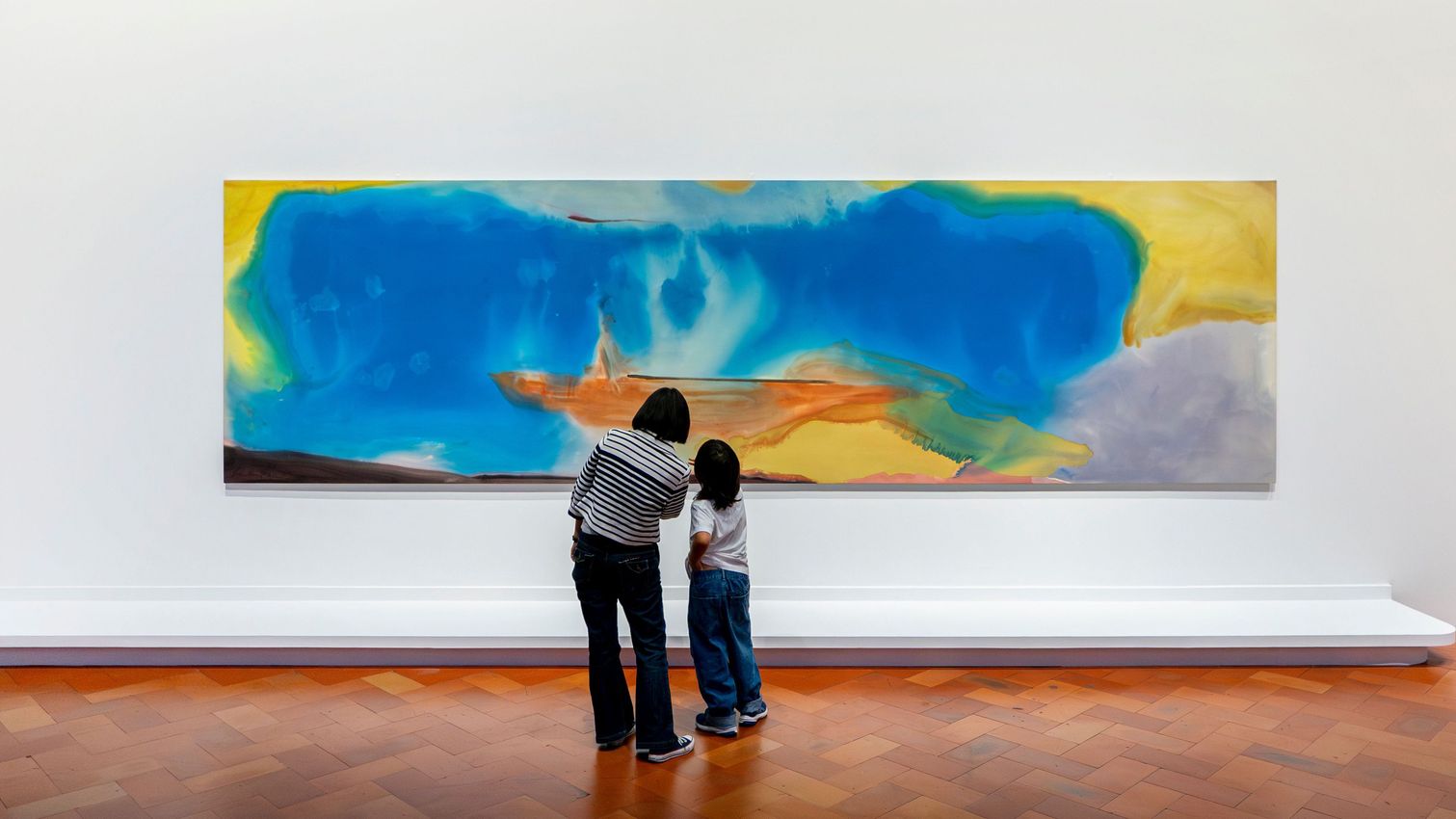
1928-2011, United StatesHelen Frankenthaler (1928–2011) is widely recognised as one of the great American abstract painters of the 20th century, and a pivotal figure in the transition from Abstract Expressionism to Colour Field painting. A leading member of the second generation of postwar American abstract artists, she is best known for her innovative soak-stain technique, in which she poured turpentine‑thinned paint onto unprimed canvas laid on the floor, allowing colour to soak into the fabric and create luminous, translucent fields.
Frankenthaler’s painting Mountains and Sea (1952) is often cited as a landmark of modern American abstraction and a key catalyst for the Colour Field movement, influencing contemporaries such as Morris Louis and Kenneth Noland. Frankenthaler’s impact on contemporary art, painting, and printmaking continues to shape how artists and curators think about colour, surface, and abstraction today.
Early life and education
Frankenthaler grew up in New York City in a family that placed a strong emphasis on culture and education. She attended the Dalton School, where she studied with Mexican artist Rufino Tamayo, an experience that gave her early exposure to modernist ideas about colour and form. She went on to Bennington College in Vermont, where artist and teacher Paul Feeley encouraged her engagement with contemporary American painting and the emerging New York School. After completing her degree in 1949, she spent a formative period in Provincetown, Massachusetts, studying briefly with Hans Hofmann and absorbing his emphasis on pictorial structure and the emotional possibilities of colour.
Early career and breakthrough paintings
By 1950 Frankenthaler was exhibiting in New York and entering the circle of artists, writers, and critics who defined the city’s postwar art scene. An early piece, Beach (1950), combined oil paint with unconventional materials such as sand and coffee grounds, signaling her interest in experimenting with both texture and surface. In 1951 she had her first solo exhibition at Tibor de Nagy Gallery, a space closely associated with younger abstract painters and poets. That same year she participated in the 9th Street Exhibition of Painting and Sculpture, a landmark group show that brought together artists such as Philip Guston, Franz Kline, Lee Krasner, Elaine de Kooning, Joan Mitchell, and Barnett Newman, positioning Frankenthaler among the key figures of what would be called the New York School.
Her pivotal technical shift came after seeing Jackson Pollock‘s drip paintings, which affected how she thought about scale, process, and the relationship between painter and canvas. Rather than emulating Pollock’s dense accumulations of paint, she began placing raw canvas on the floor and pouring very fluid, often turpentine‑thinned paint so that colour soaked into the fabric instead of sitting on top of it. The edges of these stains remained soft, and the weave of the canvas remained visible, producing a sense of transparency and atmospheric depth. This soak‑stain approach moved away from heavy brushwork and impasto and towards compositions in which colour itself becomes the main structural element.
Mountains and Sea (1952), painted when she was in her early twenties, is often singled out as the first fully realised example of this method. The painting suggests a landscape through floating, translucent washes of blue and green punctuated by areas of red and pink, yet it resists literal depiction and instead presents an image that is simultaneously spatial and flat. When other painters saw this work in her studio, they recognised that it proposed a new way for abstraction to move beyond gestural expressionism into a language of open, stained colour fields.
Development of Color Field painting and later canvases
Over the next decades Frankenthaler expanded the scale and complexity of her paintings. In the late 1950s and 1960s she continued to work with staining, but introduced more pronounced linear elements and bolder shapes that either cut across or float within broad colour passages. Works such as The Bay (1963) and Indian Summer (1967) present large, open areas of colour in tension with irregular forms that evoke landscape, water, or weather without depicting a specific place.
Materially, she shifted from diluted oil paint to acrylics, which dry more quickly and offer different optical effects. Acrylic allowed her to combine thin, watery pours with crisper edges and to experiment with layering transparent and opaque colour. This change in medium also encouraged new approaches to surface, as the paint could either soak in or sit more on the top of the canvas depending on how it was handled. Frankenthaler developed these ideas in parallel with, but distinct from, her then husband Robert Motherwell; both artists pursued abstract painting, yet her work remained strongly tied to stain, translucency, and an often landscape‑inflected sense of space.
Later paintings, from the 1970s through the early 2000s, maintained her commitment to colour and openness while showing greater variety in density, rhythm, and touch. In some works, broad atmospheric washes dominate; in others, the composition is articulated by more insistent drawing or by block‑like forms. Exhibitions devoted to her late works have highlighted the extent to which she continued to revise and complicate her vocabulary rather than simply repeating early successes.
Printmaking and innovative woodcuts
Printmaking became a major strand of Frankenthaler’s practice, and she is particularly celebrated for her contributions to contemporary woodcut. Working with master printers and specialised workshops, she translated the logic of staining and layered colour into a process that traditionally emphasised strong, graphic shapes. She treated the woodblock as a site for experimentation—carving, sanding, and scoring the surface, and using multiple blocks and extensive colour separations to achieve subtle gradations and overlays on paper.
In works such as Cameo (1980), she used several colour blocks to create a pale, atmospheric composition in blue and violet, while abrasions and incised marks interrupt and animate the surface. Madame Butterfly (2000), a large triptych composed from an exceptionally high number of blocks and colour passes, demonstrates how far she could push the woodcut medium toward a painterly, layered effect. Across her printmaking, Frankenthaler showed that woodcut—often considered a bold, flat, graphic form—could support the same kind of nuance and lyricism that characterised her paintings, and her prints have become an important reference point for later artists exploring the possibilities of large‑scale colour woodcut.
Scholarship, institutions, and the Helen Frankenthaler Foundation
Frankenthaler’s work has generated a substantial body of writing, ranging from exhibition catalogues and critical essays to full‑length studies. Publications focusing on different periods of her career have examined how she engages with landscape, how her practice fits within the histories of Abstract Expressionism and Color Field painting, and how her use of colour challenges straightforward narrative or symbolic readings. More recently, books and essays have revisited her role in the 1950s New York scene, emphasising her position within networks of artists, curators, and critics and re‑evaluating how women artists shaped the development of postwar abstraction.
Alongside her studio work, Frankenthaler held influential positions in the cultural field. She served with the American Academy of Arts and Letters and sat on the National Council on the Arts at the National Endowment for the Arts, participating in conversations about arts funding, public collections, and the place of contemporary art in broader civic life.
The Helen Frankenthaler Foundation, which she established and endowed, has been active since the early 2010s and plays a central role in preserving and promoting her legacy. The foundation supports exhibitions, conservation, and research related to her work and the broader field of modern and contemporary art. It has initiated programmes such as the Frankenthaler Prints Initiative, which provides museums with prints and related support; emergency relief and support funds for arts organisations; and the Frankenthaler Climate Initiative, which backs projects aimed at improving energy efficiency and environmental sustainability in visual arts institutions. Through these activities, the foundation extends key values evident in Frankenthaler’s practice—experimentation, long‑term commitment to the studio, and attention to material conditions—into the institutional and ecological contexts of the present.
Helen Frankenthaler Exhibitions
From the mid‑1960s onward, Frankenthaler’s work has been a regular presence in major museum and gallery programmes. Her participation in the 33rd Venice Biennale in 1966 marked an early moment of international recognition, situating her alongside other leading American artists in a global forum. Retrospective of Paintings, her major solo exhibition at the Whitney Museum of American Art, New York in 1969 went on an international tour to the Whitechapel Gallery, London; Orangerie Herrenhausen, Hanover; and Berlin Kongresshalle, consolidating her reputation and placed her firmly within the canon of postwar painting.
In the decades since, museums in the United States, Europe, and beyond have organised exhibitions that focus on particular themes or periods in her work—early stain paintings, Provincetown summers, large canvases of the 1960s, or late works from the 1990s and early 2000s. Institutions such as Tate, the Metropolitan Museum of Art, the Museum of Modern Art, the National Gallery of Australia, the Guggenheim Museum Bilbao, and others have shown her paintings and prints in exhibitions devoted to Abstract Expressionism, Color Field painting, and women’s contributions to postwar abstraction.
Solo exhibitions include:
- Helen Frankenthaler, Kunstmuseum Basel, Basel (2026)
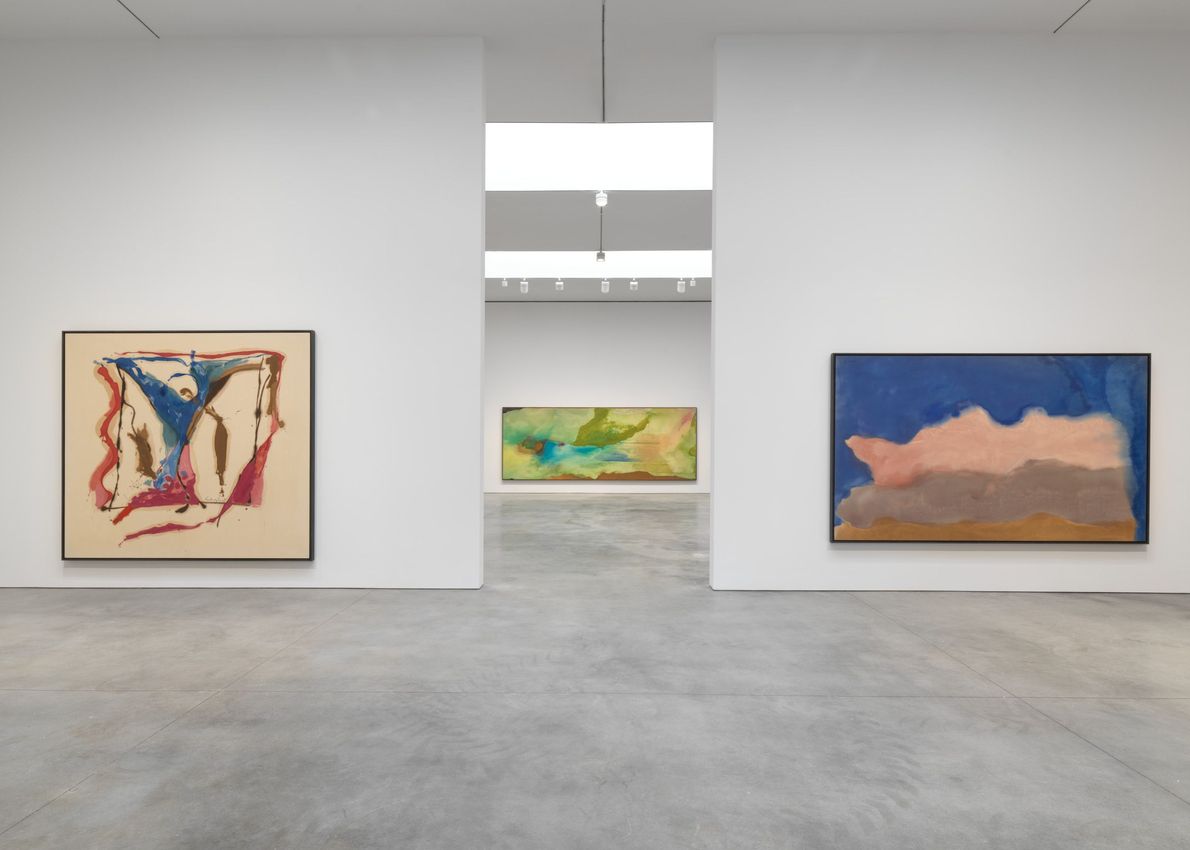
- Helen Frankenthaler: The Moment and the Distance, Gagosian, New York (2026)
- Helen Frankenthaler: A Grand Sweep, The Museum of Modern Art, New York (2025–2026)
- Helen Frankenthaler: Painting Without Rules, The Guggenheim Museum Bilbao (2025)
- Helen Frankenthaler: Radical Beauty, Dulwich Picture Gallery, London (2021)
- Imagining Landscapes: Paintings by Helen Frankenthaler, 1952–1976, Gagosian, London (2021)
- Helen Frankenthaler, Tate Modern, London (2019)
- PITTURA.PANORAMA: Paintings by Helen Frankenthaler, 1952–1992, Museo di Palazzo Grimani, Venice (2019)
- Abstract Climates: Helen Frankenthaler in Provincetown, Provincetown Art Association and Museum (2018)
- Helen Frankenthaler, Paintings: 1961–1973, John Berggruen Gallery, San Francisco (2010)
- Against the Grain: the Woodcuts of Helen Frankenthaler, National Gallery of Australia, Canberra (2005)
Selected group exhibitions include:
- Push and Pull: The Prints of Helen Frankenthaler and Her Contemporaries, The University of New Mexico Art Museum (31 January–17 May 2025)
- Contemporary Art: Five Positions, Museum of Fine Arts, Boston (2019)
- Epic Abstractions: Pollock to Herrera, Metropolitan Museum of Art, New York (2018)
- Peindre la nuit, Centre Pompidou-Metz, France (2018); Abstract Expressionism, Guggenheim Bilbao, Spain (2017)
- Making Space: Women Artists and Postwar Abstraction, Museum of Modern Art, New York (2017)
- The New York School, 1969: Henry Gelzahler at the Metropolitan Museum of Art, Paul Kasmin Gallery, New York (2015)
- Making Painting: Helen Frankenthaler and JMW Turner, Turner Contemporary, Margate (2014)
2026 Helen Frankenthal Exhibitions
In 2026, the Kunstmuseum Basel is presenting a major Helen Frankenthaler exhibition in its Neubau building from 18 April to 23 August 2026, curated by Anita Haldemann. Bringing together more than 50 works spanning six decades, it is described as the most extensive presentation of her art in Europe to date and her first institutional solo show in Switzerland. The exhibition highlights her soak‑stain paintings and their role in the emergence of Color Field painting, while also placing her work in dialogue with historical art from the fifteenth to the twentieth century and drawing on substantial loans from the Helen Frankenthaler Foundation and major international museums.
In addition to the institutional showing in Basel, in collaboration with the Helen Frankenthaler Foundation, Gagosian in New York will also be showing her work. Surveying four decades of paintings from 1960 to 1992, Helen Frankenthaler: The Moment and the Distance, features more than 20 of the American artist’s largest, most ambitious works. Arranged by decade, these canvases—with their monumental scale, sensuous color, and innovative compositions—offer new perspectives on the artist’s continual reinvention of her practice.
Helen Frankenthaler FAQs
Who was Helen Frankenthaler?
Helen Frankenthaler (1928–2011) was an American abstract painter whose innovative techniques significantly influenced postwar American art. She played a pivotal role in the transition from Abstract Expressionism to Color Field painting, developing a unique approach that expanded the possibilities of abstract painting.
What is Helen Frankenthaler’s most famous work?
Mountains and Sea (1952) is Frankenthaler’s most iconic painting. Created when she was just 23, this work introduced her signature soak-stain technique, pouring thinned oil paint onto unprimed canvas, allowing the colours to soak into the fabric. This method produced luminous colour washes that appeared to merge with the canvas, significantly departing from traditional painting techniques.
What influenced Helen Frankenthaler’s art?
A range of artists and movements influenced Frankenthaler’s work. She drew inspiration from Abstract Expressionists like Jackson Pollock and Franz Kline and from her studies under Hans Hofmann. Her relationship with art critic Clement Greenberg also played a role in her artistic development. Additionally, her exposure to Japanese art and philosophy informed her aesthetic sensibilities.
What is the soak-stain technique?
The soak-stain technique involves pouring thinned paint onto unprimed canvas, allowing the pigment to soak into the fabric rather than sitting on the surface. This method creates a sense of depth and fluidity, with colours blending seamlessly. Frankenthaler’s innovation in this technique profoundly impacted the development of Color Field painting.
Where can I see Helen Frankenthaler’s work?
Frankenthaler’s artworks are in major public collections worldwide, including the National Gallery of Art in Washington, D.C., and the Museum of Modern Art in New York. Her work continues to be exhibited internationally, reflecting
Ocula | 2026











Explore and Follow Artists Shaping Contemporary Art
A respected voice in contemporary art discourse.
Focusing on ambitious storytelling and insightful art-world commentary. Ocula Magazine publishes in-depth interviews, critical essays and timely analysis on the artists, exhibitions and ideas driving the global art world.
Learn more about Ocula Magazine
Showcasing the best of the art world.
Ocula partners with galleries from around the world to highlight their artists, artworks and exhibitions. Gallery membership is by application and invitation, with each member vetted by an independent panel.
Learn more about Ocula Membership
Specialises in the sale of major artworks.
Led by a team with deep ties to the world’s leading auction houses, galleries and collectors. Ocula’s advisory team offers bespoke services to high-net-worth clients from around the world who are looking to acquire the best of contemporary and modern art.
Learn more about our team and services