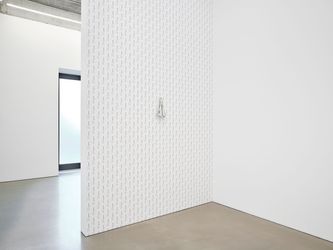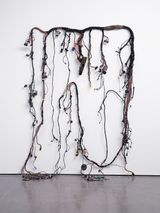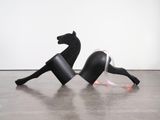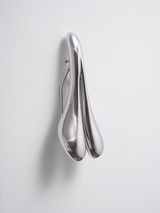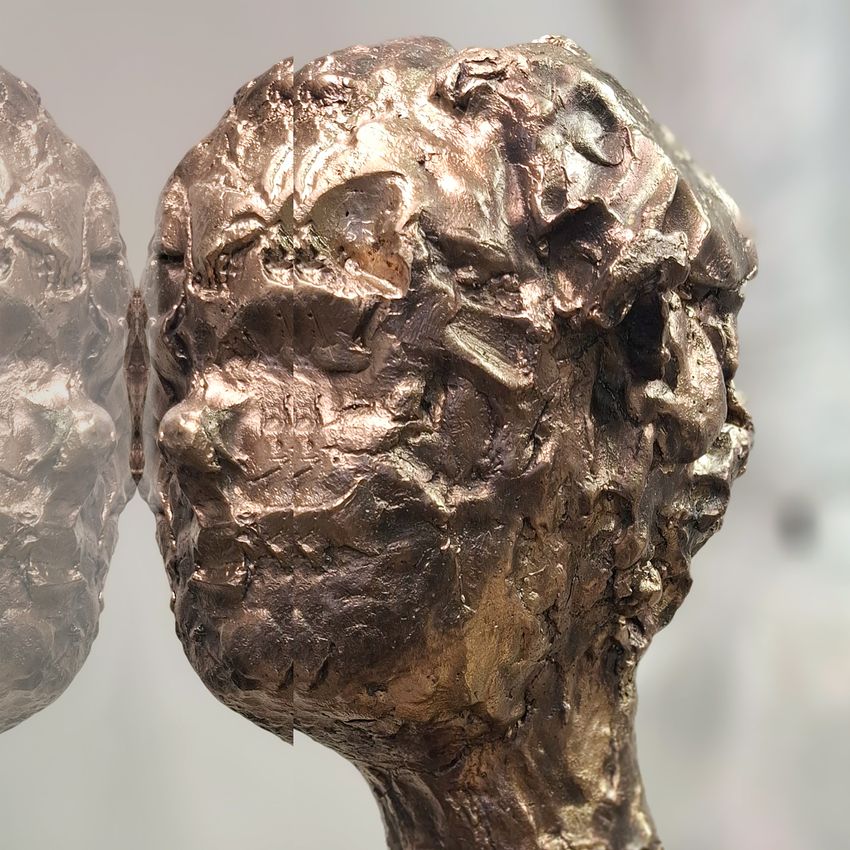
Maureen Paley and Herald St are delighted to announce Gebrochenes Pferd (Broken Horse), an exhibition of new works by Alexandra Bircken taking place in both galleries’ East London premises. Comprising sculpture, wall installation, and photography, this body of work continues Bircken’s clinical dissections of cars and motorcycles to reveal our visceral connections to the machines which empower us. Through weaving and chromed surfaces, she expands her focus from that of the singular body to the enmeshed systems which simultaneously protect and stifle the individual.
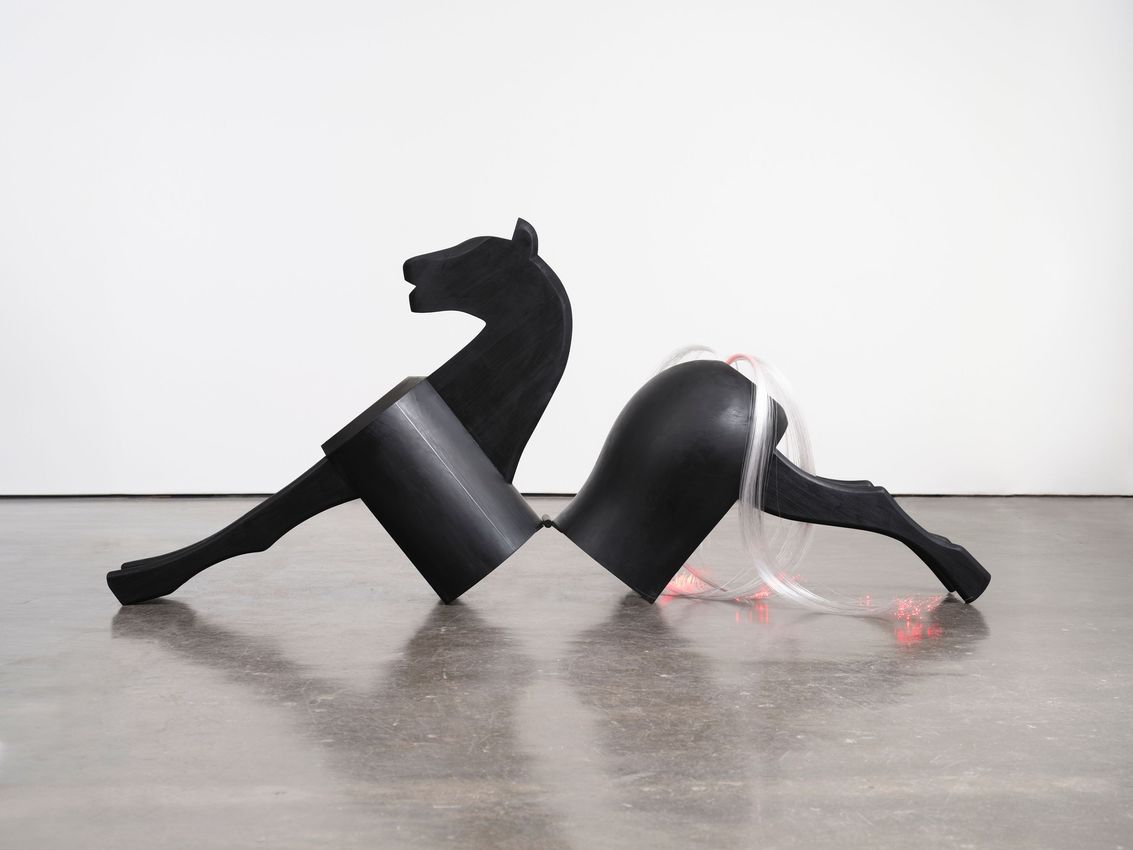
German for ‘broken horse’, the title of the exhibition announces a rupture and a feeling of unease. The same name is given to two works which echo one another in separate spaces. At Maureen Paley, we are confronted by a rocking horse in turned wood, its abdomen sliced down the middle and splayed open. Its counterpart at Herald St is a V10 combustion engine removed from an Audi RS 6 and cut into six clean tranches. The horse has long been a symbol of mobility, unbridled speed, and technological prowess even after it was replaced by fossil-fuel powered machines, as exemplified by Ferrari’s Cavallino Rampante logo. The V10 represents a pinnacle in the era of combustion engines, embodying an excess of engineering, obsession with size, and hedonistic recklessness. In this pair of sculptures, both are rendered destructive and dysfunctional, the thrill of speed and fanatical optimism of progress cut dead and brought to a standstill. Yet there remains a chance of resurrection, resting on the hinge holding the two halves of the wooden horse apart.
Bircken has long held a rooted interest in fabrics and coverings which act as a second skin, a boundary between our inner and outer selves. In this exhibition, she exposes the networks inherent to threaded and woven materials. Each gallery features wall pieces made from the cable harness of a car, a rope-like construction which, when unravelled and laid out, extends for several metres. Like the nervous system of a body, this mechanism uses electric currents to carry vital information throughout an automobile, with each wire playing an individual role to power a greater whole. At Herald St, harnesses are arranged along a warp and weft and transformed into thick cloths based on rigid grids, ordering the cables into new organisations. Grids and checkerboards are also found in two pieces with wool and nylon frameworks, one in each location. At Maureen Paley, a female figure emerges from a black-and-white knit, blending into the stinging precision of the pattern and falling softly, held by her strict underlying structure. Through weaving, knotting, and braiding, the artist uses textiles as a metaphor for cultural achievement, social systems, and societal regulations, which at once capacitate and encage us inescapably.
Bircken employs repetition and mirroring throughout the exhibition, with sets of works reflecting each other across the two galleries, including a stainless-steel bicycle seat at Maureen Paley and a severed motorcycle at Herald St with a windshield and mudguard in a similar chromed finish. As the surrounding environments inscribe onto their glossy, impenetrable surfaces, the impressions become distorted and the objects lose their inherent logic, becoming difficult to grasp and creating a fetishistic and fascinating allure. The wallpaper lining the walls of both spaces reproduces the signature of Christine Lagarde, the current president of the European Central Bank, as it appears on each Euro banknote. It is here reduced to a graphic representation of a single act and arranged in a grid, transformed into a repeating, ornamental pattern. Looking to the heightened, sensitive moment we live in, Bircken dismantles the currencies and vehicles which enable and empower us, laying bare their anatomies. She displays parallels in the organic and the mechanic, revealing a landscape in a butcher’s cutting board or intestinal twists in a steel manifold. By rearranging their components, she exposes our dependence on the machines and networks which offer us exuberance and endless possibilities as much as they hold us bound and imprisoned to them. – Émilie Streiff
Selected solo exhibitions include: A-Z, Le Centre Régional d’Art Contemporain Occitanie, Sète, France (2022); Museum Brandhorst, Munich, Germany (2021); Fair Game, KINDL Centre for Contemporary Art, Berlin, Germany (2021); Top Down / Bottom Up, Fridericianum, Kassel, Germany (2020); Unruhe, Secession, Vienna, Austria (2019); Mammal, Studio Voltaire, London, UK (2018); Stretch, Museum Abteiberg, Mönchengladbach, Germany (2016); Le Crédac, Ivry, France (2017); and Parallelgesellschaften, K21 Ständehaus, Düsseldorf, Germany (2016).
Her work has also been featured in significant group exhibitions, including: Isa Mona Lisa, Hamburger Kunsthalle, Hamburg, Germany (2024); Beaufort24, Beaufort Triennial, Belgian Coast (2024); Impossible, Museum Frieder Burda, Baden-Baden, Germany (2024); outer view, inner world, Maureen Paley: Morena di Luna, Hove, UK (2023); In Prima Persona Plurale, MACRO Museum of Contemporary Art of Rome, Rome, Italy (2023); Bodies in Society, Sprengel Museum Hannover, Hannover, Germany (2022); La pensée corps, Foundation Pernod Ricard, Paris, France (two-person with Lutz Huelle) (2022); and May You Live In Interesting Times, 58th International Art Exhibition of La Biennale di Venezia, Venice, Italy (2019). Earlier in her career, Bircken’s work was also included in an exhibition at Maureen Paley: Interim Art, London, UK (2005).


The gallery programme began in 1984 in a Victorian terraced house in London’s East End. Initially named Interim Art the gallery changed its name to Maureen Paley in 2004 as a celebration of its 20th anniversary. Since September 1999 the gallery has been situated in light industrial space in Bethnal Green. In July 2017 Maureen Paley opened a second space in Hove called Morena di Luna. In October 2020 a third space was opened in London called STUDIO M. From its inception the gallery’s aim has remained consistent: to promote great and innovative artists in all media.

A respected voice in contemporary art discourse.
Focusing on ambitious storytelling and insightful art-world commentary. Ocula Magazine publishes in-depth interviews, critical essays and timely analysis on the artists, exhibitions and ideas driving the global art world.
Learn more about Ocula Magazine
Showcasing the best of the art world.
Ocula partners with galleries from around the world to highlight their artists, artworks and exhibitions. Gallery membership is by application and invitation, with each member vetted by an independent panel.
Learn more about Ocula Membership

Specialises in the sale of major artworks.
Led by a team with deep ties to the world’s leading auction houses, galleries and collectors. Ocula’s advisory team offers bespoke services to high-net-worth clients from around the world who are looking to acquire the best of contemporary and modern art.
Learn more about our team and services