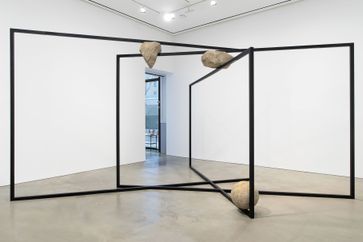
Inspired by philosophy and natural phenomena as a means to explore the human condition, AlicjaKwade (Born Katowice, Poland 1979) has embarked on a singular artistic journey. In her first soloexhibition in Mexico, Silent Matter, Kwade employs the notion of thought experiments, a toolcommonly used in science and philosophy as a means to explore concepts and phenomena that aredifficult or almost impossible to explain. In the tradition of Schrödinger’s cat or Plato’s Allegory of theCave, Kwade creates physical manifestations of thought experiments meant to stimulate discussionas well as question the limits of our ability to understand and ultimately control reality.
Presented in a human scale, the works range from contemplating the ever-expanding universe tothe infinitesimal subatomic realm. Kwade, who is constantly searching for new materials, journeyedto Mexico to develop her latest works for this exhibition. Fascinated by obsidian because of itshistoric relevance, material properties and reflective qualities, Kwade places desk lamps up againstthe polished volcanic rock to create a luminous depiction of celestial bodies surrounded by thedark vacuum of space. Continuing with the unimaginably large, celestial bodies and their movementare represented in a series of mobiles suspended from the ceiling. Depicting what Kwade oftenplayfully points out, that we are quite simply sitting on a rock floating in space. In the Impact series,meticulously arranged brass clock hands are employed to depict clusters of stars as well as thephenomenon of gravity. Moving from the vastness of the cosmos to the subatomic in thesecond-floor gallery, Kwade’s Fruit Quantum visualises the smallest unit yet conceived by sciencein the form of a cast bronze fruit peel. In the patio, a totemic structure Siège du Monde, composedof seven chairs mounted upon seven stone spheres considers intersecting notions such ashumanity’s attempt to control nature and layers of systems of social dominance. Resembling astrand of DNA, the column alludes to the subtle variations in generational transfers of power. Invisualising unimaginable natural phenomena, Kwade sheds a little light on humanity’s endlesssearch for answers and the limitations of our understanding.
Text by Pedro Alonzo. Courtesy OMR, Mexico City.

Alicja Kwade is a contemporary Berlin-based Polish artist known for her enigmatic sculptures and installations that explore concepts of space, time, science, and philosophy. She creates immersive experiences about discovery, begging viewers to question their perception of reality. ‘My efforts to understand and represent something I can barely grasp, and my failure to do so, bring forth my work,’ said the artist.


A respected voice in contemporary art discourse.
Focusing on ambitious storytelling and insightful art-world commentary. Ocula Magazine publishes in-depth interviews, critical essays and timely analysis on the artists, exhibitions and ideas driving the global art world.
Learn more about Ocula Magazine
Showcasing the best of the art world.
Ocula partners with galleries from around the world to highlight their artists, artworks and exhibitions. Gallery membership is by application and invitation, with each member vetted by an independent panel.
Learn more about Ocula Membership

Specialises in the sale of major artworks.
Led by a team with deep ties to the world’s leading auction houses, galleries and collectors. Ocula’s advisory team offers bespoke services to high-net-worth clients from around the world who are looking to acquire the best of contemporary and modern art.
Learn more about our team and services