





Did English Needlewomen Quietly Subvert the Bayeux Tapestry’s Message?

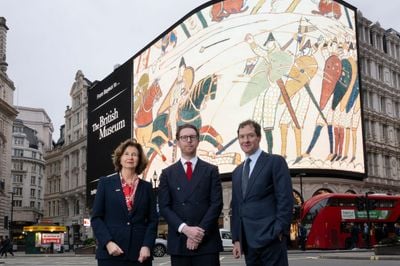
Curator Michael Lewis: Tapestry makers “may have changed things a little bit to try and get a different sort of messaging across”. Photo: Sipa US/Alamy Live News.
When the British Museum unveils the Bayeux Tapestry to the public tomorrow (10 September), the historic object is set to become London’s biggest tourist attraction.
The 70-metre-long textile depicts the Norman conquest of England and the events leading up to the defeat of Anglo-Saxon King Harold Godwinson at the hands of William the Conqueror in 1066. Likely commissioned by William’s half-brother, Bishop Odo of Bayeux, it emphasises Harold’s betrayal of a sacred oath to acknowledge William as England’s next king, which William used as a primary justification to declare war after Harold accepted the crown for himself.
While the medieval textile’s role as a piece of pro-Norman propaganda is widely accepted, a scarcity of contemporaneous source material means that far less is certain about the tapestry’s making. We do, however, know that it was likely created during the early 1070s, designed by artists referencing manuscript sources that were then embroidered.
These skilled needleworkers were likely English women who had lived through the conquest and, while they mainly followed the designs outlined for them, some embellishments may complicate an otherwise straightforward interpretation of the events the tapestry describes. Ambiguous details in its decorative border, specifically, have been the subject of various interpretations.
While some scholars have understood these details to offer satirical commentary, speaking at the preview of the exhibition earlier this week, its curator Michael Lewis stopped short of labelling them “subversive”. However, he conceded that, in the tapestry’s borders, makers “may have changed things a little bit to try and get a different sort of messaging across”.
Here are three details to look out for in the Bayeux Tapestry’s marginalia.
The symbolism of its many penises
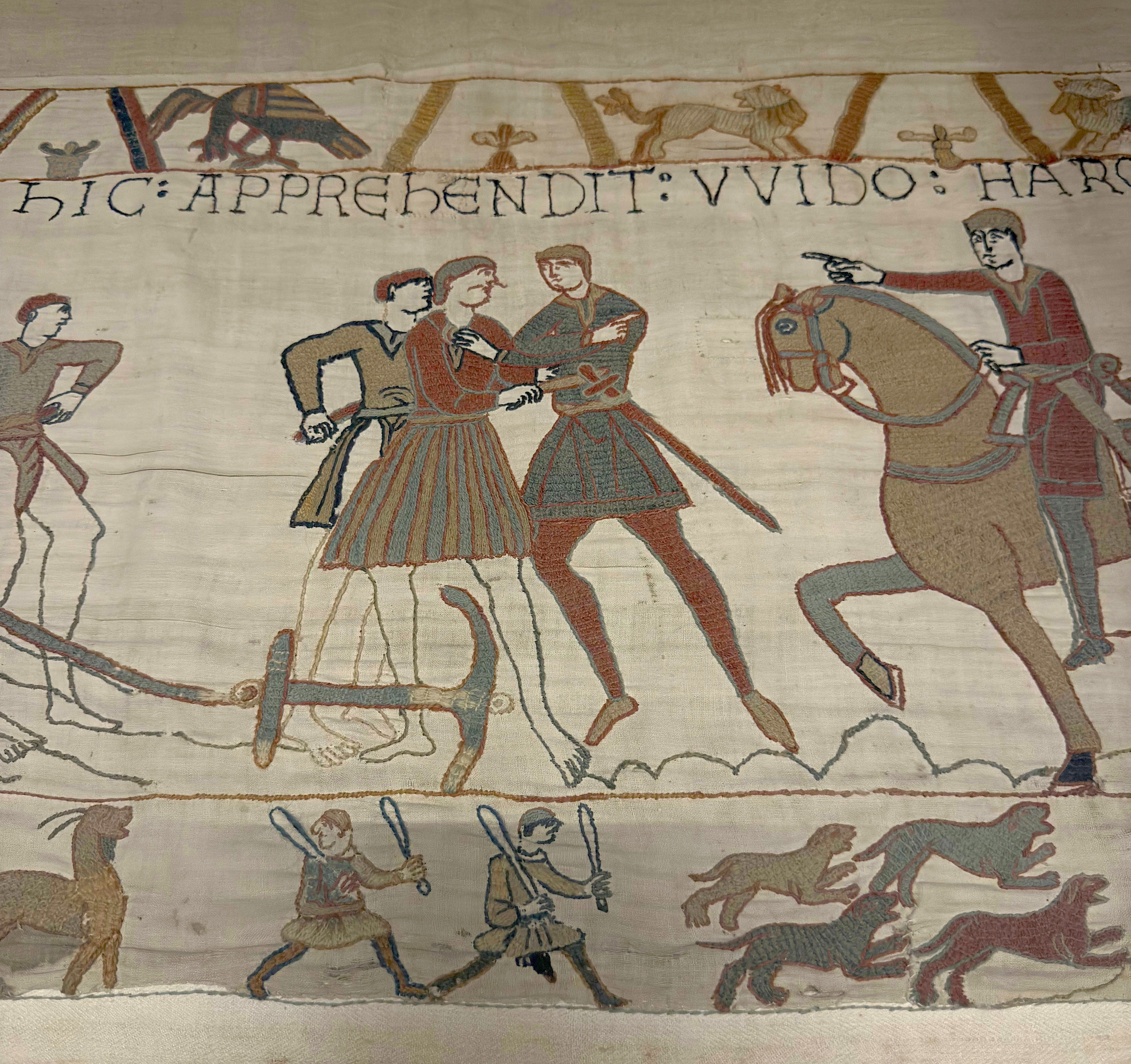
The opening of the exhibition dramatically summarises the epic tapestry in numbers: 416 plants, 115 swords, 37 ships, 11 thrones. A figure conspicuously left out is the number of penises, which has recently been the subject of debate among scholars. Oxford professor George Garnett has tallied the number of phalluses in the canvas at 93 (five male, 88 equine), although this has been disputed by a fellow medievalist, whose claims to have discovered a 94th member made the press last year.
The 88 horse penises in the main frieze present a rather obvious visual metonym for the power dynamics involved—William’s horse is the best endowed. Notably, however, all of the human penises in the embroidery appear in its decorative borders rather than the central narrative panel.
The meaning of these details is ambiguous, but Lewis told Ocula it is possible they are there to “question” or “challenge” some of the original Norman sources from which the designers worked. In that view, the male phalluses in the borders could be read as offering a translation of the horse symbolism, or even a snarky comment on the excessive machismo of the main panel’s depiction of events.
As to his view on the official penis count? Lewis could not be drawn. “I don’t really think about it too much, to be honest.” Probably wise.
A celestial portent of doom
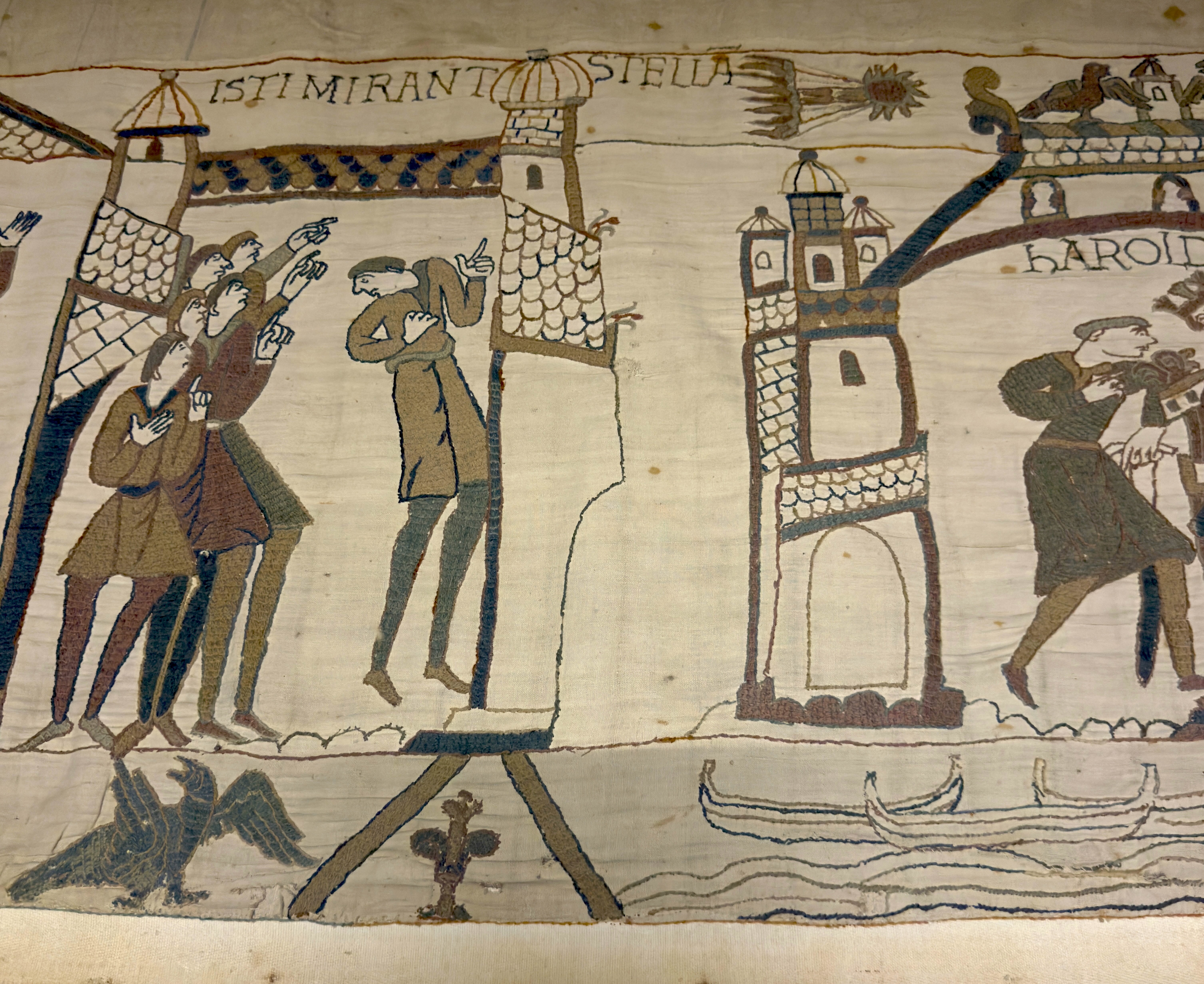
The portrayal of the celestial apparition known as Halley’s Comet in the tapestry’s upper border, shortly after the scene depicting Harold’s coronation, is the earliest European record of the star, which appears roughly every 76 years. Shown alongside the Latin inscription ISTI MIRANT STELLA (they marvel at the star), it is interpreted as an omen for Harold’s eventual defeat on the battlefield.
While this suits the tapestry’s pro-Norman narrative, according to Lewis and fellow scholar Simon Portegies Zwart, its position in the chronology is not strictly historically accurate. The pair cross-referenced medieval chronicles with modern astronomical data to show that the comet would not have been visible from England in 1066 before 24 April, whereas Harold’s coronation occurred in January.
Lewis confirmed that the tapestry is not strictly chronological, with “storytelling that goes backwards and forwards”. In a recent paper, the two scholars posited that linking the comet with the coronation was an intentional choice by the tapestry’s artists to draw the events together “for political reasons with the benefit of hindsight”.
The comet as a portent of doom is rendered even more ambiguous by an addition in the decorative border below, depicting a ghostly fleet of empty ships. The delicate outline of these vessels lends itself to a more emotional reading of the aftermath of the invasions, perhaps an acknowledgment of the 4,000 Englishmen who died in the Battle of Hastings, or the more than 100,000 English people who died in subsequent scorched-earth campaigns to crush rebellions in northern England.
A hint at the identity of a mystery woman
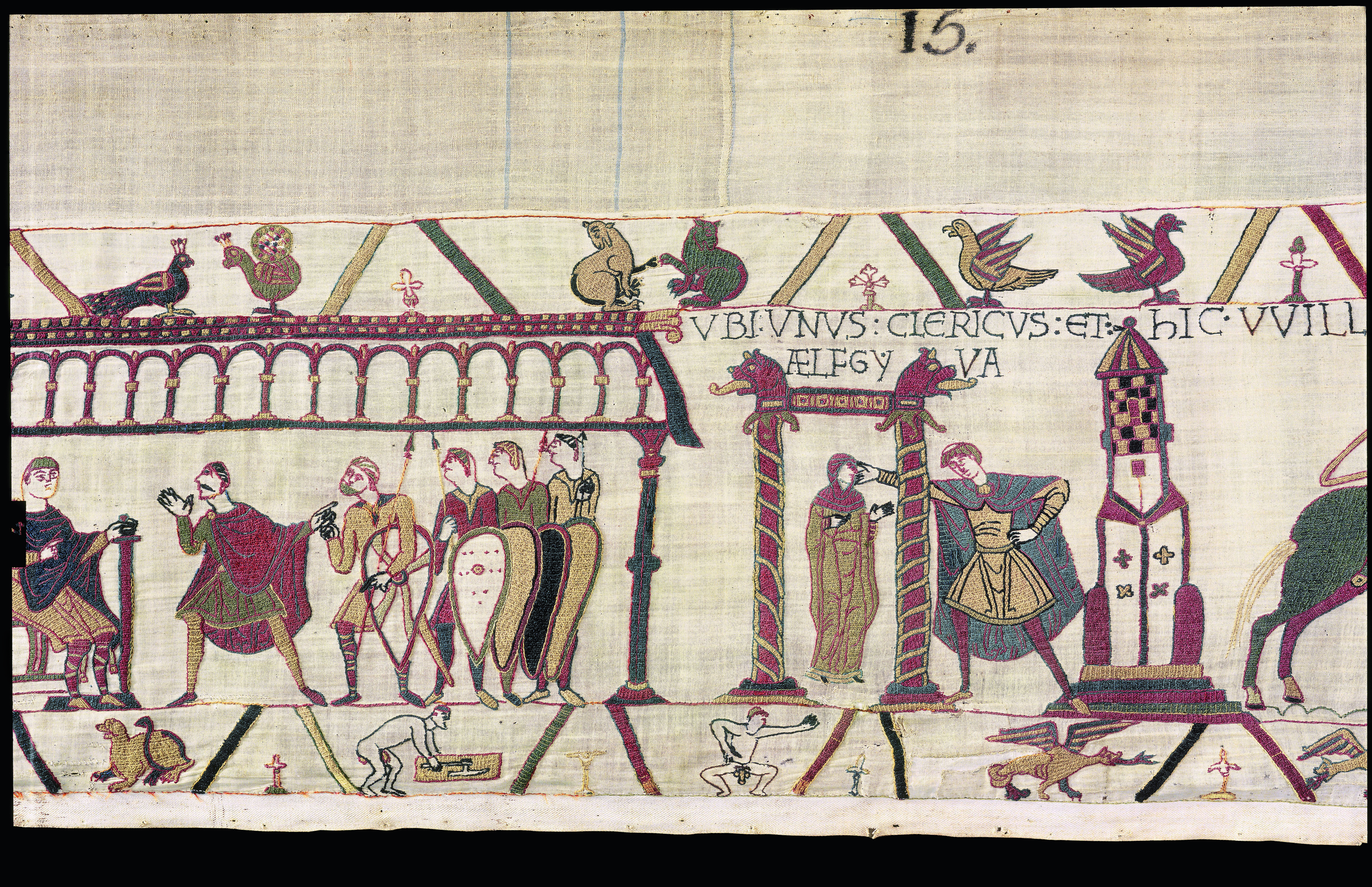
If the medieval embroidery were made into a movie, it wouldn’t pass the Bechdel test (see: penis count). Of the three women depicted in the main frieze, all are shown in what Lewis described as “moments of distress”.
A figure commonly identified as Queen Edith is mourning the loss of her husband Edward the Confessor; an unidentified woman grasps the hand of a child as they flee a burning building, and finally, Aelfgyva is a mystery noblewoman who is being touched on the face by a cleric in a manner that doesn’t appear to be reciprocal.
Aelfgyva is the only woman named in the embroidery, and scholars have advanced multiple theories as to her identity. Lewis has postulated that a naked man embroidered in the border close to her image, whose likeness mirrors the gesture of the nearby cleric, might indicate that she is Emma of Normandy, the mother of Edward the Confessor.
Emma of Normandy, who went by the English name Aelfgyva and was also William the Conqueror’s great aunt, was rumoured to have had an affair with the Bishop of Winchester. This border addition could, therefore, reference that rumour, which would have undermined William’s blood claim to the throne
“I think it was very difficult for the women who were behind the creation of the embroidery not to have [the experience of the conquest] in their minds as they’re depicting these scenes, not only of those of women but also the killing and destruction of the menfolk as well,” Lewis said. “It’s hard getting behind the minds of 11th-century people through the objects, and you sometimes wonder if you bring in your own interpretation to these things.”
We will never be sure of the intentions of the tapestry’s makers, whose additions to its borders will likely continue to be the topic of debate for many generations. However, thanks to their embellishments, we can think of this piece of pro-Norman propaganda, presented in England for the first time since it was made more than 1,000 years ago, as a more ambiguous document than at first it seems.






A respected voice in contemporary art discourse.
Focusing on ambitious storytelling and insightful art-world commentary. Ocula Magazine publishes in-depth interviews, critical essays and timely analysis on the artists, exhibitions and ideas driving the global art world.
Learn more about Ocula Magazine
Showcasing the best of the art world.
Ocula partners with galleries from around the world to highlight their artists, artworks and exhibitions. Gallery membership is by application and invitation, with each member vetted by an independent panel.
Learn more about Ocula Membership
Specialises in the sale of major artworks.
Led by a team with deep ties to the world’s leading auction houses, galleries and collectors. Ocula’s advisory team offers bespoke services to high-net-worth clients from around the world who are looking to acquire the best of contemporary and modern art.
Learn more about our team and services