




NANCY DWYER
b. 1954, United StatesNancy Dwyer is an American contemporary artist whose sculptures, paintings, and multimedia installations use language and mass media as material, offering commentary on culture, consumerism, and the instability of meaning.
Dwyer emerged in the 1980s as a member of the Pictures Generation, a group of artists known for their critical engagement with mass media. In 1974, alongside peers including Cindy Sherman, Robert Longo and Charles Clough, Dwyer co-founded Hallwalls, an interdisciplinary artists cooperative in Buffalo, New York. In 2009, Dwyer’s work was included in The Pictures Generation at the Metropolitan Museum of Art in New York. Her works have since been exhibited in major museums and are held in important international collections.
Early Years
Dwyer was born in New York City in 1954 and grew up in Schenectady, New York. She received her BFA from the State University of New York at Buffalo in 1976, where she became closely associated with fellow artists including Cindy Sherman and Robert Longo In 1974, Dwyer and her peers co-founded Hallwalls Contemporary Arts Center, which was instrumental in supporting experimental work from emerging artists. She later completed a master’s degree in Interactive Telecommunications at New York University in 2002.
Dwyer moved to Manhattan in the late 1970s, quickly becoming part of the artist cohort later dubbed the ‘Pictures Generation’—named after a groundbreaking 1977 exhibition at Artists Space in SoHo. She lives and works in Santa Fe, New Mexico, and was a professor at the University of Vermont from 2004 to 2019.
Nancy Dwyer Artworks
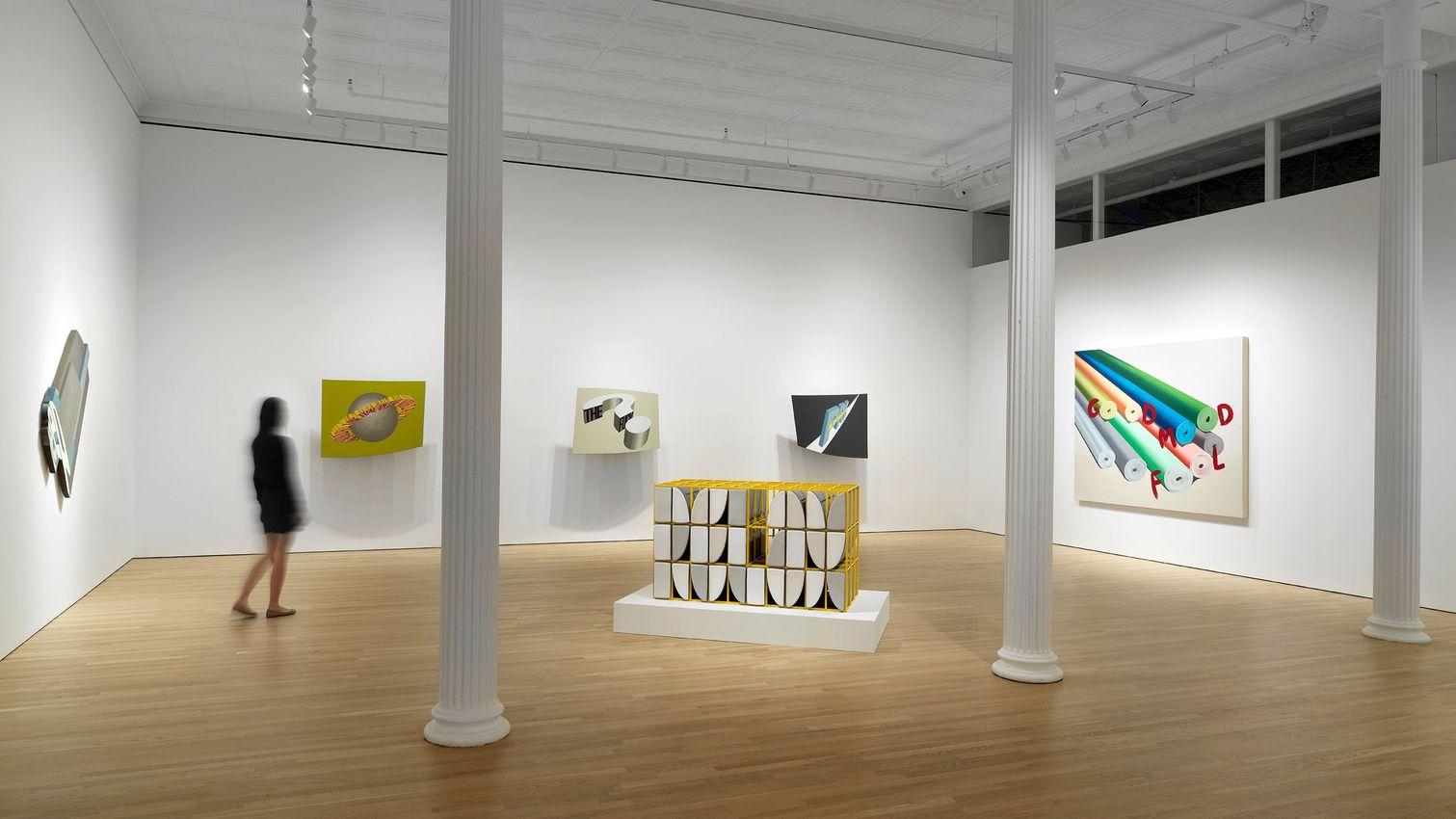
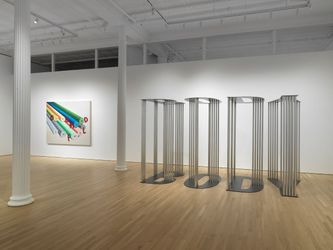
Nancy Dwyer’s art practice is defined by her transformation of language and imagery from advertising, television, and everyday life into physical and conceptual objects that interrogate meaning, value, and the manufacturing of desire. Since the 1980s, she has become widely recognised for sculptures that turn puns and catchphrases into punchy form, as well as for her paintings that manipulate vernacular graphics, signage, and mass media motifs.
Appropriated Imagery and the Pictures Generation (1970s–1980s)
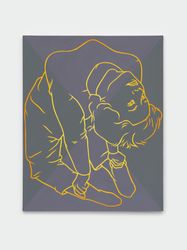
Dwyer’s early works appropriated the visual detritus of magazines, television, and popular culture, isolating and redrawing motifs as bold, simplified line drawings—often screen-printed or made into laminated ‘cards’—to both defamiliarise and universalise the expressive gestures of daily life. Projects like Cardz (1980) distilled commercial imagery into an impersonal catalogue of pose and action, reflecting skepticism toward the power of mass media.
Word Sculptures and Language as Form
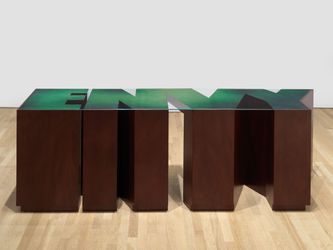
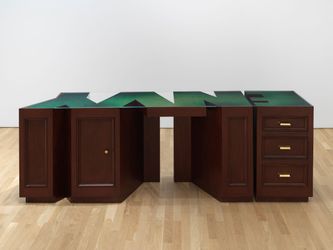
From the mid-1980s, Dwyer advanced a radical mode of ‘word sculpture’, giving shape and presence to language itself. Works such as LIE (1986), clad in marble-imitation Formica, and ENVY (transformed into an executive desk) experimented with material and typography—including the use of glossy surfaces, playful typefaces, and sometimes furniture forms—to literalise concepts and social codes. Her piece KILLER (1991) presents the word in a sharply angular table; BIG EGO II (2010) features the word ‘ego’ in oversized, inflatable yellow nylon letters.
Dwyer’s work manipulates aphorisms, puns, and buzzwords from modern culture, using her skills as a former commercial sign maker to bring darkly humorous accessibility and visual presence to clichés and adages.
Multimedia, Public Art, and New Technologies
Dwyer’s later career embraced multimedia installations, digital animation, and public commissions. Works like Everybody’s Angry (2013)—a floating cluster of papier-mâché balls spelling out the eponymous phrase—use both text and sculptural form to explore social mood and communication.
Her public artworks, installed in cities including New York, Chicago, Philadelphia, and across Europe, spell out contextually appropriate words and sentiments—sometimes installed on billboards, subway stations, or as exterior wall reliefs. Dwyer’s digital animations, such as Hasbeen Wannabe (2002), use time-based language play, transforming one word to another in an endless loop, interrogating success and identity in the information age.
Select Public Commissions
- Aluminum and painted wall reliefs in Torino, Italy (Artissima Art Fair)
- Site-specific word sculptures and billboards in New York, Chicago, Philadelphia, and Europe
- Poster series for New York City subway stations
Select Awards and Accolades
- Seymour Knox Scholarship, State University of New York (1974–76)
- New York State Creative Arts Public Service Grant (1980)
- National Endowment for the Arts Visual Arts Fellowship (1982)
- New York Council for the Arts Sponsored Project Grant (1984–85)
- Pollock-Krasner Foundation Grant (2002)
- Anonymous Was A Woman Foundation Grant (2003)
Exhibitions
Nancy Dwyer has been the subject of both solo and group exhibitions.
Solo Exhibitions
- ALWAYS, Ortuzar Projects, New York (2025)
- Hot Mess, Kunsthalle Winterthur, Switzerland (2024)
- Painting and Sculpture, 1982–2012, Fisher Landau Center for Art, New York (2013)
- Hallwalls, Buffalo (1977, 1980)
Group Exhibitions
- The Pictures Generation, 1974–1984, Metropolitan Museum of Art, New York (2009)
- Whitney Biennial, Whitney Museum of American Art, New York (1987)
- Sign Language, Museum of Contemporary Art, Los Angeles (2004)
- Bad Girls, New Museum, New York (1994)
- Word as Image: American Art 1960–1990, Contemporary Arts Museum, Houston; Milwaukee Art Museum; Oklahoma City Museum (1990–91)
- Art and Media, The Renaissance Society, University of Chicago (1982)
Dwyer’s work is held in the permanent collections of The Metropolitan Museum of Art, MOCA Los Angeles, The Walker Art Center, The Art Institute of Chicago, The Brooklyn Museum, Buffalo AKG Art Museum, and Museum Voorlinden, among others.
More Reading
Dwyer’s career and artistic themes have been profiled by Ocula, the Burchfield Penney Art Center, and in catalogues for The Pictures Generation and her retrospectives. Ocula Magazine notes: ‘Dwyer’s works turn the language of advertising and culture inside out, making the ephemeral weighty and material’.
Nancy Dwyer FAQs
Where can I see Nancy Dwyer’s art?
Dwyer’s work can be found in the collections of The Metropolitan Museum of Art (New York), Museum of Contemporary Art (Los Angeles), Walker Art Center (Minneapolis), The Brooklyn Museum (New York), Buffalo AKG Art Museum (Buffalo, NY), and Museum Voorlinden (Netherlands).
What is Nancy Dwyer best known for?
Nancy Dwyer is best known for her iconic word sculptures and paintings that transform phrases, slogans, and pop culture language into bold, tactile works, interrogating the power and ambiguity of words.
What themes dominate Nancy Dwyer’s contemporary art practice?
Dwyer’s art is characterised by its use of mass media, everyday language, humour, and irony to examine communication, power, consumerism, identity, and the instability of meaning.
What major exhibitions have featured Nancy Dwyer?
She has been included in The Pictures Generation at the Met, the Whitney Biennial, Bad Girls at the New Museum, and held major solo retrospectives at the Fisher Landau Center and Kunsthalle Winterthur.
Is Nancy Dwyer involved in teaching or public projects?
Yes, Dwyer was a professor of sculpture at the University of Vermont from 2004–2019 and has produced numerous public commissions in the US and Europe.
Are there any interesting facts about Nancy Dwyer?
Dwyer is the only person other than Cindy Sherman to appear in Sherman’s iconic Untitled Film Stills series (Still #7, 1978). She created the cover drawing for Hall & Oates’ Rock ‘n Soul Part 1 (1983), and her playful, darkly humorous approach draws from her early work as a commercial sign maker.
How do you pronounce Nancy Dwyer’s name?
It is pronounced ‘NAN-see DWI-er’.
Ocula | 2025

Representative Artworks
View story
View story
View story
View story
View story



Explore and Follow Artists Shaping Contemporary Art
A respected voice in contemporary art discourse.
Focusing on ambitious storytelling and insightful art-world commentary. Ocula Magazine publishes in-depth interviews, critical essays and timely analysis on the artists, exhibitions and ideas driving the global art world.
Learn more about Ocula Magazine
Showcasing the best of the art world.
Ocula partners with galleries from around the world to highlight their artists, artworks and exhibitions. Gallery membership is by application and invitation, with each member vetted by an independent panel.
Learn more about Ocula Membership
Specialises in the sale of major artworks.
Led by a team with deep ties to the world’s leading auction houses, galleries and collectors. Ocula’s advisory team offers bespoke services to high-net-worth clients from around the world who are looking to acquire the best of contemporary and modern art.
Learn more about our team and services