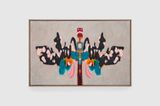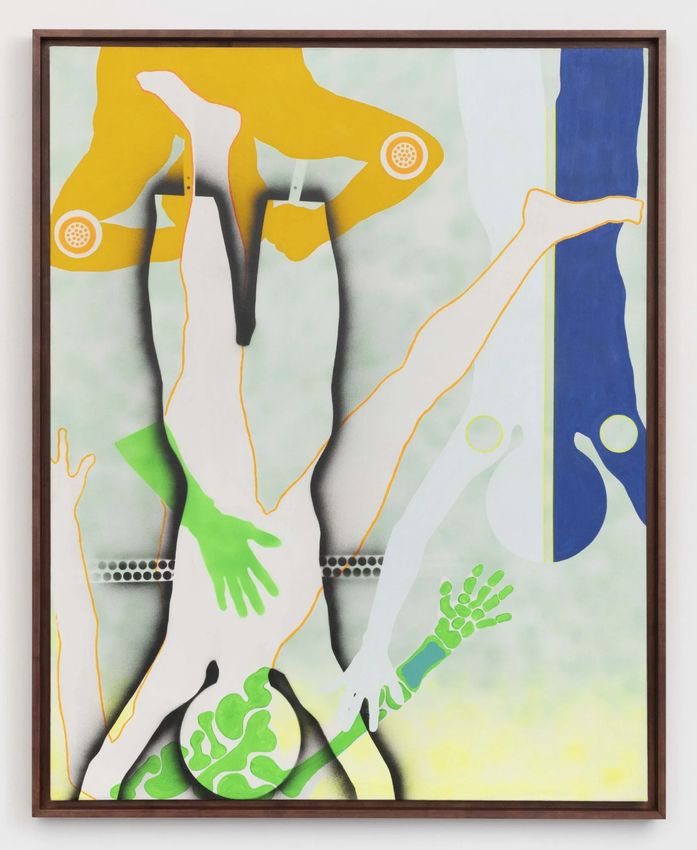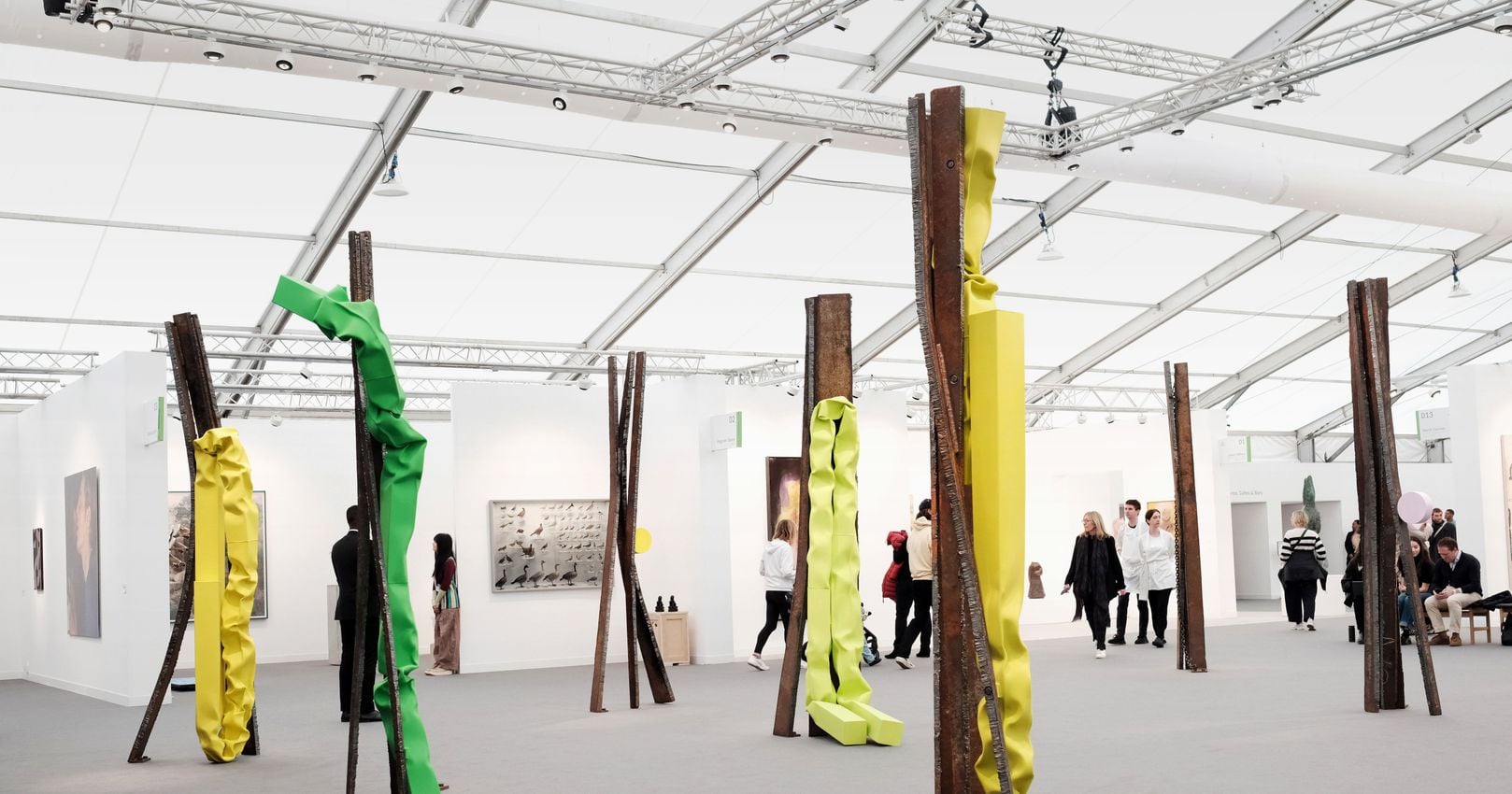
Pace Gallery is pleased to present a solo booth of new work by British painter William Monk at Frieze London 2025. The presentation brings together entirely new paintings and works on paper and coincides with the release of the artist’s first comprehensive monograph, published by Phaidon in June 2025.
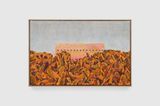
Produced over the course of the past year, following his travels to the islands of Corsica and Mallorca, this presentation weaves threads from Monk’s earlier series into a new body of work. Central to the presentation is the figure of the sentinel: solitary, watchful, and quietly enduring. Impressions of the Mediterranean saturate this figure’s surroundings, which meditate as much on memory and perception as on the specific features of the coastal landscape. Cacti emerge as a central motif in Monk’s new paintings. Abstracted into swathes of vibrant color, their pin-pricked ogival forms blur the line between the real and surreal—a tension that is fundamental to his practice.
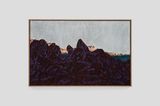
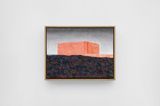
Throughout his work, Monk summons references to images both real and fictive. One such source is his own hazy teenage memory of the deserted island at the center of Michelangelo Antonioni’s 1960 film L’Avventura. Both Antonioni’s movie and Monk’s work share a spirit of metaphysical surrealism: dreamlike landscapes and deserted architecture are rendered with sharp contrasts of light and shadow, producing a sense of dislocation in space and time. In a series of small paintings that Monk started during a month-long residency at the Neuendorf House on Mallorca in 2024, the island’s changing skies and shifting light become subjects in themselves. These atmospheric paintings seem almost to vaporize color into pure luminescence. In some works, serenity prevails; in others, a foreboding presence appears to lurk on the horizon.
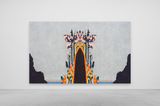
Imagery from Monk’s earlier work, particularly the Ferryman series, which drew partly on the figure of Charon, the undertaker of Greek mythology, has mutated and evolved in these new canvases. The presence Monk once called the Ferryman has now transformed. No longer just a harbinger of death, it has been reimagined as a sentinel: a guard or watcher of crossings and thresholds. Monk’s sentinel embodies these notions of transformation and passage. The receding foreground of one of the paintings anchoring the booth, Sentry’s Gate (2025), is flanked by six imposing stelae, which act as a framing device for the profusion of cacti within. At this scale, the painting becomes a portal into Monk’s oscillating vision. Further into the background, the upper band of a building completes the composition, bridging the ancient and monumental with cinematic style and form.
Ultimately, these works are about painting’s relationship to the world. The paintings’ titles—such as Cactus Garden, Underworld, and Sentinel’s End—evoke sites of geography and architecture while resisting direct correspondence with their imagery to become, in Monk’s hands, something distinctly his own. Throughout his career, Monk has embedded recurring motifs within his paintings, allowing them to shift and permute across series. Numbering, repetition, and variation open a space between image and memory, where the artist can render multiple versions of his world, layer by layer. In reconstructing his impressions of the Mediterranean landscape, Monk has, in effect, made a movie in his mind, one which acknowledges the impossibility of the past even as it seeks to crystallize the texture of memory in paint. Ultimately, these works are about painting’s relationship to the world. The paintings’ titles—such as Cactus Garden, Underworld, and Sentinel’s End—evoke sites of geography and architecture while resisting direct correspondence with their imagery to become, in Monk’s hands, something distinctly his own. Throughout his career, Monk has embedded recurring motifs within his paintings, allowing them to shift and permute across series. Numbering, repetition, and variation open a space between image and memory, where the artist can render multiple versions of his world, layer by layer. In reconstructing his impressions of the Mediterranean landscape, Monk has, in effect, made a movie in his mind, one which acknowledges the impossibility of the past even as it seeks to crystallise the texture of memory in paint.
“I thought of these paintings as depicting a moment, like an establishing sequence in a film. I saw my figure of death as a sentinel, living alone on an undefined mediterranean island like Medusa’s home of Sarpedon. My imagined island is surrounded by cactus, water, and rocks. Like a bug, one could navigate the world as an enormous obstacle or choose to live small and contained. My sentinel is living small and waiting for its next visitor.”
The presentation at Frieze also marks something of an artistic homecoming for the British artist, who has lived in New York for the past decade and last showed in London in 2019. It follows Monk’s major touring museum exhibition Psychopomp, which opened at the Long Museum, Shanghai, in 2024, before traveling to the Sifang Art Museum, Nanjing, and the He Art Museum, Shunde.
William Monk’s (b. 1977, Kingston upon Thames, UK) scenographic works tap into the rich tradition of painting. Monk paints enigmatic and vibrant works, using starkly divisional compositions and often works in extensive series that gradually evolve over time. The canvases carry irregular intensities of detail, line, foreground and background, a sense of repetition breaks down the figuration, creating visual mantras. This rhythm happens throughout Monk’s work, surrendering figurative logic to arrive at something stranger and more powerful. Atmospheric and energetic, these paintings invite a more direct physical connection, drawing in the space between our inner and outer realms of experience.
A respected voice in contemporary art discourse.
Focusing on ambitious storytelling and insightful art-world commentary. Ocula Magazine publishes in-depth interviews, critical essays and timely analysis on the artists, exhibitions and ideas driving the global art world.
Learn more about Ocula Magazine
Showcasing the best of the art world.
Ocula partners with galleries from around the world to highlight their artists, artworks and exhibitions. Gallery membership is by application and invitation, with each member vetted by an independent panel.
Learn more about Ocula Membership

Specialises in the sale of major artworks.
Led by a team with deep ties to the world’s leading auction houses, galleries and collectors. Ocula’s advisory team offers bespoke services to high-net-worth clients from around the world who are looking to acquire the best of contemporary and modern art.
Learn more about our team and services