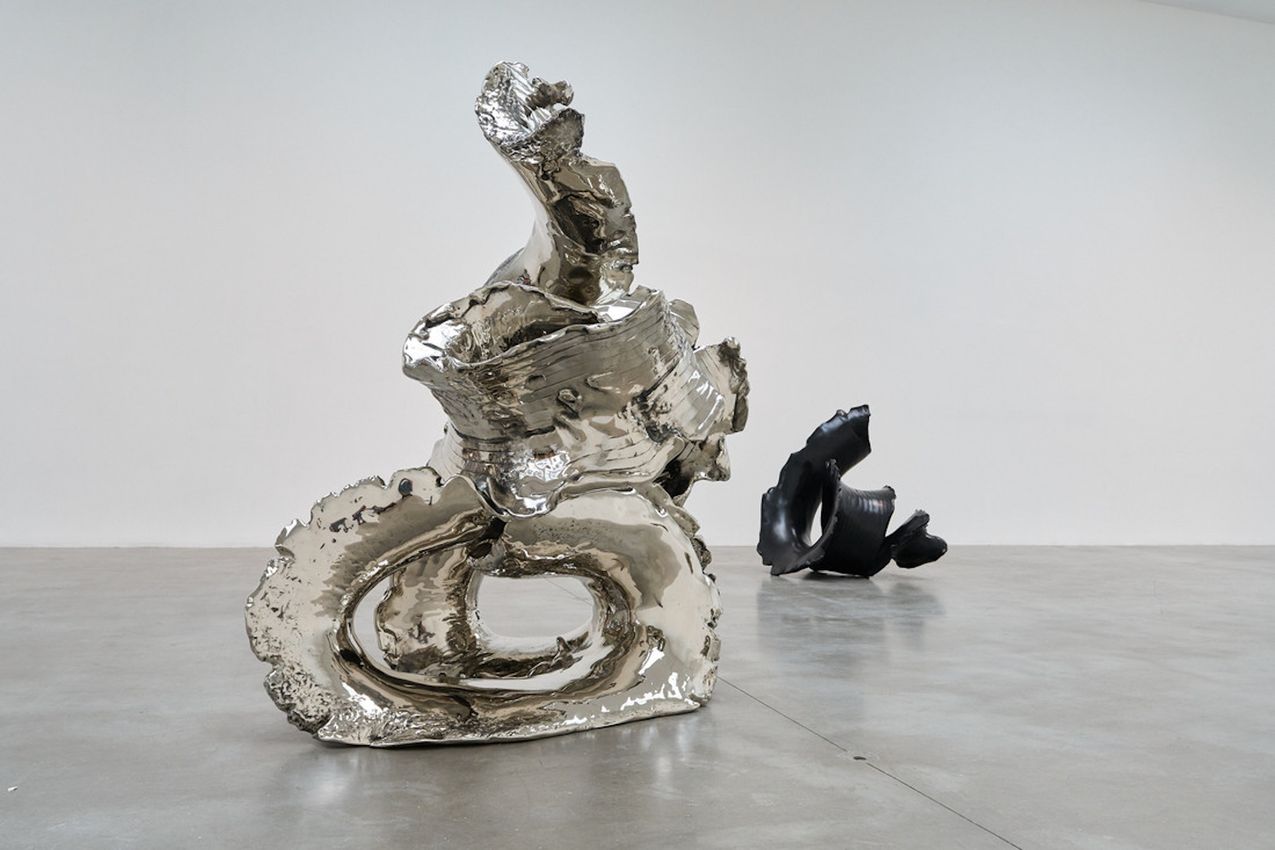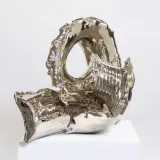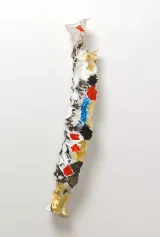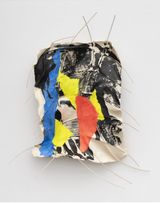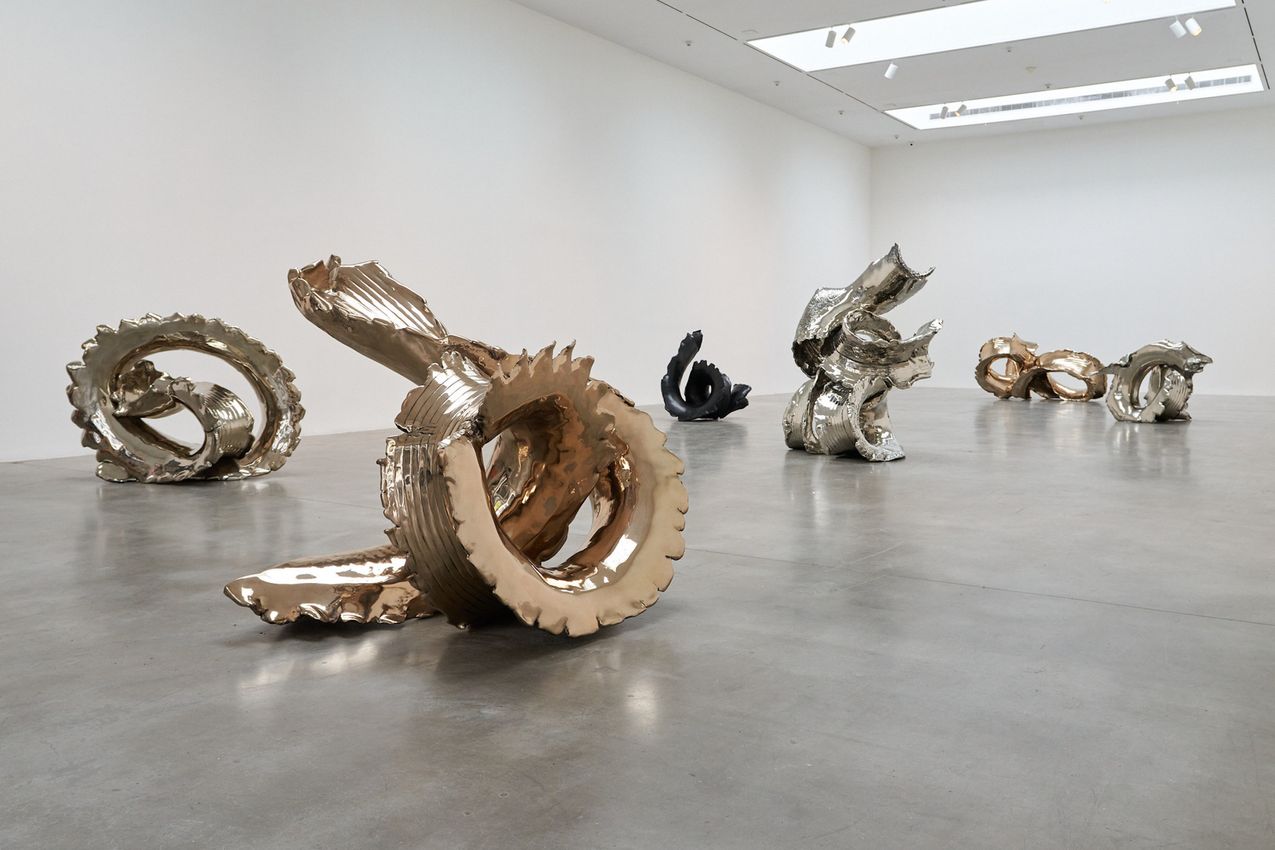
Pace Gallery is pleased to present Lynda Benglis: An Alphabet of Forms, an exhibition of sculpture in cast bronze by the pioneering artist. Marking Benglis’s first solo presentation with the gallery in New York, the exhibition brings together six new large-scale works made over the past three years. Drawing on her influential, decades-long investigation into knotted forms, her bronzes evoke both the morphology and semiotics of the knot. Glistening and reflective, her new sculptures lend shape to feeling, harnessing the dreamlike qualities of liquidity and buoyancy to explore ever newer possibilities for expressing proprioception, the body’s ability to perceive its own position in space. In these works, Benglis ties together several threads of longstanding interest in her practice: the pleasures of gesture and materiality, the powers of memory, the poetics of gravity, and the matter of sensation itself. Benglis’s new sculptures speak to the urgency of our physical bodies in a world increasingly dissolved in the ether of digital information, and the work reminds us that body remains a tactile thing.
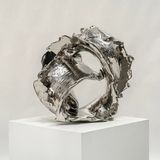
Coiling, twisting, and snaking, Benglis’s abstractions stretch upward while curling inward, frozen in suspended animation. The underlying forms in her new work began as small clay sculptures that she refers to as ‘Elephant Necklaces.’ Working with clay allowed Benglis to develop a vocabulary or lexicon of formal possibilities. Reconstituted in bronze—a process that has been part of her practice since 1974—Benglis’s new works transpose this alphabet of forms from the intimate scale of the hand to the heroic scale of the body. The resulting works continue to register the presence and pressure of Benglis’s fingers at the moment of contact with the original material. With metallic patinas that transform their complex and undulating surfaces into luminous, distorted mirrors—darkly reflecting their environments, each other, and viewers—Benglis’s works evoke nothing so much as congealed liquidities: waves, eddies, and whorls, taut and palpitating with potential energy, are frozen at the moment of crashing release.
Benglis has described her decision to enlarge her works in clay as way of utilising new technology. Beginning with an emphatically elemental form, shaped directly by her own hands, she transforms it through a digital process into a large-scale work in bronze. To begin with forms born from clay is to celebrate the persistence of the tactility and plasticity—that which is ‘of the hand and the fingers,’ as the artist has put it. These bronzes belong to a genealogy of sculptural forms that she has been developing, refining, and reworking over the course of her entire career. At the centre is the figure of the knot, to which she has frequently returned. In Benglis’s work, the knot is simultaneously a physical form, a conceptual matrix, and a cultural history. The knotted forms and congealed liquidities of Benglis’s bronzes evoke the ‘frozen gesture’ that critic Robert Pincus-Witten famously identified as the crux of her practice in the 1960s.
An ongoing exploration of knots, bows, pleats, and other modes of tying, tethering, and twisting cut through a major portion of Benglis’s work. She has connected her interest in knots to the experience of crocheting with her grandmother, who was a central figure in her early life. Benglis’s childhood memories—not just of experiences, but of sensations—constitute primary material for the artist. Her works strive to explore how kinesthetic experience subsists in memory. A whole repertoire of sensory memories informs Benglis’s new bronzes, which are not exactly knots per se—in the literal sense of her iconic sparkle knots of the 1970s—but remain indelibly entangled with the wider genealogy of knots in her work.
Additionally, Benglis’s work has long been concerned with the history of knots as a kind of alphabet. Many cultures have historically utilised knots for recording information or encoding meaning, from China to the Pacific Islands to South America, and specifically for Benglis, the Incan quipu device. She continues to draw inspiration from these sources. With reflective surfaces patinated to register viewers’ reflection as they circumnavigate the work, Benglis’s sculptures acknowledge viewers’ own involvement in the construction of meaning. The works evoke the sensations of the artist’s own body and her lived experience, inviting viewers to share in traces of her past. Presented together as a series for the first time, these works define a new chapter in Benglis’s career—one that continues to push the boundaries of what is possible with sculpture.
This presentation will run concurrent with the artist’s solo exhibition at the National Gallery of Art in Washington D.C., on view May—December 2021, featuring sculptures, paintings, drawings, prints, and videos by the artist, drawn from the museum’s permanent collection. It also comes in advance of her solo exhibition at Nasher Sculpture Center in Dallas in 2022. In September 2021, Phaidon will release a new monograph on Benglis which will highlight this new body of work alongside her larger oeuvre.

Lynda Benglis (b. 1941, Lake Charles, Louisiana) lives and works in New York; Santa Fe; Kastellorizo, Greece; and Ahmedabad, India. First recognised in the late 1960s for her poured latex and foam works, Benglis created work that was a perfectly timed retort to the male-dominated fusion of painting and sculpture with the advent of Process Art and Minimalism. Known for her exploration of metaphorical and biomorphic shapes, she is deeply concerned with the physicality of form and how it affects the viewer, using a wide range of materials to render dynamic impressions of mass and surface: soft becomes hard, hard becomes soft, and gestures are frozen.


Pace is a global art gallery of and for the future, modeled on a set of core values established during its founding in 1960 and designed to serve its artists, estates, and collectors in a way that is focused, responsive, and aligned with its enduring mission.

A respected voice in contemporary art discourse.
Focusing on ambitious storytelling and insightful art-world commentary. Ocula Magazine publishes in-depth interviews, critical essays and timely analysis on the artists, exhibitions and ideas driving the global art world.
Learn more about Ocula Magazine
Showcasing the best of the art world.
Ocula partners with galleries from around the world to highlight their artists, artworks and exhibitions. Gallery membership is by application and invitation, with each member vetted by an independent panel.
Learn more about Ocula Membership

Specialises in the sale of major artworks.
Led by a team with deep ties to the world’s leading auction houses, galleries and collectors. Ocula’s advisory team offers bespoke services to high-net-worth clients from around the world who are looking to acquire the best of contemporary and modern art.
Learn more about our team and services