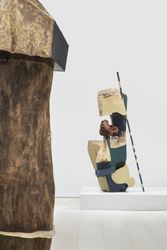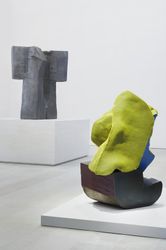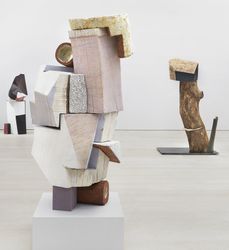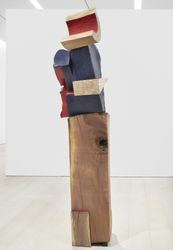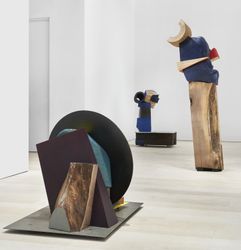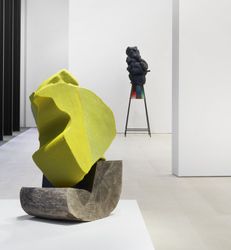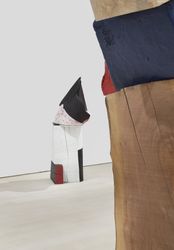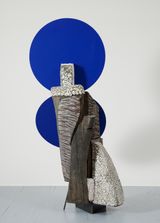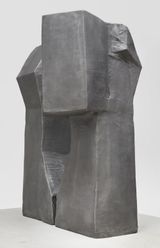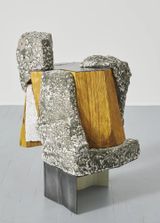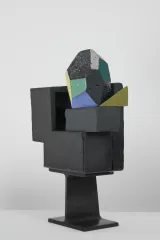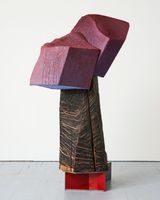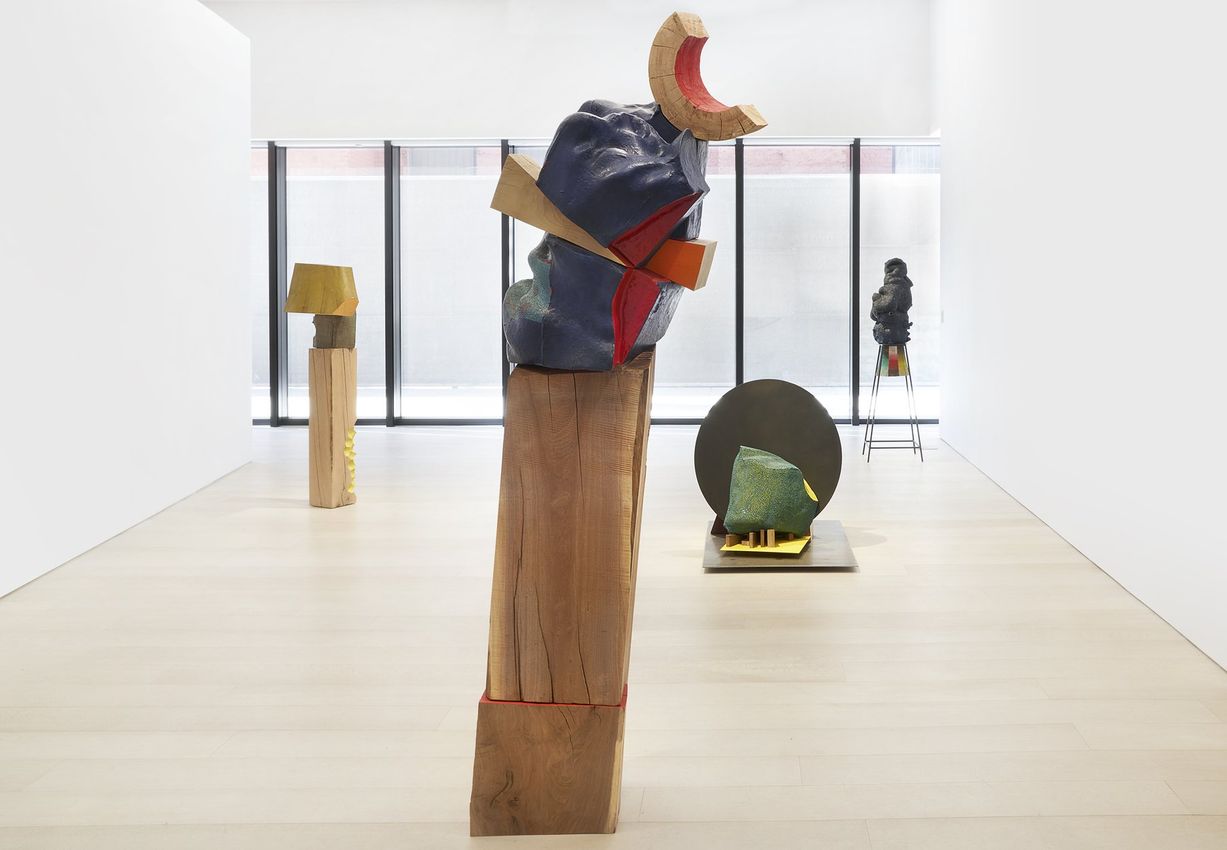
New York–Pace Gallery is pleased to present Skirts, its first solo exhibition of works by Arlene Shechet, from February 28 through April 25. Running concurrently with the Whitney Museum’s exhibition Making Knowing, which also features works by Shechet, Skirts brings together more than a dozen of the artist’s most recent sculptures, including large-scale works and a monumental outdoor piece, to be displayed on the second-floor galleries and terrace of Pace’s new flagship building at 540 West 25th street.
Rich in idiosyncrasies, Shechet’s latest pieces combine disparate mediums, from ceramics to wood and metal work, with playfully ambiguous titles that prompt endless associations. Utilising a title that is both a noun and a verb, Skirts is a testament to the artist’s fluid and unformulaic process. Though her works appear effortless and forgiving of imperfections, they are the belaboured products of an intuitive and technically fastidious approach, involving casting, painting, firing, carving, stacking, undoing and redoing with no predetermined endpoint. Her expansive approach to sculpture and materials is reminiscent of artists Shechet admires, such as Sophie Taeuber Arp and Sonia Delaunay, whose work transcends the divisions of painting and sculpture and encompassed innovative multimedia practices, distinguishing their work from that of their male peers. Shechet’s title, Skirts, also reclaims misogynist slang. As if to counter this term’s reduction of women to passive things, Shechet’s unruly, polymorphous sculptures suggest that objects themselves are active and subversive.
Shechet’s sculptures appear to be suspended between the living and inanimate. An encounter with a piece such as Grammar suggests an immediate and bodily kinship. A bloated and lumpy vessel, it seems to churn with the vitality of a stomach or lungs. Punctured by tubular openings, or what Shechet calls ‘breathing holes,’ the sculpture offers its orifices as portals through which to see internal, structural mysteries.
The potential of structure is a central concern that Shechet’s latest production explores with virtuosity. Magic Matters, for example, reveals itself as a counterintuitive pas de deux: from one side, two rectangular steel sheets seem to compress a sliced log into a starkly geometric and gravity-defying planar arrangement; from the other, this tension is suddenly released as the same wooden and metal pieces appear to unravel to the ground. Similarly, Shechet’s larger-scale assemblages are seemingly precarious stacks of massive logs juxtaposed with bronze or ceramic parts. In spite of their bulkiness, these works suggest motion, whether the swaying of skirts, teetering of towers, or slow growth of organisms. Shechet’s incorporation of wood in forms still identifiable as tree trunks suggests a kind of taming on the artist’s part, with each carefully crafted piece incoroporated without detracting from its wild rawness. The result is a type of sculpture that confounds the man-made with the organic, a reminder that humankind is neither apart from nature nor unrivalled in its creativity.
To Shechet, who has long mastered the technical difficulties of creating glazed ceramics, colour is not extraneous to structural problems. ‘In firing the glaze into the clay, the colour becomes part of the structure,’ she observes. Even in works devoid of ceramics and hence glaze, Shechet retains this understanding.
Shechet’s dismantling of the conventions of sculpture is also apparent in her treatment of the base; the work’s ‘skirt’ is integral to her work’s logic. She achieves this integration through a variety of means: a pedestal-like form might appear at the top of the work, as in Ripple and Ruffle, or a base of metal or wood might determine the contours of the ceramic forms that hug and exceed the edges of its ‘base.’ Casting ceramic parts from these supports to create a seamless interlocking, Shechet’s sculptures absorb their idiosyncratic pedestals, expanding and even encompassing the room, since Shechet choreographs the placement of her works–‘a family of actors’ in her own words–to form a totality that enlists architecture, light, and ambulant bodies in its play.
Yet Shechet’s reversal of hierarchies is not confined to the skirt of her works. It is not merely formal. Through her work in clay, paper, and porcelain, Shechet has continuously demonstrated the critical force, as well as aesthetic richness, of mediums and traditions historically marginalised as craft, to wit, gendered as the purview of women. Such masculinist policing of boundaries can no longer hold in the universe that Shechet’s art conjures so powerfully–a place of flux and transformation, where the unmooring of oppositions, identities, and hierarchies can be conceived and felt.
Arlene Shechet (b. New York) is a multidisciplinary sculptor living and working in New York City and the Hudson Valley. A major, critically acclaimed survey of her work, All At Once, took place at The Institute of Contemporary Art, Boston, in 2015. Her work also includes historical museum installations, such as Porcelain, No Simple Matter: Arlene Shechet and the Arnhold Collection at The Frick Collection, New York (2016) and From Here On Now at The Phillips Collection, Washington, D.C., (2016). She has additionally created ambitious, large-scale public projects such as Full Steam Ahead (2018) at Madison Square Park in New York and received numerous awards, including a John S. Guggenheim Foundation Fellowship Award (2004), the Joan Mitchell Painters and Sculptors Grant (2010), and the 2016 CAA Artist Award for Distinguished Body of Work. Her work is held in many distinguished public collections, including the Brooklyn Museum, New York; CCS Bard Hessel Museum, Annandale-on-Hudson, New York; The Centre Pompidou, Paris; The Jewish Museum, New York; Los Angeles County Museum of Art; The Metropolitan Museum of Art, New York; National Gallery of Art, Washington, D.C.; Walker Art Center, Minneapolis; and Whitney Museum of American Art, New York, among others.


Arlene Shechet (b. 1951, New York) is a multidisciplinary sculptor living and working in New York City and the Hudson Valley. A major, critically acclaimed survey of her work, All At Once, which the New York Times called ‘some of the most imaginative American sculpture of the past 20 years, and some of the most radically personal,’ was on view at The Institute of Contemporary Art, Boston, in 2015 with an accompanying monograph. Shechet’s work also includes historical museum installations. Porcelain, No Simple Matter: Arlene Shechet and the Arnhold Collection was on view at The Frick Collection, New York (2016); and From Here On Now at The Phillips Collection, Washington, D.C., (2016). The artist is currently working on an ambitious large-scale public project that includes monumental porcelain and mixed-media sculptures, opening September 2018 at Madison Square Park in New York.
Pace is a global art gallery of and for the future, modeled on a set of core values established during its founding in 1960 and designed to serve its artists, estates, and collectors in a way that is focused, responsive, and aligned with its enduring mission.

A respected voice in contemporary art discourse.
Focusing on ambitious storytelling and insightful art-world commentary. Ocula Magazine publishes in-depth interviews, critical essays and timely analysis on the artists, exhibitions and ideas driving the global art world.
Learn more about Ocula Magazine
Showcasing the best of the art world.
Ocula partners with galleries from around the world to highlight their artists, artworks and exhibitions. Gallery membership is by application and invitation, with each member vetted by an independent panel.
Learn more about Ocula Membership

Specialises in the sale of major artworks.
Led by a team with deep ties to the world’s leading auction houses, galleries and collectors. Ocula’s advisory team offers bespoke services to high-net-worth clients from around the world who are looking to acquire the best of contemporary and modern art.
Learn more about our team and services