For me, the very idea of an exhibition is to create a place that in itself isn’t one: a non-place. Incidentally, the neutral and interchangeable white cube of the art gallery lends itself easily to this thought. That being said, the particular non-place here is fully well situated in the city of Tokyo, to my great interest and pleasure.
–Xavier Veilhan
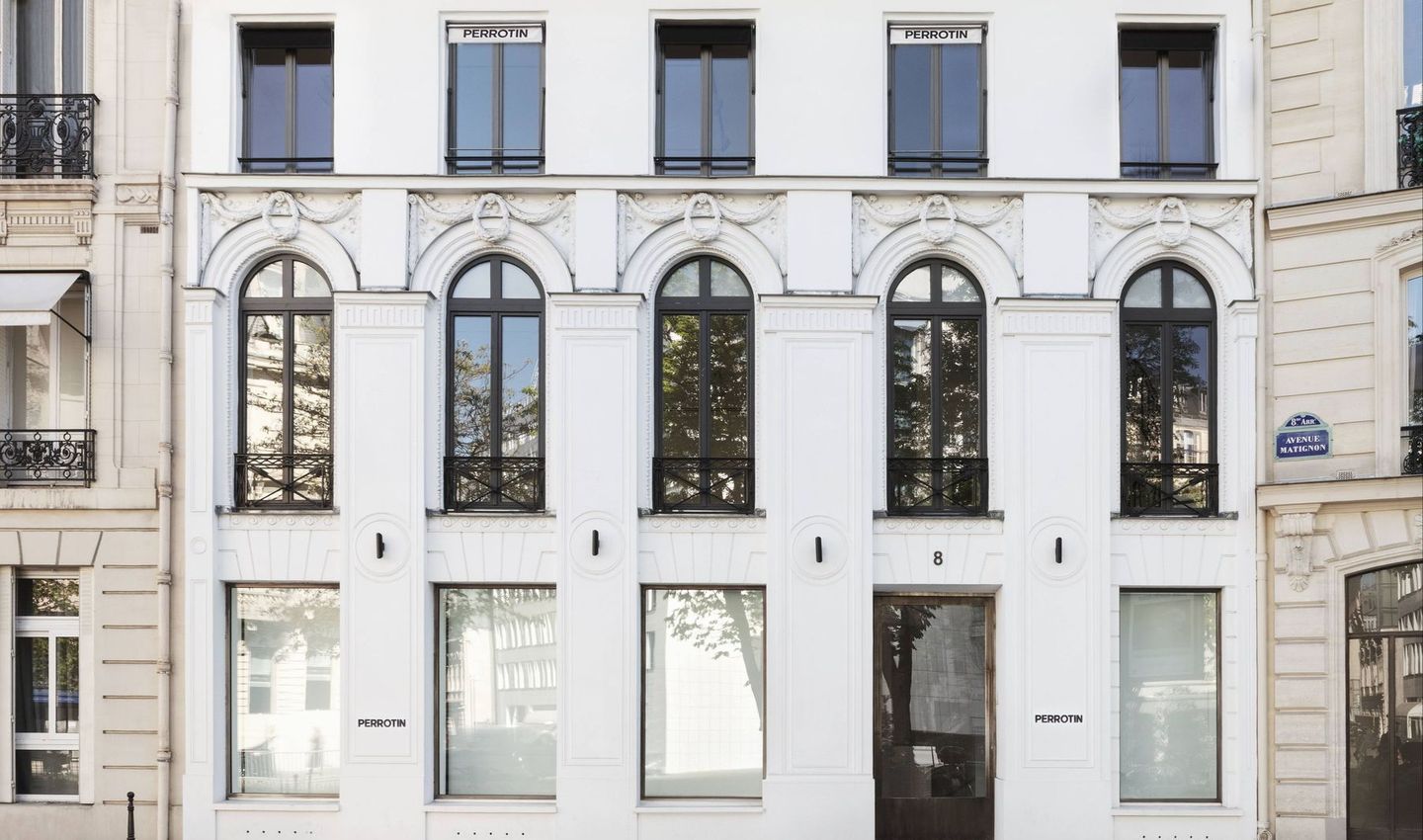
Perrotin Tokyo is pleased to present Chemin Vert, the first solo gallery exhibition of Xavier Veilhan in Japan. From his immersive installation, La Forêt, presented at CCA Kitakyushu in 1998, to La Statue de Harajuku permanently installed in Tokyo last year, Xavier Veilhan has maintained an ongoing conversation with Japan and its culture. It is here that he directed his first ever film in 2002, Le Film du Japon, and staged his « weightless » exhibition Free Fall in 2011 in the Espace Louis Vuitton Tokyo, not to forget his portraits of architects Tadao Ando and Kazuyo Sejima displayed in the garden of the Chateau de Versailles in 2009.
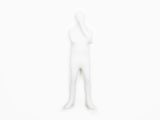
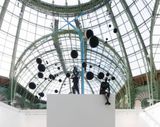
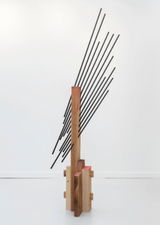
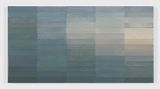
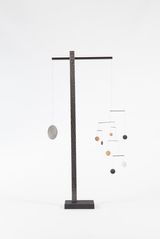
Within this context, Chemin Vert presents the principal elements of the artist’s oeuvre to the Japanese audience: one pillar being the statuary and the representation of bodies in space—a notion that he implements here both in two and three dimensions—as well as two important series from his explorations into abstraction—the Mobile and Rays installations. The show also introduces the artist’s most recent foray into marquetry and a selection of new drawings made during the Covid-19 confinement.
Through a variety of approaches to represent the human form, whether by digitally blurring the silhouette or by reducing it to facets, Xavier Veilhan furthers his study of perspective and perception. He says, ‘The works I create are more a visual device than they are an end in themselves. It is the difference between looking at a pair of glasses and looking at something through a pair of glasses’.
Xavier Veilhan has over the years developed a versatile lexicon—through painting, sculpture, performance, installation, video and photography—to honour the innovators and pioneers in various genres that have forged the modern society we inhabit. His particular interest in music and sound, expressed notably in his proposal for the 57th Venice Biennale where he transformed the French pavilion into a fully functioning recording studio, is evoked here by the work Eliane, a tribute to French electronic music composer Eliane Radigue, and by his Rays (Doppler) sculpture that makes allusion to the Doppler effect.
Titled Chemin Vert (Green Path)—a name derived from a street near the artist’s atelier and lending the show a poetic, semi-abstract location—the exhibition presents a visual forest of the artist’s expressions wherein the viewer is offered the opportunity to both encounter and question his own perceptive tendencies and discover new ways of observing.
Xavier Veilhan (born in 1963, lives and works in Paris) has since the late 1980s created an acclaimed body of work inspired by both formal classicism and high technology, exploring a range of mediums (sculpture, painting, installation, performance, video, and photography). His exhibitions question our perception and often generate an evolving ambulatory space in which the audience becomes an actor. For example, in Veilhan Versailles (2009), his series ‘Architectones’ (2012–2014) or ‘Studio Venezia’ (2017), his proposition for the French Pavilion at the 57th Biennale di Venezia.
Xavier Veilhan’s work is often showcased in the public space, withsculptures occupying numerous cities across France and abroad,including Paris, Stockholm, New York, Shanghai and Seoul, amongothers.
His work has been shown in various institutions across the world, such as the Centre Georges Pompidou (Paris), MAMCO (Geneva), the Phillips Collection (Washington D.C.), Mori Art Museum (Tokyo), and MAAT (Lisbon).
Xavier Veilhan, born in 1963 and currently living and working in Paris, studied successively at the École Nationale Supérieure des Art Décoratifs in Paris (1982–1983), the Hochschule der Künste (Art University) in Berlin (under Georg Baselitz) and the Centre Pompidou’s Institut des Hautes Etudes en Arts Plastiques (1989–1990), run by Pontus Hultén.


A respected voice in contemporary art discourse.
Focusing on ambitious storytelling and insightful art-world commentary. Ocula Magazine publishes in-depth interviews, critical essays and timely analysis on the artists, exhibitions and ideas driving the global art world.
Learn more about Ocula Magazine
Showcasing the best of the art world.
Ocula partners with galleries from around the world to highlight their artists, artworks and exhibitions. Gallery membership is by application and invitation, with each member vetted by an independent panel.
Learn more about Ocula Membership

Specialises in the sale of major artworks.
Led by a team with deep ties to the world’s leading auction houses, galleries and collectors. Ocula’s advisory team offers bespoke services to high-net-worth clients from around the world who are looking to acquire the best of contemporary and modern art.
Learn more about our team and services